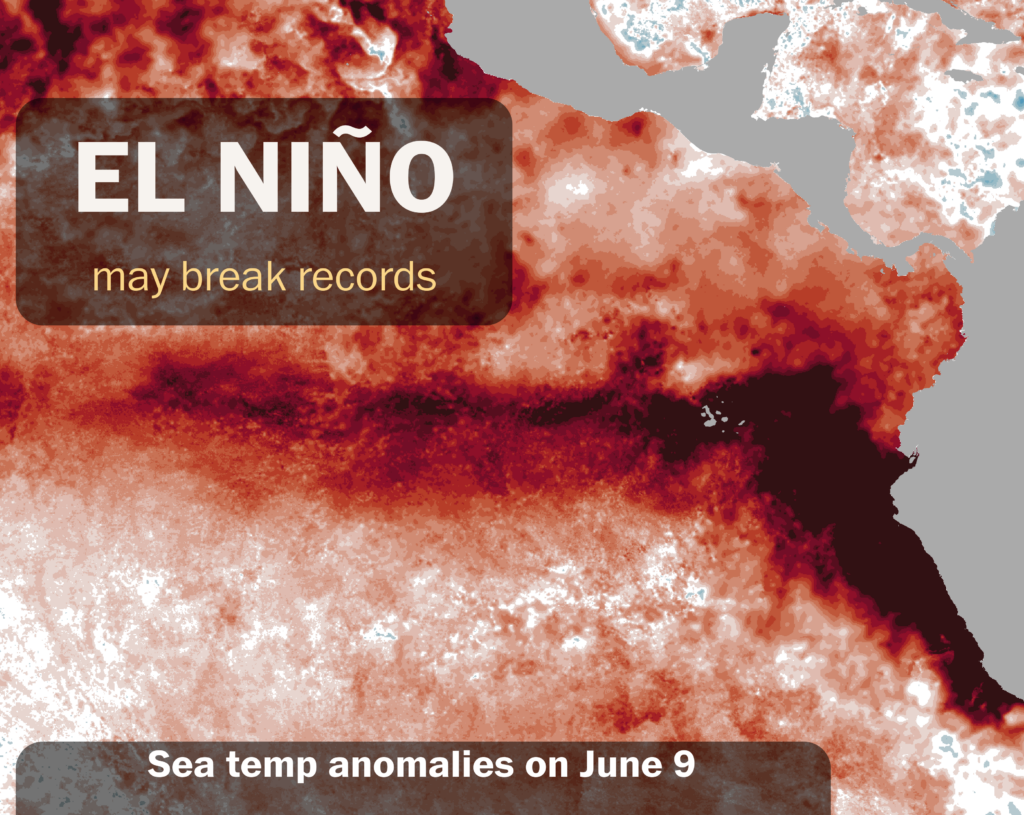
El Niño is here, according to the National Oceanic and Atmospheric Administration. The agency issued an El Niño Advisory on Thursday morning, signifying that Earth has crossed a key threshold into El Niño territory. A chain-reaction process in the atmosphere is underway and will influence global weather patterns in the months ahead.
While El Niño begins as a warming of water temperatures in the eastern tropical Pacific, there are domino effects globally. And this installment of El Niño looks to be particularly intense and could develop into a highly anticipated super El Niño.
“There is a 63% chance of a very strong El Niño during November-January … that would rank among the largest El Niño events in the historical record going back to 1950,” NOAA wrote in its release early Thursday.
El Niño is the opposite of La Niña; the two make up ENSO, or the El Niño Southern Oscillation. Like a pendulum swinging back and forth, Earth oscillates between El Niño and La Niña every two to seven years.
El Niño begins when anomalous westerly winds blow over the equatorial Pacific. That’s opposite to the direction of normal easterly trade winds.
These westerly winds push the top layer of water, which is heated by the sun, eastward. That piles hot water in the eastern Pacific, heating the air above. That air rises, and, over the course of half a year or so, key weather systems in Earth’s atmosphere are shuffled.
It’s important to remember that El Niño doesn’t begin like a switch flipping; even the most dramatic El Niños emerge gradually.
That’s why forecasters at NOAA’s Climate Prediction Center use something called the Niño 3.4 index to officially “declare” the commencement of El Niño or La Niña conditions. The index looks at water temperatures in a key zone of the central tropical Pacific (aptly named the “Niño 3.4 region”). El Niño conditions are declared when water temperatures there are running 0.5 degrees Celsius (0.9 degrees Fahrenheit) above average. La Niña necessitates the opposite: waters cooler than average.
But it’s not instantaneous; there have to be five consecutive months where the three-month running mean meets that threshold. So by the time an El Niño is declared, Earth’s atmosphere is already beginning to respond.
In recent years, it’s been increasingly difficult for scientists to separate the effects of human-induced climate change from the ordinary swings of ENSO. That’s why meteorologists often now use RONI, or the Relative Oceanic Niño Index; it compares sea surface temperature anomalies in the Nino 3.4 region to the real-time global average rather than historical averages.
A new climate change-adjusted El Niño index being used by NOAA and other climate agencies suggests that central equatorial Pacific Ocean temperatures during this El Niño event will be boosted by about 0.5 degrees Celsius because of climate change.
And this El Niño could ultimately be one for the record books.
According to new data released on Wednesday by the Copernicus Climate Change Service, 7 out of 10 key climate models predict the strongest El Niño event by November. A warming of more than 2.7 degrees Celsius (4.9 degrees Fahrenheit) in the central equatorial Pacific would break records set in 2015 and 1877.
Global impacts to expect during El Niño
Unlike a storm that suddenly hits your town, El Niño’s influence on the global climate will gradually build in the months ahead.
Drought is likely in southern Africa, Australia, India, the Indochina peninsula and Oceania. Southeast Asia, meanwhile, could see above-average rainfall and more flooding.
And in the United States, a stronger, straighter west-to-east wintertime jet stream is expected over the southern part of the country. That will mean wetter conditions and more severe weather along the Gulf Coast, but drier and warmer conditions to the north. That could lead to a less intense winter across northern parts of the Lower 48.
The climate pattern also affects hurricane season. And it can be feast or famine. In the central and eastern Pacific, rising air will support more hurricanes than average. But what goes up must come down: Subsidence, or sinking air over the Atlantic, is expected to suppress tropical activity, reducing the number of tropical storms and hurricanes that develop in that region.
In some places, the shifting conditions are bringing dramatic impacts to agriculture and commerce, like in Peru, where the effects of El Niño are already being felt. Although June typically marks the start of cooler, winter-like weather in parts of that country, the opposite is happening this year — and people are flocking to the beach amid “unimaginable” warmth.
Because of the rapidly warming water’s influence on anchovy behavior, the industrial anchovy fishing sector in Peru has suspended its activities. And the warmer-than-average waters near the sea surface suppress nutrient-rich cooler waters from upwelling. That starves smaller baitfish, yielding a poor fishing harvest.
Overall, the pattern is expected to influence weather patterns — and shift the odds for weather extremes — through at least next winter.
The post El Niño is officially here, bringing domino weather effects across the planet appeared first on Washington Post.