One hundred years ago, when enthusiasm for the country’s 150th anniversary was fading, a prizefight was held to help revive the celebration. A record-setting crowd packed a newly built stadium in September 1926 to watch the world heavyweight boxing champion fight a top-tier contender and former U.S. Marine. Not everyone was happy about it. In a letter to the editor of the New York Times, a disgruntled reader declared the event to be nothing but a moneymaking venture, adding that “the whole thing is disgraceful and humiliating (or should be) to the American people.” But in a 10-round bout at the official Sesquicentennial Exposition in Philadelphia, the champ’s face battered and ego bruised, the Marine won by unanimous decision. It seemed an outcome almost too on the nose for a nation in need of esprit de corps.
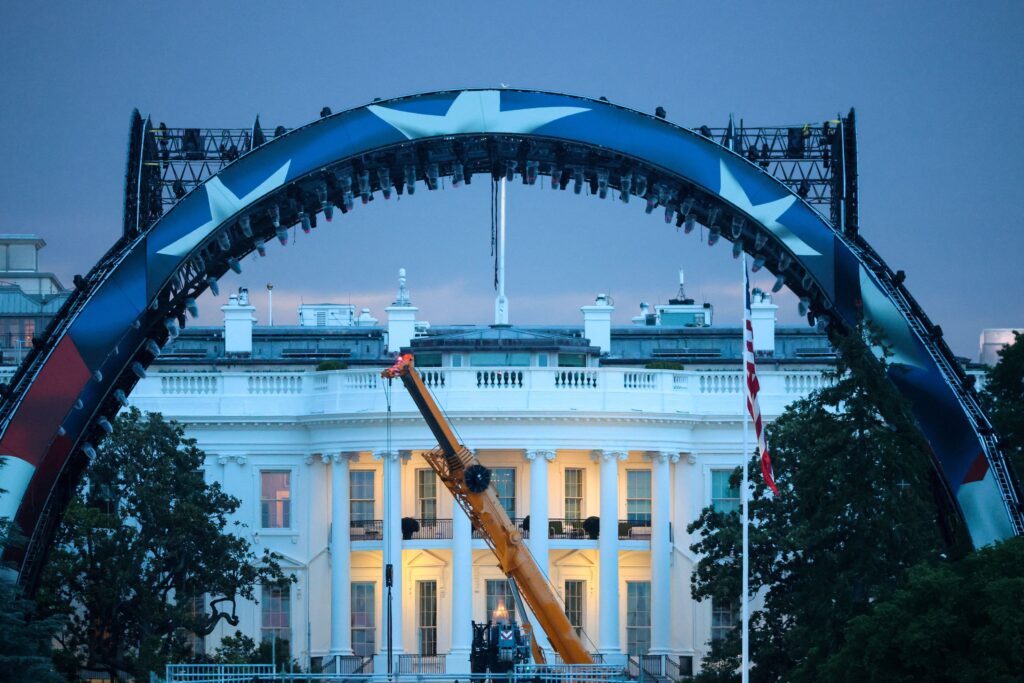
Today, another anniversary celebration is turning to combat sports. On Sunday, President Donald Trump will mark the country’s 250th anniversary by hosting a fight night at the White House. It is also his 80th birthday, so a 600-ton steel structure nicknamed “the Claw” has been constructed for the seven-bout event that serves to honor both occasions.
Americans, however, aren’t all that excited. Six in 10 adults say the country’s best years are behind it, few believe it is exceptional, and the president’s disapproval rating is historically high. Ever the promoter, Trump has pitched the matches as a source of national pride. “This will be the greatest show on earth,” he said at a photo op with the fighters. “These are all the greatest champions in the world.”
For both commemorations, a century apart, the bread-and-circuses spectacle of a prizefight arrived when the country was prosperous, powerful and mismanaging its success. The major debates of the day revealed vastly different visions of what the United States should be and whom it is for. The pageantry of combat served to capture the attention of a distracted or melancholic nation, a stand-in for the civic pride that the anniversaries and public officials couldn’t manufacture.
The similarities don’t end there. At the 150th, President Calvin Coolidge used executive power to raise tariff rates and reduce regulatory oversight of corporations. He was skeptical of binding international agreements and used gunboat diplomacy in Central America and the Caribbean. Congress had passed a sweeping immigration law in 1924 that used racial and ethnic quotas to bar or sharply limit minority immigrants and arrivals from southern and eastern Europe — a deliberate strategy, as the government put it, “to preserve the ideal of U.S. homogeneity.” The federal government also did little to protect voting rights or equal citizenship for Black and Native Americans.
Sound familiar?
Trump has likewise used executive power to impose tariffs and fill federal agencies with loyalists bent on an aggressive deregulatory campaign. He’s taken a confrontational approach to the United Nations and NATO, embracing a transactional foreign policy that treats international obligations as liabilities and bilateral leverage as paramount. The president has deployed Special Forces and naval power in South America and the Caribbean to compel compliance with his interests. His administration has contested birthright citizenship and overseen the rolling back of voting rights protections. It has also restricted immigration and undertaken a ruthless mass deportation campaign as a means of reshaping the country and redefining what it means to be an American.
But there is one major difference: Coolidge and many of his policies were popular. Trump and many of his are not. In 1926, a public weary from World War I and enjoying a new consumerism mostly approved of tariff-based nationalism and racially restrictive immigration quotas. Even the famed boxing match occurred when Black fighters were prevented from competing for the heavyweight title, effectively restricting contention to Great White Hopes for roughly two decades.
And yet that summer, Variety magazine proclaimed that the anniversary was “America’s Greatest Flop” — the world’s fair feel of the 150th proved no match for the Roaring Twenties’ consumerism. A popular president, born on Independence Day, in the world’s newest great power at a historic milestone wasn’t enough to keep Americans interested. The fight didn’t change that.
A century later, an unpopular president, born on Flag Day, in a nation showing signs of democratic decline and rampant economic inequality, is unlikely to do better. While there will be an audience for the South Lawn brawl and general interest in semiquincentennial observances, the public mood is anxious and uncertain, neither enthusiastic nor celebratory. In a seeming attempt to address the nation’s faltering faith, Trump’s mix of revanchist policy and public spectacle suggests he’s cast himself as America’s Great White Hope at the nation’s 250th.
But the real fight at 250 won’t happen at the White House; history teaches that building esprit de corps requires more than the “world’s greatest warriors,” no matter how big the steel cage. Instead, it will be waged in the national debate about America’s standing in the world and Americans’ place in their country — and that remains a split decision.
The post An anniversary cage match? America has seen this humiliating spectacle before. appeared first on Washington Post.