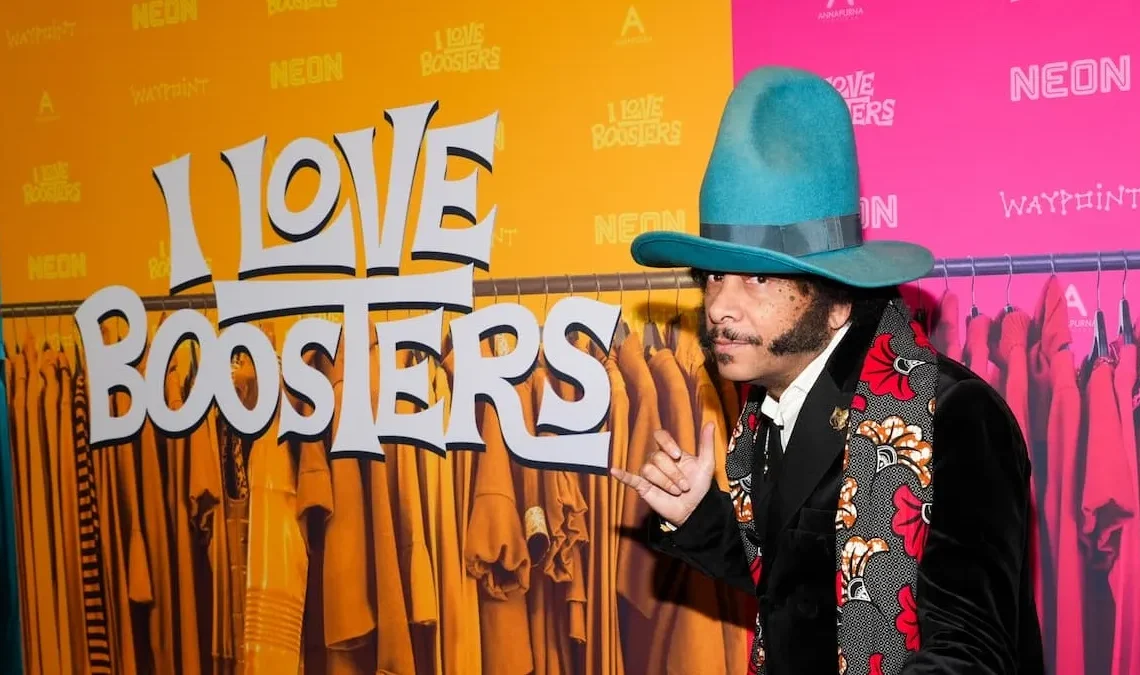
You know a Boots Riley movie when you see one. He has a distinct visual language in each of his films. Rich, colorful set design and wardrobe, wild practical effects, and daring, off-kilter decisions that act as fascinating contrasts to the rest of the film. This trend didn’t stop with his latest project, I Love Boosters, a zany heist comedy that tackles everything from modern creativity in Hollywood, workers’ rights, and the inequity of capitalism. Led by Keke Palmer, the film tinkers with stop motion and wild costume design, offering a fair share of absurdity amidst the sobering realities of the modern world.
While the visuals immediately grab you, have you ever noticed how a Boots Riley movie sounds? The music in his work pulls everything together, pulling an incredible balance of drama, surrealism, and a bit of silliness.
None of it would be possible without fellow Bay Area creatives Merrill Garbus and Nate Brenner of the Tune-Yards. They immediately understand how to translate Riley’s grand ideas before they even get a cut of the film. “They started working on stuff when I was just during the treatment phase. For [I Love Boosters], I was 20 pages in, I had been listening to a lot of the score for Emir Kusturica’s Black Cat, White Cat,” the musician turned director told us.
Boots Riley Opens Up About His Loving Collaboration with The Tune-Yards on ‘I Love Boosters’
All it took was a simple reference point, and the Tune-Yards immediately understood the vision. The first demo alone became the theme for the opening credits. It’s that rawness in how Garbus utilizes her vocals with Brenner’s textured instrumentation that Riley loves the most, a direct contrast to the grayscale smoothness of modern film scores and music today.
“Cacophony is the thing we’re going for,” Boots Riley said. “Everything is trying to be so smoothed out. I think people feel like the smoothness is a level of expertise. Like, smoothness means that you’ve achieved a thing that’s hard to achieve. I was against it already, but especially now, you can get that. You can go on YouTube and figure out how to EQ a thing. But the rawness of it is the human part.”
The differences in how Merrill Garbus and Nate Brenner each approach their work give the music harmony in Riley’s eyes. Because they’re married, they know how to switch roles, pivoting between rawness and precision and not losing a beat. “I’m able to be like, ‘can we make this sound like a Ford truck going through the snow, you know?” Riley described. “Maybe it’s bulls**t, but they kind of hold something crunchy.”
Boots Riley on The Importance of a Distinct Score
What a lot of people might miss in the musical and visual eccentricities is the strong emotional core. Riley argued that the raw messiness speaks to how complicated emotions can feel. Emphasizing the textures in the music allows the Sorry to Bother You filmmaker to access humanity in a way that can feel distant in modern scores. Because the Oakland duo doesn’t work on other scores, he gets something specially catered to his films.
“I’m spoiled by [the Tune-Yards], because often when people do scores, they’ve got maybe their four things. Then everything is just a version of those four things. If that, maybe two,” Boots Riley said. “Composers are just doing so much that they’re divvying this up. They can’t look at one thing as their baby. I get that with [the Tune-Yards], that this is their baby.”
Merill Garbus’ voice plays an essential part in the score for I Love Boosters, cooing and yodeling as an instrument itself. When watching Lakeith Stanfield scenes in the film, her voice adds to the drama and mysticism behind his character. Boots Riley explained that the voice is arguably the most important part of his process, noting that it feels more personable as a result.
“The voice is so expressive. I think it’s really important now that it gets to an emotion… It is also an instrument that has a lot more variation than any other instrument. How it gets from one note to the other, the timbre. There’s a million different ways you can do an A with your voice. Whereas, like with an instrument… maybe there’s a million, but you can only hear a few of them. It feels more handmade,” Riley stressed.
Navigating Subtlety and Balancing the ‘Fantastical’ Elements of Riley’s Work
This rooted emotion extends to the actors of his films, too. Without emphasizing emotion and story, a viewer might not buy into it, even if the visual language grabs the attention. “You could have a film about two people sitting on a couch breaking, and you don’t buy it,” Boots Riley continued.
“But if you have a performance that you believe, if that actor is actually feeling the emotion, as opposed to performing the emotion… then you could have a paper elephant come through and destroy the room. It looks like paper. But you buy it because they are having a real reaction. The stakes are more real. Even though they’re more ridiculous, they’re more realistic.”
Arguably, the hardest thing to do in modern filmmaking is to communicate with subtlety. Is it possible to convey the emotion to audiences today without beating them over the head with the core message? Boots Riley doesn’t play by a strict set of guidelines in this regard, trying to keep in mind that a lot of people simply don’t know. As long as it’s rooted in reality, it’s worth telling.
“The people that are explaining a thing in my movies, they’re explaining it to someone who doesn’t know. It’s not a thing that you’re like, ‘why don’t they know this?’ They don’t know it ’cause most people don’t know it,” Boots Riley explained. “Those things happen in real life. Maybe the strike that happens in this movie doesn’t start out as radical as the Minnesota strike that we had… But that’s basically what I do. Would that be happening in the real world? Would that be a thing that we need to know in the real world?”
The post Boots Riley on the Wild, Incredible Music in ‘I Love Boosters’ and His Ongoing Collaborations With the Tune-Yards (Exclusive) appeared first on VICE.