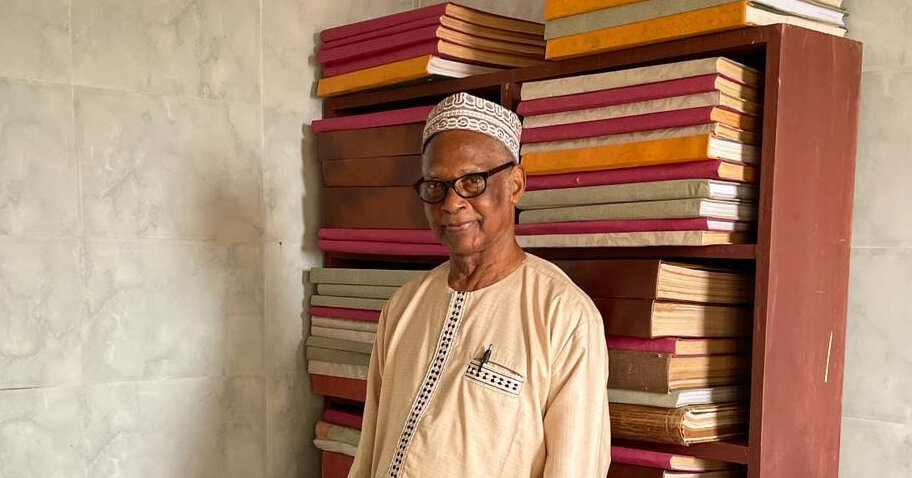
Souleymane Diallo, an independent newspaper publisher in the West African nation of Guinea who suffered harassment, official probation and even imprisonment for his irreverent take on the rule of his country’s oppressive leaders, died on Monday in Montreal. He was 80.
His death, at a hospital, was confirmed by Mamadou Diawo Barry, the director of Le Lynx, the satirical weekly newspaper that Mr. Diallo helped found in 1992. Mr. Barry said that Mr. Diallo had suffered from heart problems. Mr. Diallo lived in Conakry, Guinea’s seaside capital, and had traveled to Canada, where his daughter Idiatou Diallo lives, for medical treatment.
Le Lynx stands out in a West African press landscape in which subservience is the norm. Year after year, as Mr. Diallo’s impoverished coastal nation reeled under a succession of power-hungry, trigger-happy military men and politicians who promised change, Le Lynx — named after an animal with a penetrating gaze — mocked, investigated, caricatured and chided.
From dingy offices in downtown Conakry, where the decrepit printing presses matched the peeling walls, Mr. Diallo was the ringmaster, inciting his young reporters and cartoonists to question and provoke whomever was in power. His own weekly columns — with recent headlines like “Silence, We’re Censuring!,” “Silence, We’re Lying!” and “Silence, We’re Messing Up!” — were equally provocative, skewering the powerful with lapidary precision.
In February 2024, he wrote that Gen. Mamady Doumbouya, who seized control of Guinea in a 2021 coup, “thinks we’ve actually mistaken the path, and the era: The internet is not a right, and social media, radio and other means of communication should only channel praise-singers following orders.”
He added, “So we Guineans should therefore be thankful for this return to the Middle Ages.”
Before Le Lynx came on the scene, Guinea had a largely controlled press that printed government propaganda. Much changed thanks to the work of Mr. Diallo.
For his efforts, he was arrested and briefly jailed twice, in 1995 and 1996, during the dictatorship of Gen. Lansana Conté, who was in power from 1984 to 2008, for offending the chief of state, defamation and falsifying documents. He was placed on probation under President Alpha Condé, in power from 2010 to 2021. Last October, the offices of Le Lynx were burglarized and the printing presses damaged.
Mr. Diallo never stopped. He continued writing his column even while he was in jail, and he never ceased decrying what he regarded as the theft of Guinea’s early promise.
Ahmed Sékou Touré, the first leader of an independent Guinea, boldly broke from France in 1958 but quickly became a paranoid tyrant, forcing up to a third of his compatriots (including Mr. Diallo) into exile and torturing hundreds of others at a prison camp in the middle of Conakry.
Mr. Touré remained in power until his death in 1984. Recalling his famous declaration to the French leader Charles de Gaulle that Guineans “prefer to be free and poor rather than rich and enslaved,” Mr. Diallo wrote in 2010, not long after the country had weathered yet another coup, “Ever since then, we’ve never ceased trooping to the polls for results that are always known in advance.”
He wrote those words on the eve of the country’s first-ever free election. “A week before the vote,” Mr. Diallo added, mockingly, “and we still don’t know the winner: a real sacrilege, given our historic past.”
Mr. Condé, who won that election, would go on to illegally claim a third term, bloodily repress demonstrations and jail opponents. Mr. Diallo earned the president’s ire by publishing the exorbitant cost of his travel abroad, and Mr. Condé was regularly depicted in caricatures in Le Lynx as grasping, sweaty and sinister — “the climber,” in the newspaper’s description.
In December, General Doumbouya won over 86 percent of the vote in the election after barring his main challengers from taking part in the race. Just before the vote was held, Mr. Diallo printed a cartoon that left little to the imagination, depicting nine polling booths, but only one drawing voters. As a voter approaches, sweating in fear, General Doumbouya is shown napping inside, his legs crossed, a Kalashnikov rifle in front of him.
Le Lynx is protected, at least in part, by the limitations on its power in a country in which fewer than half of all adults are literate. Yet this “strange newspaper that refuses to give up,” as the French paper Libération called it last year, remains something of a miracle amid a series of dictatorships.
“Le Lynx opened up a new era,” Mr. Diallo wrote in 2001. “People bought newspapers. They informed themselves. We printed caricatures of the leader. We published uncomfortable ideas.
“Bring me the damn newspaper!” he added, mouthing the voice of his readers. “I want to see what those bums have written!”
Souleymane Diallo was born on Nov. 17, 1945, in Labé, the capital of the mountainous Fouta Djallon region in Guinea’s north. He was one of about 10 children of Thierno Amadou Diallo, a local village chief, and Mominatou Diallo, one of his father’s four wives.
According to Mr. Barry, his colleague, Souleymane Diallo was from an aristocratic lineage and was a descendant of Karamoko Alfa, a warrior imam who helped found Labé in the 18th century.
After his parents died when he was 5, he was raised largely by his uncles, his daughter Idiatou said in an interview.
Mr. Diallo graduated from the Lycée de Labé in 1961, attended Guinea’s National Languages Institute in Conakry in 1962 and received a diploma from the Federal Advanced Teachers’ Training College in Lagos, Nigeria, in 1966. He received a Ph.D. in Anglophone studies from the University of Nice, in France, in 1985.
In 1970, Mr. Diallo went to work as a reporter for Mr. Touré’s party newspaper Horoya, but soon felt stifled at having to recycle propaganda for a repressive government. He went into exile in Ivory Coast in 1973, working for the Ivorian newspaper Fraternité Matin, and did not return to Guinea until 1990.
In February 1992, he started Le Lynx with a group of friends. The only printer in Conakry, scared of losing government business, refused to have anything to do with the upstart publication, and Mr. Diallo had to fly a computer disk with the paper’s contents to Abidjan, in Ivory Coast.
Vendors attempting to sell the first issue were harassed. But soon after the second issue appeared, “all of Conakry rushed to get it,” Mr. Diallo recalled. “By 4 o’clock in the afternoon, there wasn’t a single copy left.”
In addition to his daughter, Mr. Diallo is survived by his wife, Fatoumata, and two other daughters, Mariam and Kadiatou. His son, Mohamed, died in 2021.
Mr. Diallo never stopped hoping or despairing. “Most of our neighbors have known civil war,” he wrote in 2024, “but they’ve succeeded in turning the page, out of patriotism, to look in the same direction, to the future of their country.”
He added bitterly: “As for us, we burst with impatience every evening to also all look in the same direction, toward the television set, to see if we’ve benefited from a new government decree.”
The post Souleymane Diallo Dies at 80; Daring, Mocking Journalist in Guinea appeared first on New York Times.