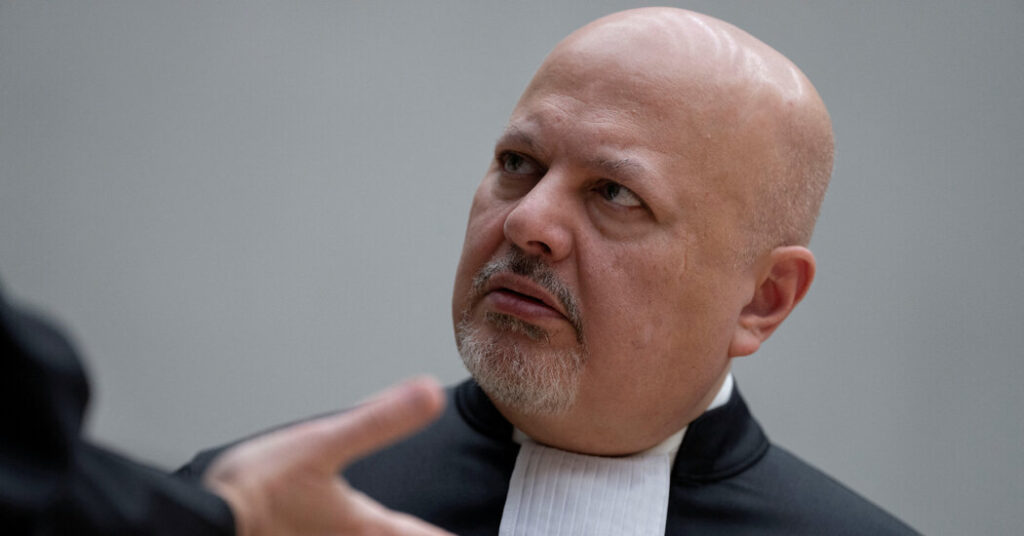
Karim Khan, the chief prosecutor of the International Criminal Court, was suspended while the court’s member states consider disciplinary measures against him, continuing a saga that has left the institution in a state of upheaval for much of the past two years.
The Bureau of the Assembly of States Parties, a 21-member oversight and management body for the court, announced on Monday night that it had made a decision on allegations of sexual misconduct against the prosecutor, but that the decision and related documentation would remain confidential. It referred the matter to the full assembly for further disciplinary proceedings.
A person familiar with the decision said that a majority of the bureau members had found that Mr. Khan — who was already on voluntary leave — had committed serious misconduct.
While the decision is a meaningful step in the process, whether Mr. Khan will be removed from his post or allowed to stay on at the International Criminal Court remains to be seen. Under the court’s rules, the chief prosecutor can now be removed only if a majority of the full Assembly of States Parties finds that he committed serious misconduct and votes to remove him from office.
Reuters reported that Mr. Khan’s lawyers had issued a statement denying any wrongdoing on his part and saying that “the decision is unlawful, procedurally unfair and unsupported by evidence.”
Under the court’s procedural rules, a chief prosecutor can be suspended from office pending the final decision on disciplinary measures if the allegation at issue “is of a sufficiently serious nature.” However, in its statement, the bureau stated that the suspension was not an indication of the final outcome of the disciplinary process.
Allegations of sexual harassment first surfaced internally at the court in May 2024. Mr. Khan, who has repeatedly denied the accusations, stepped down temporarily last year pending the outcome of the investigation.
A team from the United Nations investigated the allegations at the court’s request, and their findings were then reviewed by a panel of judges, who evaluated the evidence. The U.N. investigators said they had found evidence that Mr. Khan engaged in “non-consensual sexual contact” with a woman on his staff, but the judges determined unanimously that the evidence did not meet the “beyond a reasonable doubt” legal standard for a finding of misconduct.
The bureau reviewed the investigators’ report and the judges’ opinion. In April, the assembly voted to continue the disciplinary proceedings against Mr. Khan, and it gave him and the accuser an opportunity to provide further evidence directly to them for review.
This latest step in Mr. Khan’s case comes after a long process that has created a sense of limbo at the I.C.C., which was established in 2002 to investigate and prosecute people accused of the world’s gravest offenses, like genocide and war crimes.
The investigation has also raised questions about whether Mr. Khan, a prominent figure who has obtained arrest warrants for Prime Minister Benjamin Netanyahu of Israel and President Vladimir V. Putin of Russia, will be able to perform effectively if he returns to his position.
“A chief prosecutor needs to be known for the truth,” said Kenneth Roth, the former executive director of Human Rights Watch. “If the bureau has repudiated Khan’s denials, it shreds his credibility and raises important questions as to whether he should even continue to contest the charges, as opposed to resigning for the benefit of the court.”
The court said that it had not conducted an internal investigation at the time the accusations first surfaced.
The accusations became public later that year, when a British newspaper, the Daily Mail, reported in October 2024 that a female official at the court had complained about Mr. Khan’s behavior toward a colleague, who in turn reported the allegations to the court’s human resources department.
The Guardian later reported that Mr. Khan had tried to suppress the accuser’s claims.
In November, the court, based in The Hague, announced that it had commissioned an independent inquiry into the accusations “to ensure a fully independent, impartial and fair process.”
Mr. Khan temporarily stepped back from his position in May 2025, pending the outcome of that investigation, which was conducted by the United Nations.
But the results of that inquiry were not clear-cut.
The U.N. investigation found evidence that Mr. Khan had “non-consensual sexual contact” with a junior employee, and that he retaliated against two other employees who reported her allegations to the court after she confided in them, according to a summary produced by the judges in the case and obtained by The New York Times.
The woman who made the allegations was working as a special assistant at the time, and Mr. Khan was her boss, according to that report. In her interviews with investigators, according to the judges’ report, she described escalating sexual overtures from her boss: first, excessive familiarity during a work trip to London, then touching in his office.
Eventually, according to her account, the overtures progressed to sexual activity, in his office and later on work trips.
“The power dynamic between them meant that she could not say no to Mr. Khan,” the report said.
But U.N. investigators did not make clear determinations about the witnesses’ credibility, which the judges said limited how useful their findings were.
Jeanna Smialek is the Brussels bureau chief for The Times.
The post I.C.C. Prosecutor Suspended, but Future at Court Remains Unresolved appeared first on New York Times.