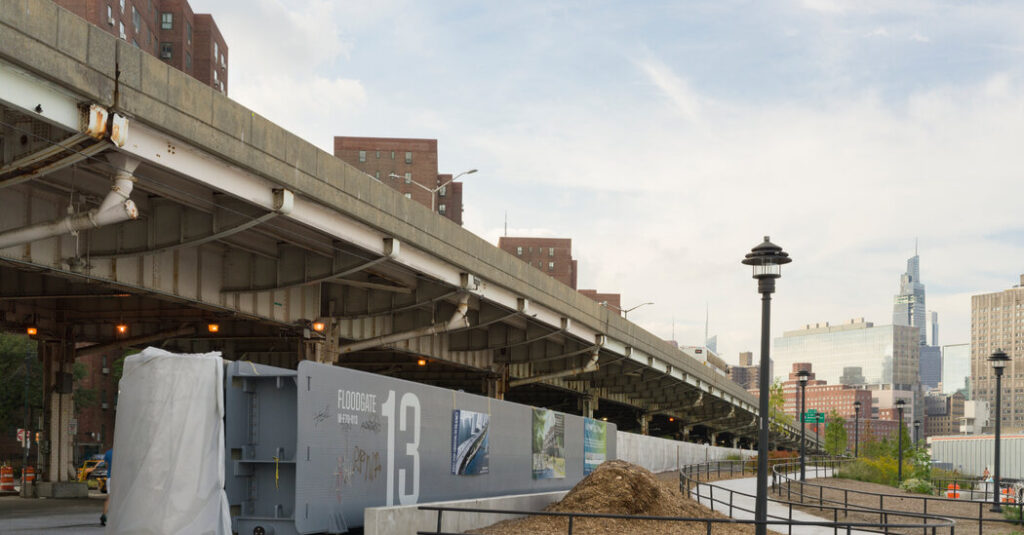
In 2027, more than 100 flood gates are scheduled to start protecting residents in Lower Manhattan from the next Hurricane Sandy. Just one problem: There’s no money to maintain and operate them.
That will soon change.
On Friday, Mayor Zohran Mamdani announced that the Bureau of Coastal Resilience, the agency in charge of the gates, would receive a substantial infusion of money, with its budget increasing to more than $43 million in coming years.
“As climate change accelerates, so, too, must our efforts to protect our communities,” Mr. Mamdani said in a statement. “This investment ensures the bureau can keep pace with the billions of dollars in infrastructure coming online in the next few years.”
The flood gates in Lower Manhattan, which represent the bulk of those billions, were devised after Sandy killed 44 New Yorkers and caused nearly $19 billion in damage in 2012. Other areas in New York City with significant, yearslong projects nearing completion include Red Hook in Brooklyn and the south shore of Staten Island.
Thaddeus Pawlowski, an urban planner and designer who specializes in environmental justice, welcomed the news. “This investment signals a capable approach to managing the climate crisis in New York City,” he said.
Since the Bureau of Coastal Resilience was founded in 2023 as part of the city’s Department of Environmental Protection, it has existed in the shadows with a skeletal staff of six and a budget of about $1 million a year. With the cash infusion, the budget will increase to more than $10 million this year, which will allow the bureau to start expanding its staff from six to 75. Positions will include engineers, flood experts and field and maintenance crews.
In addition to the expansion of the staff, the money, the rest of which will be dispersed in subsequent years, will go toward researching how to protect the city’s 520 miles of coastline, Mr. Mamdani said.
Besides operating the flood gates, the bureau coordinates the other projects that are designed to protect New York City from sea level rise and storm surge.
Nearly one-fifth of New York City’s population lives in flood plains, and 14,500 businesses lie in such areas. This adds up to about $250 billion in property values, according to city data. And sea levels could rise by as much as two feet by 2050, according a state report. Higher sea levels mean higher storm surges, which happen when a hurricane pushes ocean water ashore.
“Every major coastal storm reminds us that resilience isn’t built in the days before landfall — it requires sustained investment, careful planning and a long-term commitment to protecting New Yorkers,” said Lisa F. Garcia, who leads the city’s Department of Environmental Protection.
Although coastal flooding is an ongoing risk for New Yorkers, they are also facing the constant threat of extreme rain, which complicates how infrastructure should be designed and built in low-lying areas. A $52 billion proposed plan by the U.S. Army Corps of Engineers to build movable sea barriers across the mouths of major bays and inlets along New York Harbor has been delayed to conduct more research on extreme rain. The bureau hopes to contribute to this work, according to the Department of Environmental Protection.
The $43 million will help provide staff members for the bureau but is a drop in the bucket compared with the billions needed to keep up with climate change.
“This is a welcome investment in what will have to be a much larger effort to address the growing problem of flooding in low-lying and coastal communities,” said Paul Gallay, a flood risk researcher at the Columbia Climate School. Recent city estimates show that $130 billion is needed to address all manner of flooding, including storm surge and extreme rain, he said.
A report published this week by Rebuild by Design, a nonprofit that works on flood-related protection initiatives, said that New York City is projected to spend more than $387 billion on flood infrastructure by 2050.
Mr. Gallay added that while billions of dollars are needed for flood protection, millions of dollars should continue to be invested in community outreach and training programs. Research shows that neighborhoods with strong planning and communication can protect New Yorkers as much as strong infrastructure, he said.
Ms. Garcia said that the funding will “protect the communities, businesses and critical infrastructure that keep our city running.”
The post Mamdani Commits $43 Million to Jump-Start Effort to Stop N.Y.C. Flooding appeared first on New York Times.