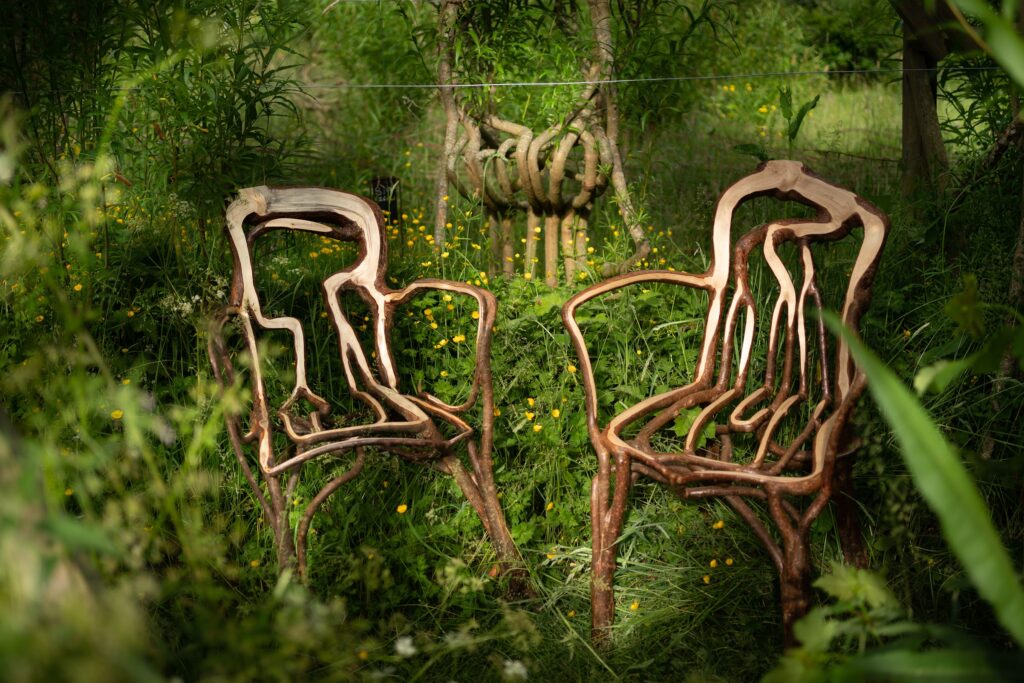
When Gavin Munro was about 7 years old, he looked at his parents’ overgrown bonsai trees and noticed that the silhouette of one looked like a throne. The image stayed with him.
At the time, Munro was spending long stretches in the hospital being treated for scoliosis and Klippel-Feil syndrome, a rare bone disorder. He passed the time by watching the trees and wildlife outside his window. Nature, he said, helped him heal.
“The first seeds were sown when I was a little boy,” said Munro, who has spent the past 20 years trying to grow trees into chairs.
Since 2006, Munro and his wife, Alice Munro, have been shaping young trees into furniture on a field in Derbyshire, England, that they refer to as the Chair Orchard.
The process takes six to 12 years per chair — depending on the species and weather — and so far, they have produced about 15 prototypes.
“For me, it’s about sustainability and watching the amazing wildlife developing in the orchard,” Alice said.
Some of the chairs are usable as furniture, but for now they are sold as works of art, and are priced beginning around $87,000. The Munros hope to ramp up production, and they have led workshops at schools and design programs in the hope of teaching others their technique.
Gavin, who is a furniture designer by trade, and Alice, who has a background in horticulture, run Full Grown, a company that employs specialized ancient techniques — including coppicing, grafting, pleaching and espalier — to shape living trees into chairs. The couple had long been friends, and they married in 2011.
While the idea for Full Grown had been percolating in Gavin’s mind since childhood, it intensified during his years studying furniture design, when his class traced the life cycle of a Coke can. Gavin said he realized the complexity — and cost — involved in producing everyday objects.
“It was an absolute eye-opener,” he said, explaining that it can take decades to grow a tree that would be cut down and turned into a standard wooden chair.
“You cut them down into small bits and stick them together in ways that are only ever going to come loose,” Gavin said. “We’re trying to work out what is the most subtle interaction we can have with nature and still have beautiful things that can last hundreds of years.”
Before he began experimenting, Gavin said he read about others who had grown furniture from trees, including John Krubsack, a banker from Wisconsin who created a chair in a similar fashion, and Axel Erlandson, who made sculptures and furniture by grafting branches and trees together.
“We knew it was possible,” Gavin said.
In 2006, the Munros took over a shady, windy corner of a friend’s farm in Derbyshire to start testing. They quickly realized that the trees didn’t get sufficient sunlight, so they leveled the hillside into flat rows and replanted — only to have cows trample over the trees.
“We’ve had a few setbacks,” Gavin said.
The experiments then moved to Alice’s late mother’s garden, where their first chairs were produced. In 2008, the Munros planted some 3,000 trees on a rented field that became the Chair Orchard. Over the years, they’ve experimented with several tree species, including willow, oak, ash, hazel, beech and cherry.
The process begins with a single sapling, left to establish its roots and grow for about five years. The Munros then coppice the tree — cutting it down to the stump — which encourages new shoots to grow from the roots. Those shoots are guided around a frame, shaping them gradually into the form of an upside-down chair.
To coax the tree into the correct shape, the Munros prune unwanted branches and graft others — which involves binding shoots together so they slowly fuse into one. They also make small cuts in the bark to influence the direction of growth. Once the chair is ready to be harvested, it is dried indoors for a year and sanded.
“When they’re very young, they’re quite flexible, so they’re easier to shape,” Alice said. “We’ve gone through many forms and molds and designs.”
It has been, the Munros said, a constant process of trial and error — which is why they have far fewer finished chairs than they had hoped at this point.
“The generation we thought was going to work actually grew out of shape when it got close to harvesting,” Gavin said, adding that they have also produced lamps, tables, benches and structures.
Along the way, they have learned to lean into nature.
“We’re trying to ask as little as possible from the trees and offer as much protection,” Gavin said.
“The better you treat the tree, the more it’s going to work with you,” said his wife. “The more we’ve worked with nature rather than trying to control nature, the more successful we’ve been.”
The Munros’ method sometimes leaves small wrinkles in the wood — marks of the shaping process.
“It’s a sign of collaboration with the tree,” Gavin said. “It looks beautiful. It’s a visual symbol of working with the tree and not against it.”
The unusual chairs have drawn attention around the world and have been displayed in museums and exhibits in Europe, Asia and the United States. One chair has been acquired by the San Francisco Museum of Modern Art, the Munros said.
About 10 chairs have been sold as artwork through the Sarah Myerscough Gallery in London, to galleries, museums and private collectors.
“We can’t sell them as chairs because they’re a working prototype,” Gavin explained. “We haven’t managed to make a chair production line yet; we’re underway.”
The Munros said they do not have one of their own chairs in their home, as they fear their dog Doris would devour it.
They said they still have much work to do to produce chairs on a broader scale — which is their goal. Though people can sit in the current prototypes, they must do it gently, and they said comfort varies.
“Even though we’ve been at it 20 years, we are literally at the beginning of this,” said Gavin, adding that the finished chairs require minimal maintenance, apart from a waxing every 10 years or so. “I thought it would take a few years, but it’s going to take a few decades.”
The Munros hope to share what they’ve learned with others. They are in the process of launching the Full Grown Academy, a citizen science project aimed at teaching their techniques more widely. They plan to have the academy running by next spring.
“We are really keen for what we have learnt to not disappear into the ether,” Alice said. “We want to help other people who want to grow their own chairs and small structures.”
They both said they’re excited by the possibilities.
“It would be lovely if every community had their own chair orchard,” Gavin said.
The post This couple grows trees in the shape of chairs. They sell for $90K. appeared first on Washington Post.