MetLife Stadium will host eight matches during the 2026 World Cup, including the final in mid-July. Getting there from New York City will cost you.
A round-trip ticket on NJ Transit from New York’s Penn Station (normally around $13) will be $98, a reduction from the extortionate $150 that was originally planned. Parking for cars could cost as much as $225. The stadium is less than 4.5 miles from the Weehawken end of the Lincoln Tunnel. You’ve already spent a fortune on World Cup tickets — couldn’t you just walk there instead?
To be clear, officials advise strongly against this. “Do not walk,” announced Alex Lasry, chief executive of the New York New Jersey Host Committee. “You are going to be putting yourself, you are going to be putting law enforcement and people on the road in danger if you walk to the stadium.”
The photographer Tom Wilson and I decided to see if we could make the trek anyway. We’d have to walk through what is, for many residents, the Bermuda Triangle of the tristate area; it is more often associated with organized crime and pollution than with wildlife and wetlands. And we couldn’t walk through the Lincoln Tunnel. Instead, we started our journey by taking the ferry to Weehawken from 39th Street, near Penn Station, where many soccer fans will also start their journey to the stadium.
We stepped off the ferry and climbed the Liberty Steps to the top of the ridge. Moving north, we passed through the towns of West New York, Guttenberg and North Bergen. These municipalities are not only home to some of the greatest views of the New York skyline in the metropolitan area, but they are also among the densest in the United States. They developed long before mass car ownership, at a time when electric streetcars were still a dominant form of transportation. Walk along the bustling commercial corridor of Bergenline Avenue and you will find crowded sidewalks, no shortage of mom-and-pop businesses, and one of the highest concentrations of Latino residents on the East Coast. It’s not the pedestrian danger zone officials’ comments might lead you to believe.
So far, we had had little sense of where we were in relation to MetLife, relying almost entirely on the glowing map on our cellphone screens. After passing beneath an overpass, we found ourselves at the gates of a cemetery in Fairview. Standing on our tiptoes beside a chain-link fence, we caught our first glimpse of the landscape we hoped to soon navigate. Through gaps in the rows of aging headstones, we could see a Skechers warehouse outlet and a Walmart in the distance. Beyond the winding Hackensack River sat a natural gas storage facility, a mall aptly named American Dream and, finally, MetLife itself.
The ease with which we had moved quickly disappeared. Tightly packed apartment buildings gave way to single-family homes with front yards and driveways. By the time we reached the fast-moving traffic of Route 9, walking no longer felt reasonable, even if the crumbling sidewalks said otherwise. Carelessly spray-painted crosswalks atop fresh blacktop suggested an unwritten warning: You were allowed to walk there, but you probably shouldn’t.
Where the sidewalk vanished, dirt paths, formed by those who had walked before us, emerged along the roadside. We passed auto body shops, Korean restaurants and the ominous hum of a power plant, speaking little to one another until approaching Overpeck Creek, a tributary of the Hackensack River. The water reeked.
Farther up the road, we crossed an Interstate 95 overpass. At the crest, we stopped to look at the Manhattan skyline hanging in the haze. Beyond the guardrail, salt hay swayed in the wind below, offering a glimpse of what the Meadowlands may have looked like before the highways, warehouses and runoff from the New Jersey Turnpike transformed it. Once covered in Atlantic white cedar and expansive salt marshes, these wetlands have only fragments of that ecology still surviving in scattered pockets.
After we crossed a bridge over the Hackensack River, we passed through the towns of Little Ferry and Moonachie. Several storefronts, including a liquor store, displayed temporary signs proudly announcing that the World Cup was hosted in New York New Jersey, the mythical destination we were slowly approaching. Rain started to fall as we marched down Washington Avenue through Carlstadt toward the final stretch. The road was essentially a four-lane highway, albeit one with a sidewalk and the occasional crosswalk. The sound of semis’ engines and screeching brake pads followed us past nondescript warehouses and gas stations. Ahead, a traffic sign pointed toward the Sports Complex. The stadium was close.
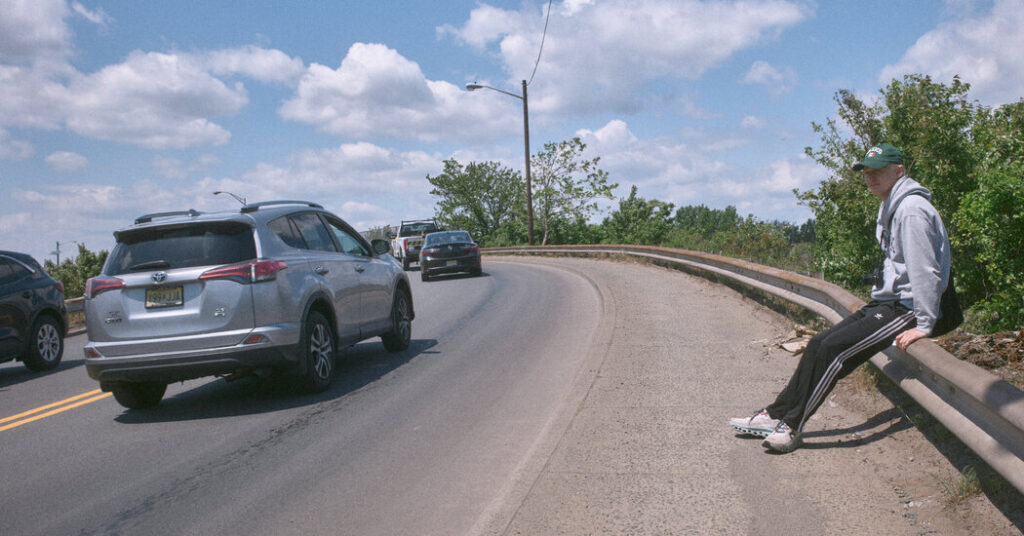
Up until this point, we had encountered very few obstacles. When the traffic finally cleared, we sprinted across the street to Paterson Plank Road, and on toward the least pedestrian-friendly stretch of the route. Ahead, two young women took selfies of each other on a hill beside an exit ramp. A group of tourists looking to shop at American Dream shuffled through the grass. There was no shoulder to follow, just construction machinery and trash.
A maze of connector roads, parking lots and concrete barriers surrounded us. Cars approached from every direction. We tiptoed along curbs or walked directly on the road itself. After moving from one parking lot island to the next, we asked a mall employee for directions. He had little to offer beyond “good luck.”
Construction had closed the pedestrian bridge from American Dream’s parking deck over Route 120 — a wall of traffic that cuts through the Meadowlands Sports Complex and is otherwise nearly impossible to cross on foot. We were forced to improvise. Though our phone maps insisted we could walk an alternate route, no sidewalks existed. Instead, we dashed halfway across the road, taking refuge on a median as traffic rushed toward us, and waited for the coast to clear. On the other side, we descended a large grassy hill into a giant parking lot where construction crews staged materials for the stadium’s opening match between Brazil and Morocco.
Beyond the construction fencing, MetLife came into view, a gridiron rising from a sea of asphalt. After we had spent roughly six hours approaching it on foot, the complex felt strangely indifferent, surrounded by open pavement and the distant hum of traffic. We stood outside the admission gates. For the first time all day, it occurred to us that we hadn’t considered how we would return home now that we had made it all this way.
It was difficult to imagine anyone wanting to walk here. I tried to picture hundreds, maybe thousands, of soccer fans arriving from around the world to follow the same path. MetLife Stadium holds more than 80,000 spectators. On match days, the sidewalks we walked could fill with thousands of fans all trying to reach the stadium within a matter of hours.
If they did, the world would experience the Meadowlands, a place that is often treated as somewhere to be ignored. To walk through this place is to encounter America’s contradictions firsthand. In a region with some of the most extensive public transportation options in the country, it is difficult to explain why traveling the final few miles to the stadium is such a costly and contentious proposition. Unlike much of our car-centric country, this region is well served by trains and buses. Yet, between the stops and stations, walking feels impossible. That is by design.
Over decades, we have chosen to de-prioritize environments built at a human scale in favor of ones designed for vehicles. In doing so, we have become increasingly alienated from walking, the most accessible form of transportation, to the point where it now seems absurd, even impossible, to the people whose job it is to think about how we move through space.
If the region wanted a safe, direct and walkable path to MetLife Stadium, it could have built one. Instead, we’ve been left with a maze of parking lots, a tangle of highways and a patchwork of sidewalks to nowhere.
So should fans walk to the World Cup? Probably not. Even if walking is free, it comes at a cost: The journey was needlessly complicated, our legs ached, and we were worn down from hours spent alongside the constant buzz of traffic, breathing exhaust. But what lingered with us most was not whether fans should walk to the stadium, but why walking here had become so unthinkable in the first place.
Alex Wolfe is a writer and artist who leads public walks through New York City. Tom Wilson is a photographer and high school science teacher.
The Times is committed to publishing a diversity of letters to the editor. We’d like to hear what you think about this or any of our articles. Here are some tips. And here’s our email: [email protected].
Follow the New York Times Opinion section on Facebook, Instagram, TikTok, Bluesky, WhatsApp and Threads.
The post You Can Walk to the World Cup in New Jersey. But Should You? appeared first on New York Times.