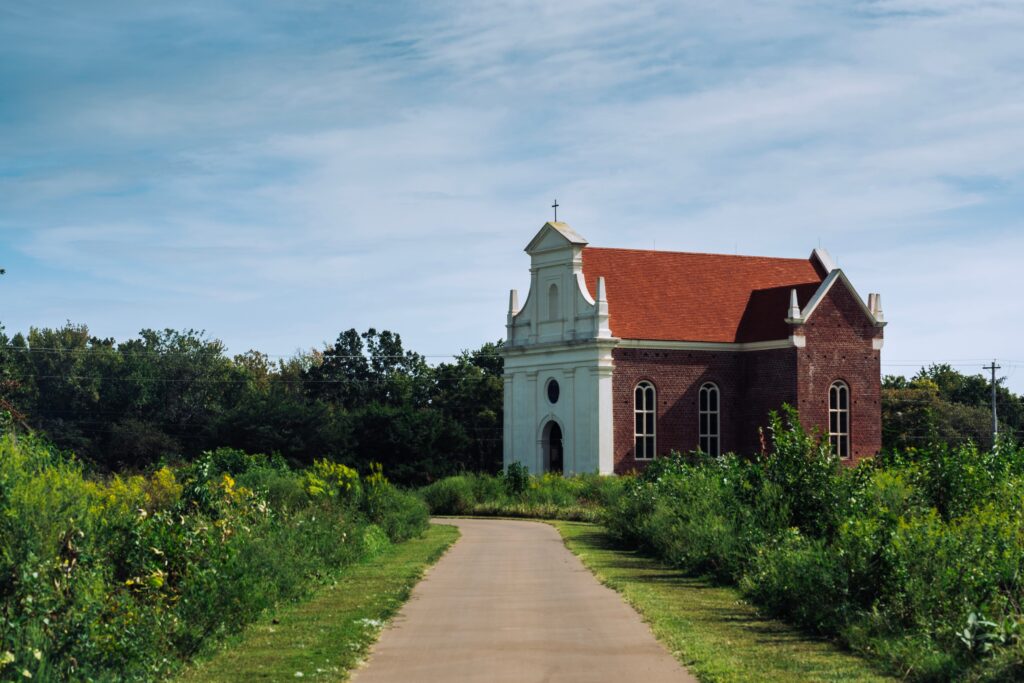
The burial site designated No. 56 included a skull and a jumble of arm and leg bones that had been laid to rest in a wooden box just outside the walls of the old Jesuit chapel in St. Mary’s City, Maryland, more then 300 years ago.
Experts could tell they were the remains of a White man who seemed to be about 40 when he died. There were no other clues in the box. No remnants of clothes. Nothing in the historical record. No hint of who he was.
But his 300-year-old bones still held a genetic connection via his DNA to modern-day descendants that scientists say, in a first, has helped them figure out who he may have been.
The experts say burial No. 56 was probably Leonard Greene, the son of Maryland’s second colonial governor, Thomas Greene, and his first wife, Anne Cox. Leonard Greene died around 1688.
Little is known about Leonard, but his parents were among Maryland’s first settlers and were the first Europeans to be married in the colony.
It was the first time “ancient DNA” has led to the proposed identity of an unknown individual without any supporting historical evidence to go on, said Eadaoin Harney, a senior scientist on the population genetics team at the 23andMe Research Institute.
Ancient DNA is DNA that is at least 100 years old, and it can be much older, Harney said.
“It’s a very big deal,” she said in a recent interview. “We’ve taken a step that has never been done before.”
“There’s been a variety of studies that have claimed to use ancient DNA to help reidentify individuals,” she said. “But all of those studies have always started with a very strong prior hypothesis about who someone was.”
“In this case, we didn’t start with any prior hypothesis,” she said. “We just let [the] DNA lead us,” she added.
Henry M. Miller, a Maryland heritage scholar at Historic St. Mary’s City, said: “It’s something that has not been possible before now.”
“To me, the important thing is we’re kind of restoring [him] to memory, with new scientific tools that couldn’t have been done 20 years ago,” he said.
St. Mary’s, founded in 1634 by English Catholics fleeing oppression, was the first European settlement in Maryland and one of the earliest in what would become the United States. For years, it was a place where freedom of religion was paramount, according to historians.
The project, which tapped experts at Harvard University and the Smithsonian Institution, used 23andMe’s 11-million-person genetic database to help narrow down Leonard’s identity, according to a recent report on the effort in the scientific journal Current Biology.
Leonard appears to have been first buried elsewhere, St. Mary’s historians said. Later, his bones were dug up and reburied in the box outside the community’s brick church.
The identification of Leonard’s bones then led scientists to identify the remains of his parents, who were buried nearby. Experts had figured out that there was a parent-child relationship among the three, but they didn’t know who they were, Harney said.
Miller, the historian, said Thomas and Anne met during the founding sea journey from England to St. Mary’s in 1633-34. He said they sailed on the Ark, one of the two ships that made the voyage to Maryland. The other ship was the Dove.
Anne “was a single woman … probably of some noble ancestry,” Miller said. She was only about 30 when she died in 1638. Father Andrew White, a Jesuit priest at the settlement, later wrote: “She was especially known for her charity to the sick, as well as other virtues.”
Thomas was a gentleman who brought two servants with him.
He became a tobacco planter and served as Maryland’s second colonial governor, from 1647 to 1649. Thomas died in 1651, aged about 42.
Starting in the 1990s, the Greenes’ burials were among the dozens exhumed at a large cemetery on the site of two vanished chapels built by the English Catholic settlers.
The exhumations happened because officials wanted to reconstruct the brick chapel that had been there, and they didn’t want to destroy burials in the process, Miller said.
Experts eventually identified three members of the prominent Calvert family, via DNA and historical and physical clues.
But all of the others exhumed as part of the reconstruction project remained unidentified.
“The sad part about [most] of these burials is: We have no idea who they are,” said Timothy B. Riordan, retired chief archaeologist with Historic St. Mary’s City. “There are no records.”
Douglas Owsley, a Smithsonian museum curator and biological anthropologist, said one point of the project was: “Who are you? Tell us your story.”
At the request of St. Mary’s officials, the bones were taken to the Smithsonian’s National Museum of Natural History, in Washington, for study and safekeeping.
Over time, researchers were able to link members of several different families among those exhumed for the project, Owsley has said.
They also pinpointed an African American boy of about 8 years old buried in the remnants of what was a well-made coffin. He is believed to be the earliest known African American whose remains were discovered in Maryland, Miller has said.
They studied the bones of two men, probably from Ireland, who may have been indentured servants.
They found the remains of a man who may have been a Catholic priest who was wearing what could have been a religious medal.
But until Leonard Greene was identified, no names were attached to any of these remains.
The project, led by Harney, Owsley and David Reich, a genetics expert at Harvard Medical School, used DNA from 49 of the exhumed individuals for analysis, Harney said.
The experts found 1.3 million distant genetic relatives of the St. Mary’s settlers in the 23andMe database, according to the paper.
They discovered several thousand people in the database who had a strong genetic connection to burial No. 56. They were able to narrow that further, via questionnaires and DNA, to focus on two anonymous 23andMe participants.
They searched those participants’ family trees for candidates and came up with several that might be linked to No. 56. Eventually, using archaeological and anthropological data, they ruled out all but Leonard Greene.
“That was the key identifier,” Miller said. “The progress of science has now let us return these people to memory.”
Harney, of 23andMe, said in the future “the opportunities are kind of limitless, where the vast majority of historical burials are unknown people.”
Just in the old St. Mary’s cemetery, which Miller said was once the largest in 17th-century Maryland, as many as 400 people are still buried.
In September, the bones of Leonard Greene and his parents and all the others in the project were returned to a special vault in the chapel near where they had been buried more than 300 years ago.
The post Ancient DNA helps identify bones of a lost governor and his family appeared first on Washington Post.