Katherine Homan remembers how the construction of Interstate 35E in the 1950s and ’60s left the Oak Cliff neighborhood of Dallas broken.
Within Oak Cliff, a chunk of the Tenth Street Historic District community, one of Dallas’s oldest Black neighborhoods, was demolished to make room for the multilane highway. The connection it once had to the rest of Oak Cliff was gone through eminent domain.
Dozens of families were displaced, commercial investment in the area stagnated and property values dropped in certain parts of the neighborhood.
That did not stop Ms. Homan, 85, and her family from moving into a fixer-upper on Handley Drive Street in Oak Cliff in 1974.
“People were already griping about how it had interfered with their life there,” she said.
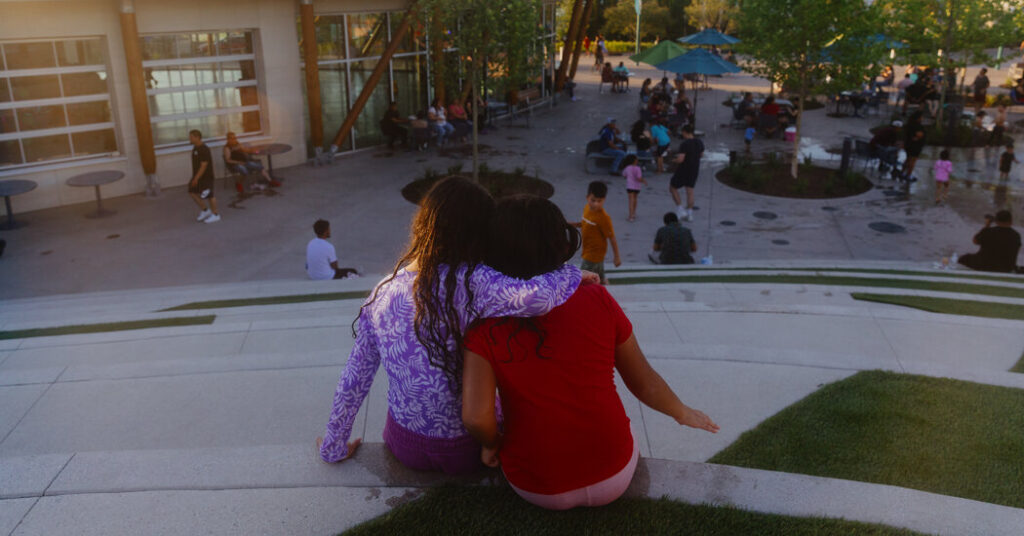
Today, the highway stands as a cautionary tale of mid-20th-century urban planning, though now with a green twist: In May, Halperin Park opened directly above Interstate 35E — a roughly five-acre elevated park that attempts to stitch together the stretch of Oak Cliff that the construction of the highway tore apart decades ago.
“That’s a history that exists all over the state and all over the country,” said April Allen, who lives in the neighborhood and is the president and chief executive of the Southern Gateway Public Green Foundation, which manages the park. “The freeways were built in alignment with redlining maps and intentionality around dividing neighborhoods, and we have this opportunity to really heal those wounds.”
Halperin Park is now the second park in Dallas built directly above a highway, and it is one of several other projects throughout Texas that are reconnecting communities and making life easier for pedestrians in a state that relies heavily on cars.
“To do this in a neighborhood like ours, I think, is a real example for other cities about how you can transform communities,” Ms. Allen said.
The divide in this part of Dallas dates back well before the highway was built. After the Civil War, freed slaves began living in a neighborhood known as Tenth Street. City records show that by 1900, the Tenth Street neighborhood had two churches, a school, drugstores and saloons. It was a thriving neighborhood until the middle of the 20th century, when construction began on what would become part of a highway that stretches from Laredo, Texas, to Duluth, Minn.
The construction of Interstate 35E was part of the Interstate Highway System, a public works project that spawned thousands of miles of new roadways across the country with the support of former President Dwight D. Eisenhower. But it created a barrier between the mostly Black residents of Tenth Street on the east side and a predominately white community on the west side.
“He did this in every city,” Ms. Homan said of Mr. Eisenhower’s project. “He just plowed through wherever he needed the road to go and did not really look at where it was going to be cutting through.”
After Interstate 35E was constructed, the demographics of this part of Dallas began to change. As schools and neighborhoods integrated, many white residents moved farther north within Texas in a wave of white flight. Today, Oak Cliff has a large Latino and Black community.
In 2016, the Texas Department of Transportation began planning improvements to Interstate 35E, which led to community meetings in the Oak Cliff area. At one meeting, Ms. Homan met Paul Carden, 36, who also lived in the area. Together, Ms. Homan and Mr. Carden helped play a role in what would become Halperin Park.
Mr. Carden, who grew up on the east side of Interstate 35E, said he remembered hearing stories from his grandparents about how the highway changed the neighborhood.
“The version of Oak Cliff I grew up in was vastly different than the one they originally moved to,” Mr. Carden said.
Growing up, he said, he also felt the impact of the highway, even playing football with his cousins.
“My aunt’s house was directly back onto the freeway itself,” he said, “so out of bounds was essentially the freeway’s right of way.”
The idea for Halperin Park was inspired, in part, by Klyde Warren Park, another green space built over a freeway in downtown Dallas. Before Klyde Warren Park opened in 2012, walking from downtown to the Uptown neighborhood meant crossing a bridge over eight lanes of traffic as cars rushed below. In the summer, the Texas sun turned the bridge into a sweltering stretch of concrete and exhaust.
“Our founding fathers in Dallas did a lot right, but they didn’t establish a central park,” said Rob Walters, who serves on Klyde Warren Park’s board of directors. “So we’ve had to infill or reverse engineer with Klyde Warren and other downtown parks to create more green spaces.”
Klyde Warren Park now draws more than two million visitors a year. On weekends, food trucks set up around the park, feeding tourists and residents from across North Texas.
There are hopes that Halperin Park will attract the same kind of crowds as Klyde Warren Park, though some residents have expressed concerns about its long-term impact on the surrounding neighborhood.
Phil Gibson, a longtime Dallas resident and president of the Cedar Crest Merchants Association, said that residents have been largely “over the moon” about the new park. But, he said, there have been some concerns about gentrification.
“Our goal is to develop the area,” Mr. Gibson said, “but not displace people in a way that they can’t afford to live there.”
Klyde Warren Park and now Halperin Park have other cities across the country, including Austin and El Paso in Texas as well as Little Rock, Ark., asking Dallas the same question: How can they build their own?
Karla Windsor, a senior program manager with the North Central Texas Council of Governments, said a key to building these parks was support from all sides, including the community, local governments and the private sector.
Halperin Park was built and paid for in two parts. The deck of the park, which cost about $47 million, was paid for using funds from the North Central Texas Council of Governments and bonds from the city of Dallas. The amenities for the park, which cost about $75 million, were paid for with money raised by the Southern Gateway Public Green Foundation.
A similar project completed in Houston in 2023 was funded through a similar public-private partnership. The project, the Kinder Land Bridge, was built to connect the north and south sides of Memorial Park, which had been previously divided by a road that cut through the wilderness park.
Chris Ballard, the president and chief executive of the Memorial Park Conservancy, which operates the park, said that unlike other park projects, the land bridge also benefits the environment and wildlife.
“I hope that this project can serve as this example of what can be done and how it can be done in a really thoughtful way that thinks about people, wildlife, water ecology and resilience,” Mr. Ballard said.
Not to be outdone by Dallas and Houston, El Paso has a proposal to build a park over Interstate 10, and Austin is also planning a similar project over Interstate 35 that could connect East and West Austin.
In McKinney, a suburb north of Dallas, city officials had considered plans to take a different approach, building a plaza under, rather than above, a highway deck. The project, called the Lower 5 Plaza Project, was put on hold after federal funds that would have been used to build the project were rescinded. The city had expected to receive a federal grant for the project, but those funds were pulled back after the passage of the One Big Beautiful Bill Act.
Bill Cox, the mayor of McKinney, said the city was still looking for ways to improve pedestrian crossing, especially as the city continues to grow.
“Increased foot traffic,” he said, “is not going to go away.”
On a recent morning at Halperin Park, a few children were playing on the playground while others were making crafts at an indoor building. Food trucks were lined up nearby for hungry visitors. Watching children play there, Mr. Carden, who lives in the area, said, gave him reason to believe the neighborhood’s next generation might inherit something different.
“The idea that those kids won’t grow up with the same division and separation,” he said, “or the haves and have not, or the wrong side of the highway that we grew up with — to me, that’s just one of the greatest joys.”
Jeff Adelson contributed research.
Jesus Jiménez is a Times reporter covering North Texas. He is based in Dallas.
The post Neighbors Hope a New Park in Dallas Can Heal an Old Divide appeared first on New York Times.