As Ebola spreads in East Africa, the United States is playing a much smaller role than it has in previous outbreaks. That leaves China, an economic powerhouse with epidemic control and biotech expertise, as the next global power that could commit supplies, money and medical workers to the effort.
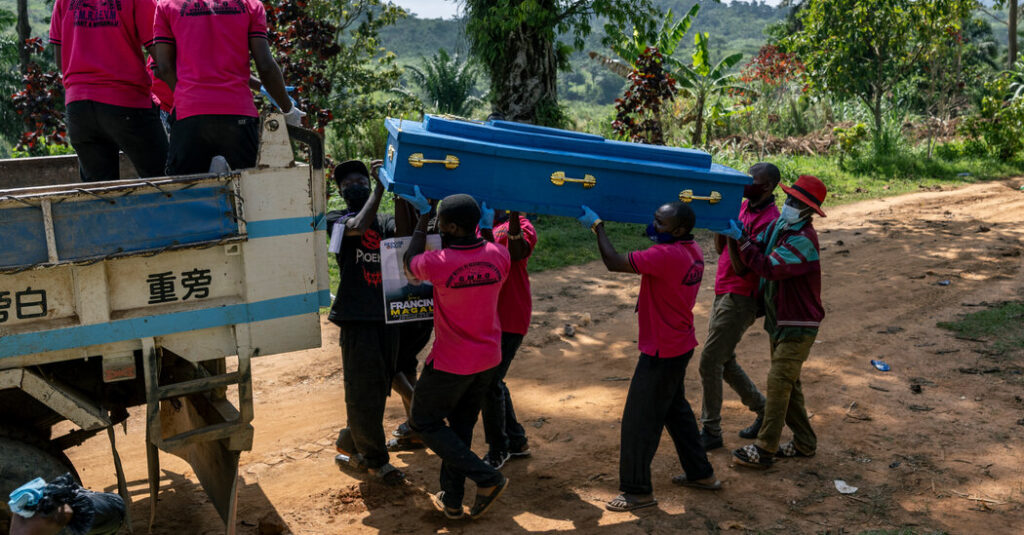
In Mongbwalu, a town in the Democratic Republic of Congo that is the epicenter of the outbreak, treatment centers are in dire need of equipment, medicine and basic supplies. A lack of testing has made it harder to slow the spread of the Bundibugyo virus, which caused the outbreak and for which there is no approved vaccine or treatment.
But despite Beijing’s significant investments in the region, it is unclear how much China is willing to do to help confront what could become the deadliest Ebola outbreak in history. With the United States playing a sharply diminished role compared with its emergency response in the pre-Trump era, China faces less competitive pressure to step up. And Beijing, ever cautious, is not likely to jump in quickly to help contain an outbreak in a remote, conflict-ridden region.
“Now we are in this moment of truth,” said Bradley Parks, executive director of AidData, a research lab at William & Mary.
For China, this crisis is “really going to force them to answer the question: ‘Do we just let this thing run wild and let there essentially be a leadership vacuum, or do we step into the breach?’” he said. “We just don’t know if they have the appetite to step into a leadership role.”
China took a tentative first step this week, almost three weeks after the outbreak was declared. It sent a five-person team of medical experts to Kinshasa, Congo’s capital, more than 1,000 miles from the center of the outbreak.
They brought with them protective equipment and lab supplies. Lu Ming, the head of the mission, told state media China was “fulfilling its duties as a major power.”
At the same time, Beijing has not yet publicly responded to an official African appeal for $319 million in aid. Its officials are not on a World Health Organization committee addressing the outbreak.
Jin Jiyong, a professor at Shanghai International Studies University who studies global health, said he was confident China would beef up its efforts if the outbreak worsened.
“I do think it’s a good opportunity for China to show its strengths and ambitions” particularly in public health, research and medicine, he said.
In many ways, China is well positioned to help.
China, with its enormous manufacturing base, can quickly produce and ship medical supplies. It provided much of the personal protective equipment sent to Africa during the Covid pandemic. Chinese biotechnology companies, which are developing affordable and easily adaptable medical innovations, could contribute new tests and vaccines.
During the world’s worst Ebola outbreak, which ravaged West Africa between 2014 and 2016, China mounted its largest-ever overseas humanitarian effort, sending more than $100 million worth of supplies, including ambulances, and hundreds of medical workers. For the first time, China built a biosafety lab and an infectious disease medical center overseas.
China also moved more quickly then. It took only a day after the W.H.O. declared that outbreak a global health emergency for Beijing to announce it would send help. China’s leader, Xi Jinping, himself expressed support to the countries hit by the virus.
But that was a different time, said Zhida Shang, a resident doctor at the University of Toronto who has studied China’s participation in the W.H.O. “It was pre-Covid,” he said. “Everyone still had a brighter vision for global health.”
“I believe the Chinese leadership really wanted to show both the world and their own domestic population that, ‘Hey, look, there’s a crisis in the world. We’re going in. We’re going to help them. We’ll be the heroes,’” Dr. Zhang said.
Stephen Morrison, a senior vice president at the Center for Strategic and International Studies, said China could again deploy health workers. During that outbreak he visited a Chinese-run Ebola ward in Liberia and was impressed. “They were very well organized and very professional and very proud of what they were doing,” he said.
China’s booming biotech sector could play a role.
Twelve years later, China is wealthier, with a greater presence in Africa. It has a strong relationship with the Africa Centers for Disease Control and Prevention, whose headquarters it helped build. After Covid, China also has more experience responding to epidemics.
Its most significant contribution to fighting the current outbreak may come from its booming biotechnology industry. China is a leader in testing technologies, including adaptable machines that can screen for many diseases, and tests to identify a pathogen that can be used at a patient’s bedside, said Sonjelle Shilton, who works on access to diagnostics for the aid group Doctors Without Borders. That could eliminate the need to transport samples to central labs — in Congo’s case, across hundreds of miles and through an active conflict zone.
Chinese companies have been developing diagnostics that can detect multiple viruses in the Ebola family, she said. Such a test might have sped up response to this outbreak, since health workers who first suspected Ebola had tests to detect only a different species of the virus.
Scientists in China are also researching an mRNA vaccine that would provide protection across hemorrhagic fever viruses, such as Ebola — work that is in early stages, according to a peer-reviewed article in The Proceedings of the National Academy of Sciences.
Those researchers are not yet part of the international scientific effort to respond to the outbreak that is being coordinated by the Center for Epidemic Preparedness Innovations, a group that works to speed vaccines to market.
The smaller role of the U.S. takes pressure off China.
During the 2014 Ebola outbreak, China’s strong response may have been driven in part by a desire to match American efforts, experts said.
Now, the United States’ withdrawal from the W.H.O. and its smaller role in the outbreak could be having the reverse effect.
Beijing “might think the U.S. is no longer a leading global health player so the incentive to compete with the United States for soft power might be reduced,” said Yanzhong Huang, a senior fellow for global health at the Council on Foreign Relations.
The outbreak this time is more complex, in part because its epicenter is in northeastern Congo, where armed groups are active.
“I don’t think the Chinese want to want to barge in and own this problem,” Dr. Morrison said.
Any decision to ramp up Chinese involvement would likely happen at a senior level in Beijing, given the lack of independent aid groups in China and that humanitarian assistance often involves the military or the state-controlled Red Cross Society.
“If someone in Beijing makes the decision and says, ‘We are going in,’ I would expect things to move quickly,” said Marina Rudyak, an expert on China and foreign aid at Heidelberg University. “But the bureaucratic system today is less agile than it was in 2014 — decision-making has been more centralized.”
For Beijing, economic interests are paramount.
Some experts say China’s foreign aid efforts are driven by a desire to protect its economic investments, and so far those interests have not been hurt.
Chinese companies own or run most of the critical mineral mining operations in Congo, largely in the south of the country, far from the outbreak. Workers said business was as usual.
A Chinese construction worker in the city of Kolwezi in the south, who gave only his surname, Liu, said he had heard about the outbreak only this week.
He cannot afford a flight home, so has no choice but to stay. “Of course I’m worried,” he said. “Who isn’t afraid of dying?”
Jeremy Konyndyk, a former senior U.S. official who oversaw the Ebola response in West Africa, said the scale of China’s involvement in this outbreak might be determined by how much the mining industry is affected.
“When China gets involved in foreign aid type activities, it is not about benevolence and solving a problem, it is about protecting their economic interests,” said Mr. Konyndyk, who is now president of the aid agency Refugees International.
In that way, he said, the Chinese calculus is similar to that of the Trump administration’s “America First” global health policy.
Pei-Lin Wu contributed reporting.
Lily Kuo is a China correspondent for The Times, based in Taipei.
The post As Ebola Spreads in East Africa, Will China Step Up? appeared first on New York Times.