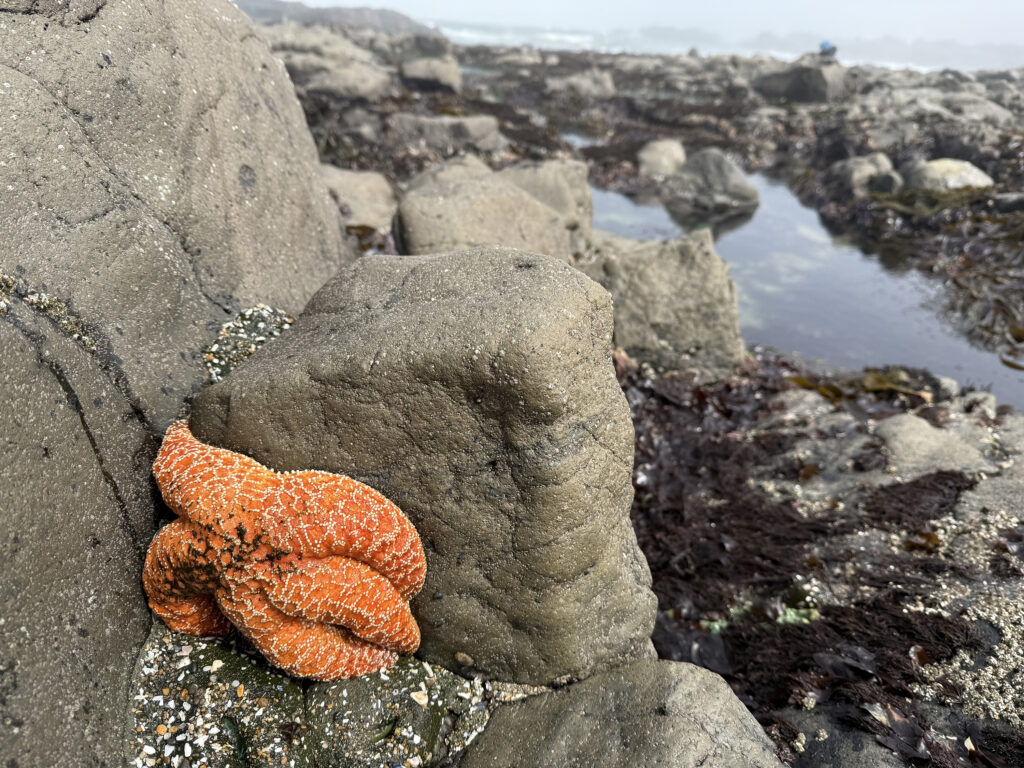
YACHATS, Ore. — For much of his career, Bruce Menge assumed he would conduct the same research until he died. The marine biologist has studied sea stars since the 1970s, and the animals had always seemed more solid a bet than others in the ocean. They have no natural enemies, regenerate limbs when they lose them and reproduce prolifically.
Then, just over a decade ago, a mysterious disease wiped out 90 percent of the West Coast’s sea star population. Tide pools emptied, and Menge had no idea what might become of his work.
“I was upset,” Menge said. “I thought these animals were immortal.”
Little did he know, some of the biggest and busiest days of his career were still ahead of him.
Menge is 82, but he clambered over a mussel bed one windy morning in mid-May faster than any of the biology students working alongside him. He took a seat in a spot that would soon become part of the Pacific Ocean, and he peered down at something he hadn’t seen much of in the decades he’d been coming to this Oregon Coast tide pool — a teeny-tiny sea star, no bigger than his fingernail.
Six months ago, Menge’s team published exciting research — five-legged sea stars were undergoing a significant “baby boom.” The tide pools were denser than they had been before the disease, and the juveniles were eating mussels and clearing space for other species. In short, something rare and wonderful was happening on the Oregon Coast: One of the intertidal zone’s most important predators had returned from the brink.
As the oceans warm and species disappear, good news can feel increasingly rare for a biologist to come by. The resurgence, Menge admitted, is “pretty cool.” But he has no idea why Oregon’s sea stars rebounded or how long they might live. Scientists are forecasting both a warm summer and an El Niño — either of which could spell trouble — and the last decade has taught Menge that disease can take out even the strongest beings.
But as Menge scrambled over barnacle-covered rocks this spring, he kept in mind another, more hopeful, possibility. These new sea stars were growing despite the continued existence of the disease that killed an earlier generation. If they made it to adulthood, they just might be as resilient and indestructible as Menge once believed their ancestors were.
Menge began to notice what came to be called “sea star wasting disease” in the spring of 2014. He and a team of researchers had been doing what they’ve done twice a year since the 1990s — measuring and weighing sea stars — when he noticed an unusual development.
Menge’s research methods are old-school. He uses a ruler and a small scale, then notes each star’s particulars in pencil. (Menge never calls sea stars starfish, even though “quite a few great scientists do,” because “they are not fish.”) Over the years, his team has compiled one of the most robust datasets in existence on the five-legged ochre sea star, which is known for its tenacious rock-clinging and its appetite for mussels. They went back to the same sites so often, Menge says he began to recognize individual animals.
“There was one with a split, Y-shaped arm,” he said. “I weighed that one many times.”
But in late April 2014, Menge observed that some of the sea stars at his sites had twisted arms. Others had lost their grips on the rocks. Something disturbing and novel was afoot.
Menge was disheartened, but he was also a scientist. He began visiting 15 sites down the Oregon Coast and into Cape Mendocino, California, some as many as every two weeks. Initially, less than 3 percent of the animals had twisted arms. By late summer, 93 percent of the sea stars were affected. Eventually, the Pacific Ocean lost billions of sea stars from 20 different species between Alaska and Baja California.
Scientists rarely have a chance to chronicle a population crash in real time, and the sea star die-off was the largest known decimation of a marine invertebrate. As he and his team returned to their sites, they noticed trends. After the sea stars’ arms began to curl, they would develop lesions. Many flattened out “like pancakes.” Others began to liquefy into a pile of spines called ossicles.
Scientists tried out a number of theories. The early days of the disease happened during a marine heat wave and El Niño that also killed off kelp species. Sea stars in the warmest parts of the ocean did suffer more, but others died in cooler waters, so Menge wasn’t sure climate warming was the sole reason for the mass extinction. For a while, some scientists thought a densovirus was to blame — something similar to parvo in dogs. But they later found that hypothesis to be wrong.
Last summer, after four years of studying the sunflower sea star, scientists from Vancouver, British Columbia, and Washington state announced they had linked the mass extinction to Vibrio pectenicida, a strain of bacteria that once decimated scallops on the East Coast.
The researchers told journalists they “got chills” when they made the discovery. The sunflower sea star is the world’s biggest. Some are an entire yard wide and have up to 24 arms. The scientists had all been heartbroken when they died, and hoped their findings might lead to a recovery.
But a known culprit is not yet a cure. When they published their findings, the scientists also wrote that the sunflower star had never bounced back. For now, the species is functionally extinct along most of the Pacific Coast.
Three months later, Menge published a dataset borne out of all his note-taking. Yes, wasting disease was still killing the sunflower and other sea stars. But the ochre sea stars that live on the rocks between the tidemarks had begun to rebound. In fact, their populations were denser than he’d ever seen them.
Menge and a team of biology students resumed their studies last month during a series of low tides. The fog was thick, and the wind strong in Yachats as Menge set up a research station on a rocky slope hidden behind vacation rentals.
The team had a “MacGyver” quality. A field technician used a screwdriver and a Home Depot bucket to collect specimens, and Menge protected his scale with a pop-up tent meant for cats. By 9 a.m., he had a pile of stars. He reached into the tent and set a bright orange one on the scale. It weighed just 11.5 grams — roughly the same as four pennies.
“Before the wasting event, you would almost never see these little guys,” he said.
The year after the mass extinction, Menge found more babies than he’d ever seen. At some sites, he calculated as much as an 8,100 percent increase in juvenile density. Menge is still trying to discern what led to the baby boom. One possibility is that the wasting disease triggered the resurgence, similar to the way wildfires spur new forest growth.
That initial discovery was exciting, but Menge had no idea if the babies would mature into adults. Sea stars are slow-growing, and he would need years worth of data to say for certain whether the species was recovering.
All morning in Yachats, he held a ruler up to stars no longer than a few inches. These were likely a few years old, a sign that was encouraging, if not quite definitive. As Menge weighed and measured, field technician Emma Neill appeared with a heavy bucket.
“I come bearing more stars for you!” she said.
Menge peered in, then pulled out a purple star whose arms were about half a foot long.
“Oh, there’s a big one,” he said. It weighed nearly a pound.
These days, big stars are the novelty. Though the tide pools are rich with sea stars, most remain much smaller than the animals Menge used to see before the outbreak. That can feel thrilling when it comes to cuteness, but troubling for the shore’s diversity. The “little guys” that researchers call “recruits” can’t eat large mussels the same way bigger stars can. That has all sorts of downstream effects. If sea stars don’t eat mussels, the mussels blanket intertidal rocks and make life difficult for seaweeds and other invertebrates. The more sea stars consume, the greater chance other species have to thrive.
Still, a decade in, Menge and a former postdoctoral student have been able to show that many stars are reaching adulthood — a fact that could indicate that this generation is somehow resistant to the wasting disease.
But some of the animals Menge weighed in mid-May had lesions, and he had no idea what the summer might hold. Forecasters believe a super El Niño will bring elevated temperatures and unusually high tides to the Oregon Coast by July.
“We are sitting on the edge of our collective seats to see what might happen this year,” Menge said. “All I can say is, ‘Stay tuned.’”
The post After massive die-off of sea stars, biologist sees a surprising ‘baby boom’ appeared first on Washington Post.