Formula 1 teams spend millions of dollars annually designing, manufacturing and developing inch-perfect machinery, chasing thousandths of a second in performance gains.
The cars, which usually debut in February, are typically retired just nine months later, replaced by the next model. After the final race of the year, the model becomes a heritage car.
That means a Formula 1 team usually has two operational cars, and a spare, that will no longer be raced. What happens to them?
“All of the cars have been prepared for either T.P.C. running,” or the Testing of Previous Cars program, “or a pit-top practice car,” Jim Barker, the heritage and legacy specialist at Williams, said about this year’s cars in an interview last month. “That’s so we can practice pit stops at the factory; we have a complete car ballasted up to a suitable race weight, so it replicates race conditions pretty well.”
T.P.C.s are private test programs for cars that are two or more years old — which for 2026 has been changed to allow one-year-old cars — often to help young drivers, reserve drivers or for race drivers to train during the winter.
“T.P.C. is a very good grounding for teaching people about modern F1 cars,” Neil Oatley, a technical consultant for McLaren Racing, said. “We probably have two or three people a year going from the T.P.C. project to a modern F1 team, building a car, assembling a car, and graduate on to the race team; it’s a good grounding for producing young people to getting used to working on an F1 car.”
Those T.P.C. cars are eventually superseded by the latest model.
“If we take our 2023 cars, they had been assigned to T.P.C., then they came to the Williams commercial marketing team to use as show cars,” Barker said. “We will apply the latest livery on them, and we have two of those cars in both” of the reception areas at the team headquarters in England. “It will come to a point where we no longer need them as show cars, so then they’ll be handed over to our heritage division to decide what the future of those cars is.”
There is also a case of learning from that year’s car components.
“A component has a life expectancy,” Barker said. “You learn through its cycle; we are still understanding them as we get to full life.”
Designers, he said, “may want to subject them to further testing to gain more information, maybe test them to destruction or things like that. Once we’ve done that, we get our learning from them, and then we can hand those components over to our sustainability team to understand how we best recycle them.”
Amanda Martins, head of sustainability at Williams, said in an interview that, “Whenever you extend the cycle of a part, it means you’re being more efficient, so that incentivized different departments to look into that with a different eye.”
That means there are simply fewer components and cars nowadays.
“If we took our car from 1993, we had seven racecars and then four test cars at the end of the year,” Barker, who joined Williams in 1991, said. There are far fewer cars now, so “there are far fewer spares at the end of the season.”
Williams keeps one of every car, typically the most successful, to be available for display at its museum — though there are caveats. Sometimes, particularly toward the end of regulation cycles, teams will retain a chassis from one year to the next, as Williams did in 2024 into 2025 and from 2012 into 2013.
Barker said the FW34 cars from 2012 were turned into FW35s for the 2013 season, but because Williams had won the 2012 Spanish Grand Prix, the team decided to convert one of the FW35s back to an FW34 specification “because we very much wanted that in the museum as our last race-winning car.”
That was achievable because Williams keeps every engineering sheet for each on-track session. Car components are logged and stored, sometimes stacked floor-to-ceiling in warehouses with hundreds of huge containers. That makes remanufacturing possible.
“If you said to me, ‘Oh, Jim, there was a test at Brands Hatch on the 11th of June in 1978’, I could confirm that that was true,” Barker said. “I could go and get the handwritten engineer’s notes. I could tell you exactly what spring rates, gear ratios, cambers, ride heights. We keep everything. We’ve got every single original drawing of all of the components so we can remanufacture, and it’s fantastic.”
McLaren, Formula 1’s second-oldest active team (Ferrari is the oldest), has an extensive collection of old cars. Several models are permanently on display at its headquarters in England, including the M23, in which James Hunt won the drivers’ title in 1976; the MP4/1 of 1981, one of the first carbon-fiber chassis in Formula 1; and the MP4-22 of 2007, all of which are being maintained.
McLaren owns some of its old cars, but others are in private hands. McLaren sold a 2026-spec MCL40A last December for $11.4 million. The owner can drive it during supervised track days, supported by a crew, but the car won’t be delivered to the owner until 2028.
“There’s fairly wealthy owners who want to drive their cars in proper conditions, so a number of cars don’t belong to us, but we’re maintaining them for our customers,” Oatley, said. “We’ve got an extensive collection, almost every model from ’81 onwards we have running cars; for many years they were in bits and pieces, but now we’re trying to get those up and running.”
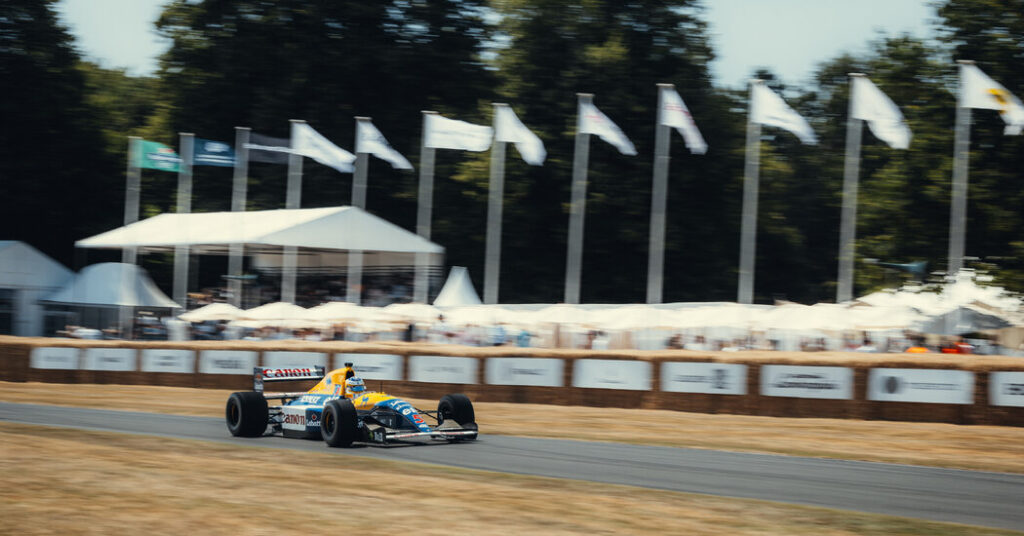
This usually involves demonstration runs at special events, such as at the Goodwood Festival of Speed or at a McLaren event in Miami in April to celebrate the team’s 1,000th Grand Prix. There are also historical racing categories where enthusiasts race cars from previous generations.
“There will be a point in the future where the cars we’re seeing on TV, whether that be in five, 10, 15 years’ time, will be probably in a similar situation to our cars from the ’90s, and ’80s, which are very popular cars to own,” Barker said. “They are very sought after items. They’re very low volume. They are considered to be very, very good investments.”
Some teams have STEM initiatives, where car components are used to educate children in a show-and-tell style. Sometimes parts are sculpted into memorabilia for enthusiasts to buy. An old chassis might also be rebuilt using old components — not in a running condition — to be displayed at exhibitions.
There is also the nostalgia of reviving old machinery.
“We see the effect it has on people when we turn a car from a static exhibition piece into a dynamic one,” Barker said. “It’s huge. We feel a duty to try and get as many of these cars running again as possible.”
Barker quipped that “we have 10 people deep at the front of our garages recording on their iPhones,” and that excitement extends beyond fans.
“We’re working on an FW18 at the moment because we’re celebrating Damon’s 30 years on from winning the championship,” he said, referring to Damon Hill, who won the drivers’ title in 1996. “I know how excited he is about getting back in that car. And that’s, you know, that’s the world champion that drove it, not just the fans.”
The post The Second Life of Formula 1 Cars appeared first on New York Times.