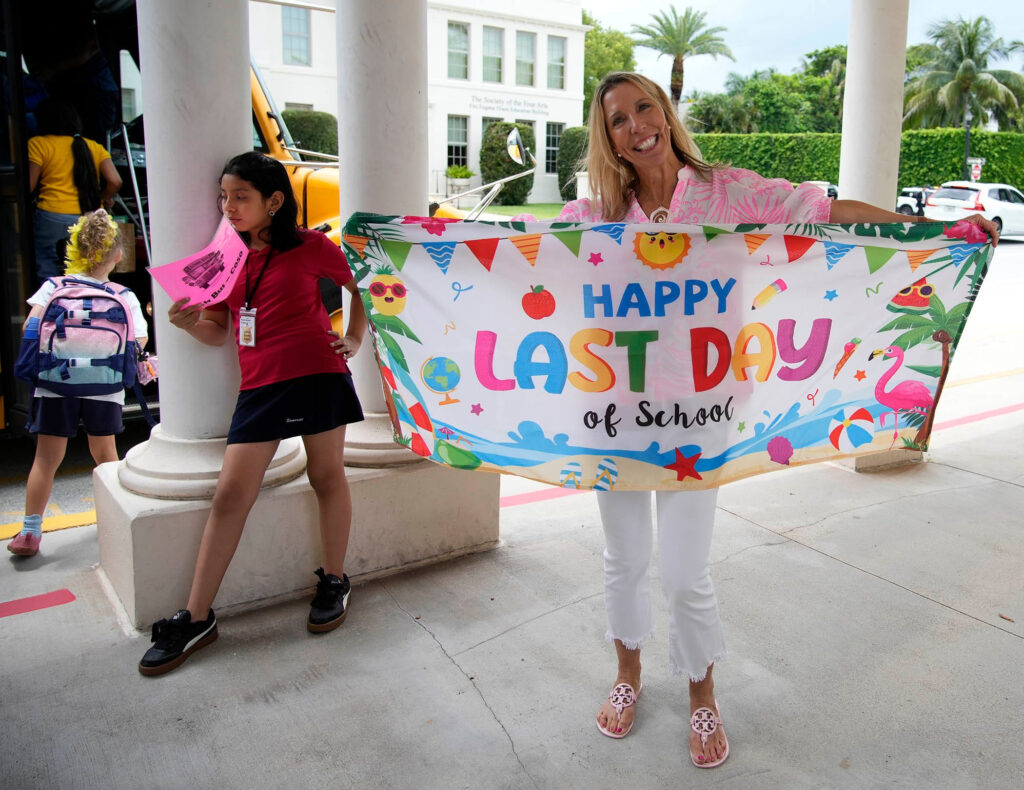
By the end of the 2025-26 academic calendar, Fairfax County Public Schools students will have had 20 five-day instructional weeks. That’s a meager 45 percent of the calendar, and the calculation does not include the eight three-hour early releases for elementary-age students, the four two-hour early releases at quarter ends, and weather-related delays and closures. By comparison, five-day instructional weeks for the D.C. region and other Virginia public schools range from 56 to 67 percent, while the national public school range is 53 to 74 percent. Among peer regional institutions, FCPS has the lowest percentage of five-day weeks, the longest school year (305 days); the shortest summer break (66 days); the highest number of days off (41); and the largest number of religious holidays (eight).
Meanwhile, despite objections from numerous families and educators across the county, the school board has approved a 2026-27 academic calendar that again fails working parents, students and teachers. The regularity of FCPS students not being in school for five days each week has become a financial and psychological burden for many working parents. We are left scrambling to find care on these random days, given that many employers, including the federal government, increasingly require employees to be in the office every day of the week. Moreover, many teachers have expressed their displeasure with the irregular schedule. Students often cause disruptions and are more prone to poor behavior because of these inconsistencies in their academic life. Frequent interruptions also mean more reteaching and slower pacing through curriculums.
It is amazing to me, and I am sure to many other parents, that we are fighting for something that seems so obviously important: a regular school calendar and consistent education.
Steve Sidorek, McLean
Holy moral panic, Batman
There are practical problems with restricting minors’ access to social media platforms. But there is also a historical parallel worth considering.
In 1950s America, comic books became the focus of a national moral panic. Critics claimed they were corrupting children, promoting violence and fueling juvenile delinquency. Political pressure eventually produced the Comics Code Authority, a censorship regime that revealed far more about adult anxieties than about comic books.
Social media risks becoming the latest scapegoat.
This is not to deny the dangers of algorithm-driven platforms, especially for adolescents. Artificial intelligence increasingly powers recommendation systems designed to capture attention. But banning teenagers from social media will not prepare them for a future in which digital systems influence nearly every aspect of life.
History suggests that societies rarely resolve cultural anxiety simply by prohibiting the dominant medium of a generation. Rather than trying to shield young people from digital reality, democratic societies should focus on teaching them how to navigate it responsibly.
Gaspare Jucan Sicignano, Naples
When in Rome, study Iran
Marc A. Thiessen’s May 29 column, “Why no deal with Iran could be even better than a good deal,” a cri de coeur for President Donald Trump to summon into being a free, non-nuclear Iran, midwifed by a CIA covert operation to train the opposition to make permanent peace with the United States and Israel, called to mind an exchange in Shakespeare’s “King Henry IV, Part 1″:
Glendower: “I can call spirits from the vasty deep.”
Hotspur: “Why, so can I, or so can any man/ But will they come when you do call for them?”
Thiessen’s line of thinking begot our disasters and defeats in, among other places, Vietnam and Afghanistan. It does not improve with age.
Likewise, the May 27 editorial “A former U.S. ally is slipping into Iran’s orbit” summoned into being yet another national security threat: the featherweight nation of Georgia. Previously, The Post’s opinion pages have touted U.S. control or domination of sub-featherweight nations or territories including Belarus, the Solomon Islands, Fiji, Venezuela, Cuba, Vanuatu, Syria, Lebanon, Yemen, the North Pole, the South Pole, Chad, Burkina Faso and the Democratic Republic of Congo as integral to national security.
It is lunacy to ape the folly of the Roman Empire before its self-ruination. Before writing another editorial clapping for an American Empire, reflect on renowned economist Joseph Schumpeter’s 1919 observation:
“There was no corner of the known world where some interest [of Rome’s] was not alleged to be in danger or under actual attack. If the interests were not Roman, they were those of Rome’s allies; and if Rome had no allies, then allies would be invented. When it was utterly impossible to contrive such an interest — why, then it was national honor that had been insulted. The fight was always invested with an aura of legality. Rome was always being attacked by evil minded neighbors, always fighting for a breathing space. The whole world was pervaded by a host of enemies, and it was manifestly Rome’s duty to guard against their indubitably aggressive designs. They were enemies who only waited to fall upon the Roman people.”
Bruce Fein, Washington
The writer was associate deputy attorney general under President Ronald Reagan.
As we look at the long history of U.S.-Iranian relations, an interesting pattern emerges. Following World War II, the United States and Iran were deeply entwined. The United States saved Iran in 1946 from being cut apart by the Soviet Union, in the first crisis of the Cold War. In a similar situation, the Roman Republic fought as an ally of Carthage in the Pyrrhic War of 281–275 B.C.
Later, when it became clear that Carthage was a rival and not an ally of Rome, the two ancient states fought three wars before Carthage was finally subdued by Rome. Our current time is analogous to that of Hannibal, the great Carthaginian general, during the Second Punic War. Long-standing resentments have boiled to the surface, sparking conflict and testing the onetime savior’s resolve.
Rome triumphed in the long run not due to superior resources or better military tactics. Rome won by adopting a long-term view, husbanding its resources and striking at the right moment. Rome played the long game, and so should we.
Stuart Gallant, Belmont, Massachusetts
Is human writing obsolete?
In her June 1 column, “AI fiction is the new fast food,” Megan McArdle lamented how stories concocted by artificial intelligence tend to be “smoother, tighter and psychologically simpler than [their] human-written counterparts, explicitly stating themes, constructing ‘single-track narratives with fewer loose ends’ and portraying fewer morally ambiguous characters.” She continued, “One might argue that’s not a problem for anyone except (she said nervously) professional writers.”
To quote Samuel Johnson, “No man but a blockhead ever wrote, except for money.” As a writer, I do not fear AI despite what experts predict about lost jobs and income, because I already make money from the entity using my natural intelligence.
This year, I sold two history books I wrote a few years ago to an AI company. The AI payment was more than three times my royalty payments for sales of both books during 2025.
Human writers can outperform AI through editing, fact-checking and selecting factoids. The historical record is available, and new means of expression by reporters and writers remain to be realized. To all human scribes, I say do not fear being replaced by non-human entities; embrace the AI market, collect royalties and disregard any doomsday scenarios about becoming obsolete.
Arthur H. Redman, Portland, Oregon
I share concerns expressed by Pope Leo XIV and others about the widening use of artificial intelligence in human undertakings. Even the software I am using to type this is “AI-powered.”
My limited experience with AI is disconcerting. When I type on my laptop, I often see that AI has “guessed” what I’m going to say next, which in many cases does not make sense or is actually wrong.
I agree with whoever first quipped that “with artificial intelligence comes artificial stupidity.”
Rose D. Padlan, Kensington
Post Opinions wants to know: What things did your father say that have stayed with you into adulthood? Share your response, and it might be published as a letter to the editor. wapo.st/father_knows_best
The post Early dismissals and random days off are driving parents and teachers crazy appeared first on Washington Post.