Alan Saret, a sculptor who bucked his medium’s traditional association with solidity by reaching for the ineffable with delicate materials like metal wire, died on May 26 at his home in the Williamsburg section of Brooklyn. He was 81.
His death was announced by Karma, the gallery that represented him. No cause was given.
“There is no doubt in my mind that he was one of the most important artists I ever worked with,” Alanna Heiss, the founder of the Clocktower Gallery and the P.S. 1 Contemporary Art Center (now MoMA PS1), said in an interview.
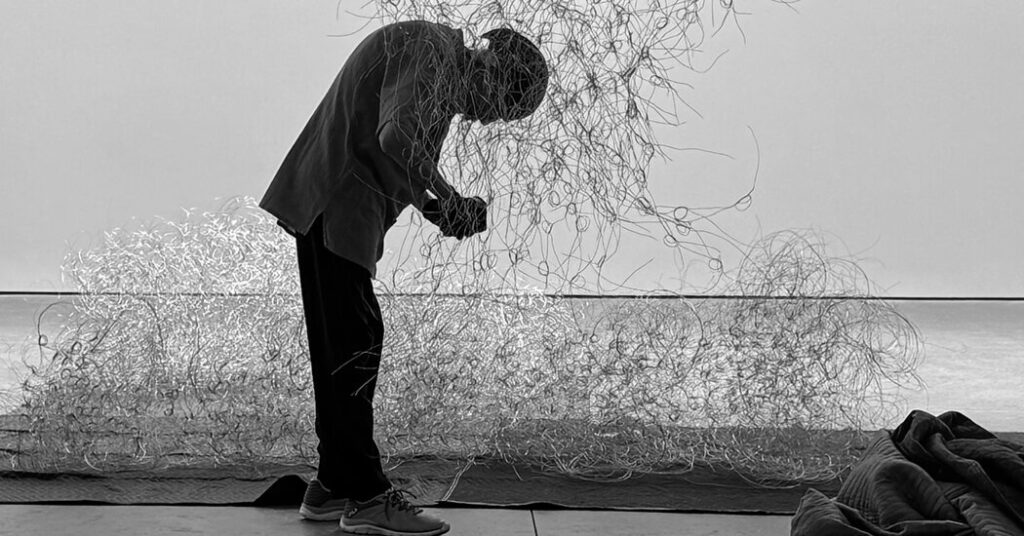
Mr. Saret’s best-known works were large, airy clouds of intricately tangled wire that he called “flexible sculpture.” Some were created by following complex mathematical patterns; some were more free-form. If a window was open, they might sway in the breeze.
Other sculptures, made from porous chicken wire, confused a viewer’s ability to distinguish inside from outside. Winsome sketches executed with fistfuls of colored pencils — Mr. Saret called them “gang drawings,” as in gangs of pencils — occupied a borderland between intention and chance.
Typically quiet and self-contained, these works were surprisingly difficult to parse, and critics often resorted to lists of associations.
For Michael Brenson, writing in The New York Times in 1987, one construction of metal rods brought to mind “jugglers, a sculptural group by Kenneth Armitage, the rising, pyramidal movement in Gericault’s ‘Raft of the Medusa’ and currents of energy in Chinese landscape painting.”
Johanna Fateman saw in Mr. Saret’s wires “a storm cloud, a charred bush and a Balenciaga creation in tulle.” Ken Johnson found “tumbleweeds, nests, hanging plants, giant hairballs and clouds,” and Michael Kimmelman, looking at the drawings, thought of “bamboo thickets, fireworks, Impressionist landscapes, Chinese calligraphy and the works of Cy Twombly.”
In a 1969 Artforum review of Mr. Saret’s debut solo exhibition at Bykert Gallery in New York, Emily Wasserman suggested that sculpture was “almost too heavy a designation for Saret’s work.” She called the things he made “webs, clusters and billows.”
Ms. Heiss, who organized exhibitions of his work at Clocktower and P.S. 1, said that while he “didn’t fit securely into the platform” of Post-Minimalist sculptors, he was “the most interesting of the non-Post-Minimalists.”
But whatever movement Mr. Saret was linked to, and whatever materials he chose, his abiding preoccupation was with unseen forces — those charted by Western science, as well as the energies described in other traditions.
Some of his wire sculptures were meant to evoke the particles orbiting through empty space that make up apparently solid matter. He meant the visual ambiguities of other pieces, with their confusion of inside and out, to point to deeper philosophical questions about identity and self. His esoteric, often fanciful titles often incorporated the word “ensoulment,” which traditionally refers to the process by which a being gains a soul.
Mr. Saret credited Zen Buddhism, the Hindu philosophical system known as Vedanta and the teachings of Ramana Maharshi, a Hindu sage he met during a three-year sojourn in India, with sparking his interest in these questions.
“I ended up finding a direction, anyway, with Ramana Maharshi self-inquiry, which is about finding the origin of being,” he said in a 2022 interview with the curator Hans Ulrich Obrist. “What is the ultimate meaning of the term I?”
Alan Daniel Saret was born on Dec. 25, 1944, in New York City, to Augusta and Leonard Saret, and grew up in Washington Heights, near the northern tip of Manhattan.
He studied architecture at Cornell, earning a bachelor’s degree in 1966. During college, he spent a summer working for the Italian architect Paolo Soleri.
In 1967, he enrolled in a master’s program at Hunter College, where he studied with the Minimalist sculptor Robert Morris. By then, Mr. Saret had found his own distinctive approach.
“Wondering what painting would be like if the space between the threads of the canvas were expanded, I tried stretching chicken wire over frames made of electrical conduit,” he wrote on his website. “Fascinated by the potential of the wire mesh alone, I abandoned the frame.”
After his solo debut at Bykert, he was invited to be a part of a number of group shows. But he turned down the opportunity to take part in what would become one of the era’s most influential exhibitions — “Anti-Illusion: Procedures/Materials” at the Whitney Museum in 1969 — reportedly because he didn’t like the title.
He hosted other artists’ work and performances at his loft on Spring Street in SoHo, calling the place Spring Palace. He was also involved, alongside Jeffrey Lew, in founding the artist-run venue known as 112 Greene Street, where artists like Gordon Matta-Clark and Joan Jonas got their start. (The project eventually evolved into the nonprofit gallery White Columns.)
In 1971, Mr. Saret was selected by the Museum of Modern Art to participate in an international exhibition in New Delhi. It was a trip that would shape the remainder of his career.
“I felt that art had taken me to a portal, but could not reveal what was beyond,” he wrote on his website.
In New Delhi, Mr. Saret built a ramp out of local construction materials. “I decided to cash in my return ticket,” he wrote, “and spent almost three years exploring the ultimate questions of self and world that the art had occasioned.”
In addition to his sculptures and the gang drawings, Mr. Saret made more precise geometric drawings, and early on had occasional excursions into symbolic figuration, like a watercolor view from below of a person walking a tightrope.
He also composed short phrases — “BODY DIES WHO AM I,” for example, or “ROUND RADIANT SELF ENTIRE” — that fell somewhere between mantras, haiku and koans. He called them dharanis, using the Sanskrit word, and insisted that they were “meant to focus attention and not to be seen as art or literature.”
Still, the aesthetic care that went into them is unmistakable. At first, he wrote them on paper in careful calligraphy. Later, he laid them out on a computer, but using luminous colors and serene Roman capitals, sometimes incorporating little typographical winks, as in “PLACE WHERE BLISS GROWS ROUND” and “PEACE OCEAN UNION GLORY FOUND,” both of which were colored to highlight the vowels.
Mr. Saret withdrew from the commercial art world for most of the 1980s, ’90s and 2000s, forgoing gallery representation and rarely exhibiting.
“In the end, he was a loner,” Ms. Heiss said. “People admired him, and I’m sure many loved him. He was a very good person to admire, but he was a very difficult person to love.”
Information about his survivors was not immediately available.
In recent years, Mr. Saret began an association with Karma and had shows at museums in Paris, Los Angeles and Mexico City. His work was collected by major institutions like the Art Institute of Chicago, the Metropolitan Museum of Art, the Museum of Modern Art and the Whitney.
He never stopped working. Indeed, making art was almost all he did.
Speaking to The Paris Review in 2012, the curator Jessamyn Fiore said of Mr. Saret, “He really believed that an artist’s whole life is his artwork.”
The post Alan Saret, Sculptor Who Made Clouds of Wire, Dies at 81 appeared first on New York Times.