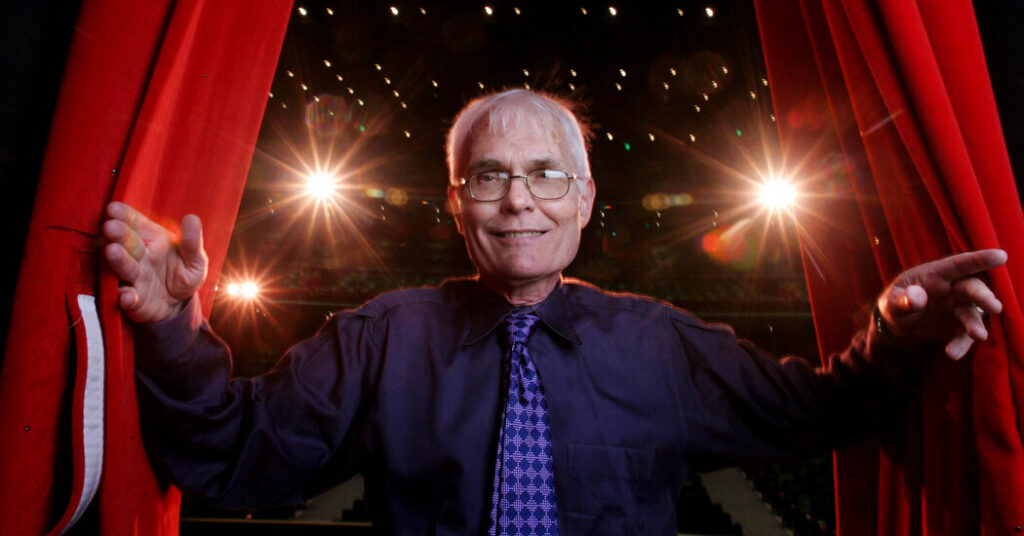
Speight Jenkins, an opera journalist, critic and commentator who had never produced a performance of any kind when, in 1983, he was hired as the general director of Seattle Opera, which he turned into one of the most adventurous and respected companies in the United States during a 31-year tenure, died on May 30 in Seattle. He was 89.
Seattle Opera confirmed the death, at a hospice facility, but did not provide a cause.
Passionate about opera from an early age and sought after as a speaker, with his infectious wit and thick Southern drawl, Mr. Jenkins, a native Texan, came to Seattle in 1982 to lecture about Wagner, a specialty of the company’s and his.
The board, which was looking for a new director, asked him for advice about the search, was impressed by his knowledge and ideas, and ended up offering him the job.
“Even all the critics said: ‘What does he know? He’s only a critic,’” Mr. Jenkins told The New York Times in 2001. “But I knew that I knew opera, I knew singers.”
The company’s ticket sales were struggling, and balancing the budget had become an overriding focus.
“I’m all for being financially responsible,” he said a few years later, “but you can carry anything too far. In this case, quality had begun to suffer, particularly the look of the productions.”
Swiftly doubling the budget, which caused some early deficits, Mr. Jenkins began to emphasize edgier repertory and directing styles.
Seattle had, before his time, become known for its performances of Wagner’s four-opera “Ring.” But soon after Mr. Jenkins’s appointment, he replaced a traditional staging of the cycle with an avant-garde one that polarized audiences — in a good way. He eagerly embraced the new technology of above-the-stage supertitle translations, which made opera far more accessible. (Imagine watching a Bergman film without subtitles.)
“With Wagner, it made all the difference in the world,” Mr. Jenkins said of the titles, adding: “Everybody thought that Wotan’s monologue” — a 20-minute sequence in “Die Walküre” — “was boring. Now nobody does.”
Under his leadership, the company offered early opportunities to singers like Renée Fleming, Ben Heppner and Jane Eaglen, and presented productions like the director Christopher Alden’s modern vision of “Don Giovanni,” Francesca Zambello’s ambitious (and expensive) staging of Prokofiev’s epic “War and Peace” and a 1993 “Pelléas et Mélisande” designed by the glass artist Dale Chihuly.
In 2001, the company’s third “Ring” production, directed by Stephen Wadsworth, evoked the wilds of the Pacific Northwest; by then, Seattle’s Wagner offerings were drawing visitors from around the country and the world. Two years later, its opera house reopened after a renovation that cost $127 million (roughly $230 million today).
And while new works were never the company’s priority, Mr. Jenkins did participate in commissioning operas by composers like Daron Hagen, Jake Heggie and Daniel Catán, and was beloved for leading what the company said were nearly 1,000 post-performance talkbacks.
“I love to work with Speight,” David Gockley, then the general director of Houston Grand Opera, said in 1995, “because of that dogged enthusiasm he has for everything, that wide-eyed excitement.”
Speight Jenkins Jr. was born on Jan. 31, 1937, in Dallas, to Speight Jenkins Sr. and Sara Baird Jenkins, wealthy, culturally active philanthropists.
He fell in love with opera when he was 6 and heard a Metropolitan Opera radio broadcast of “Die Walküre.” “I have no idea why Wagner hit me at that age,” he later told The Dallas Morning News, “but it connected to me instantly.”
He saw his first operas, “Aida” and “Faust,” a year later. A touring Met performance of “Rigoletto” starring Jan Peerce and Leonard Warren affected him enough that he later recalled thinking, “This is what I’m going to do with my life.”
“I studied a little piano and clarinet,” he told The Times in 2001, “but I really had no desire to perform, conduct or direct. So my parents would say, ‘What do you want to do, sit in an opera house all your life, listening?’ Well, exactly!”
Mr. Jenkins graduated from the University of Texas and, after a stint at Cornell’s medical school in New York, earned his law degree from Columbia.
He was drafted and served as an Army lawyer in Iran (where he hosted a classical music radio show) and, later, at Fort Hood in Texas. When he was around 30, he mulled returning to school to study music history, but decided to follow his father’s suggestion that he try out criticism.
Moving to New York, he became an editor at Opera News in 1967 and also began reviewing performances. Among them was the 1971 Met debut of the conductor James Levine, who, Mr. Jenkins wrote, “brought to ‘Tosca’ a dramatic tautness frequently missing in the Met’s pit.”
Mr. Levine, he added, “should have a great career ahead of him.”
In 1973, he became a critic for The New York Post, and from 1981 to 1983 was a host of “Live From the Met” on PBS.
By then, Mr. Levine had become the Met’s music director and a friend, and was one of the people Mr. Jenkins consulted when Seattle Opera’s board asked if he would be interested in replacing Glynn Ross, who had been the company’s director from its start in the early 1960s.
“You were always designed to do this,” Mr. Jenkins recalled Mr. Levine telling him. “You were never designed to be a critic. You must do it.”
By the time he retired, three decades later, the company was weathering the same financial pressures as other nonprofit performing arts organizations, and had cut back its annual schedule to four productions from five. (The coming 2026-27 season in Seattle includes just three staged operas.)
Mr. Jenkins’s marriage to Linda Sands ended in divorce. He is survived by their son, Speight III; their daughter, Linle Jenkins Froeb; and three grandchildren.
Mr. Jenkins said his management style was built on two pillars: close involvement with every detail of every production and supportive treatment of visiting artists. He liked to quote the great soprano Birgit Nilsson: “Songbirds sing when they’re happy.”
“If a singer is unpleasant to the wig people or the makeup people while they’re here,” Mr. Jenkins said, “I may not bring them back. But while they’re here, we’re going to make them happy.”
The post Speight Jenkins, Who Brought Adventure to Seattle Opera, Dies at 89 appeared first on New York Times.