This is an edition of Time-Travel Thursdays, a journey through The Atlantic’s archives to contextualize the present. Sign up here.
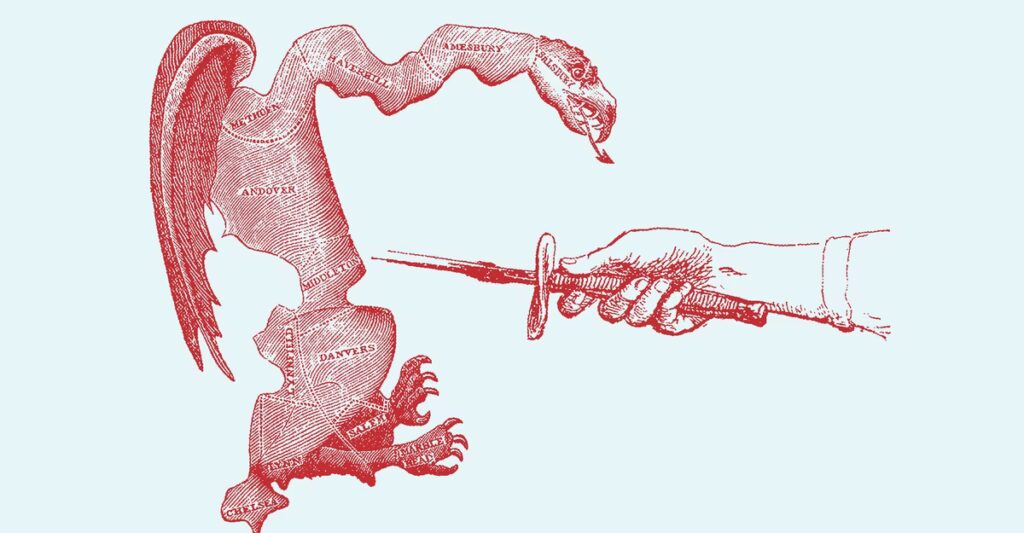
Not long after the original gerrymandertook its monstrous shape in 1812, The United States Gazette issued a harsh prophecy. Massachusetts Governor Elbridge Gerry might otherwise have been forgotten to history but for the wicked practice that would come to bear his name. According to the paper, gerrymandering, “like the word mammoth, will probably be familiarly understood long after the filthy beast to which it is applied, shall become extinct.”
As political predictions go, it was a good one. In 2026, the political map is crawling with newborn filthy beasts. Last year, at the direction of President Trump, the Texas state legislature gerrymandered its districts to give Republicans an edge in the House elections. More red states followed suit, triggering redrawn maps in blue states. In April, the Supreme Court’s Callais decision to block a majority-Black district in Louisiana effectively ended the Voting Rights Act’s requirement for majority-minority districts, opening the door to further gerrymanders across the country.
We are entering gerrymandering’s golden age. The situation is extreme, but it’s not exactly new. Gerrymandering and other forms of skullduggery—“all the frauds and tricks that go to make up the worst form of practical politics,” as John Bach McMaster put it in an 1895 Atlantic essay—are as old as the Republic. No sooner had James Madison helped see through the ratification of the Constitution than his fellow Virginian Patrick Henry tried to district him out of a congressional seat. In other instances, Americans have repeatedly tried to solve problems of representation through districting, but reforms meant to curb unfairness have created new opportunities for manipulation. We’ve become so accustomed to thinking about the district as the core form of representation that we have difficulty imagining any alternative.
One looks mostly in vain for some halcyon era of fair play and good will in the apportionment of representation in the United States. Although the particulars have changed through time, the broad narrative has been mostly the same: One party dilutes another party’s electoral strength either through clever districting or by refusing to create new districts, and tilts the board in its favor. The losers are shocked at the injustice; the winners explain why their actions are virtuous and necessary, or they just shrug. But what remains certain is that yesterday’s victims of gerrymandering will just as readily become the gerrymanderers of today.
In 1842, the Whig Party’s Apportionment Act mandated geographically contiguous, single-member districts. The measure was meant to eliminate the so-called general-ticket system, which allowed a majority party to take a state’s entire congressional delegation. It was also, the Whigs hoped, a way to maintain power, because the states using the general ticket leaned toward their Democratic opponents. Changing systems didn’t help the Whigs much, but it did lay the groundwork for future outbursts of gerrymandering.
What appeared to be a long period of détente in the gerrymandering wars—from the early 20th century to the 1960s—happened only because gerrymandering wasn’t necessary: Things were unfair enough without it. In the Jim Crow–era South, where most Black Americans couldn’t vote and Democratic rule was mostly a given, there was little pressure to redraw maps. Many states in other regions also froze their maps; representatives from rural and small-town districts had little incentive to surrender their advantage as populations shifted toward cities and suburbs. The resulting imbalances were astonishing. By the early ’60s, a House district in Atlanta contained more than 820,000 people, and a rural district in the same state sent a representative to Congress on behalf of fewer than 275,000 people.
A series of Supreme Court decisions, along with civil-rights legislation in the ’60s, entrenched modern districting. Most important, the 1964 Wesberry decision mandated that states maintain congressional districts of approximately equal population to ensure the principle of “one person, one vote.” To abide by the ruling, states generally adopted the practice of redistricting after a census—once every decade—to keep the required balance. When southern states threatened to return to the general-ticket system, which could dilute the voting power of newly enfranchised Black citizens, Congress again passed legislation mandating single-member districts. In some states, independent districting commissions helped limit extreme gerrymandering, and the Voting Rights Act curtailed efforts to dilute Black political representation in the South.
But the conditions for abuse were in place. By the beginning of the 21st century, advanced computer modeling had lent neighborhood-level precision to partisan districting efforts. Add to that polarization, the dismantling of some fair districting commissions, and more Supreme Court decisions allowing gerrymandered maps to stand, and we’ve reached a new breaking point.
Perhaps we should stop trying to solve the problem of districting with districting. This was the case that a little-known writer named Stoughton Cooley made in a pair of 1892 Atlantic essays. Working in a moment of corruption and cynicism similar to ours, Cooley had watched Ohio be “gerrymandered and re-gerrymandered, and gerrymandered again” (six times from 1878 to 1892); he noted the long-standing issue of single-party rule in states such as Kansas. In “Legal Disfranchisement,” he unraveled the ways in which districting doesn’t just make for unfair representation but also corrodes the entire political culture. Voters in minority parties give up on the political process altogether, and political leaders become aligned with the narrow interests of their parties rather than the people. “A premium is put upon mediocrity; a reward is offered for dishonesty,” Cooley wrote.
If his diagnosis of the problem is hauntingly familiar, his solution is perhaps less so. In “The Slaying of the Gerrymander,” Cooley argued for a system of proportional representation that would eliminate districts altogether; parties would receive seats according to their share of the statewide vote. The result, he argued, would be something that looked like real representative government, defined by a genuine contest of ideas and energized by broader participation.
With as few as 18 true toss-up House seats in the coming midterms, it might be worth hearing Cooley’s lonely shout from the Gilded Age. Proportional systems have their drawbacks, but as we’re seeing now—and as we’ve seen from the beginning—districting can erode democracy. Elbridge Gerry’s legacy has survived long enough.
The post Welcome to the Golden Age of Gerrymandering appeared first on The Atlantic.