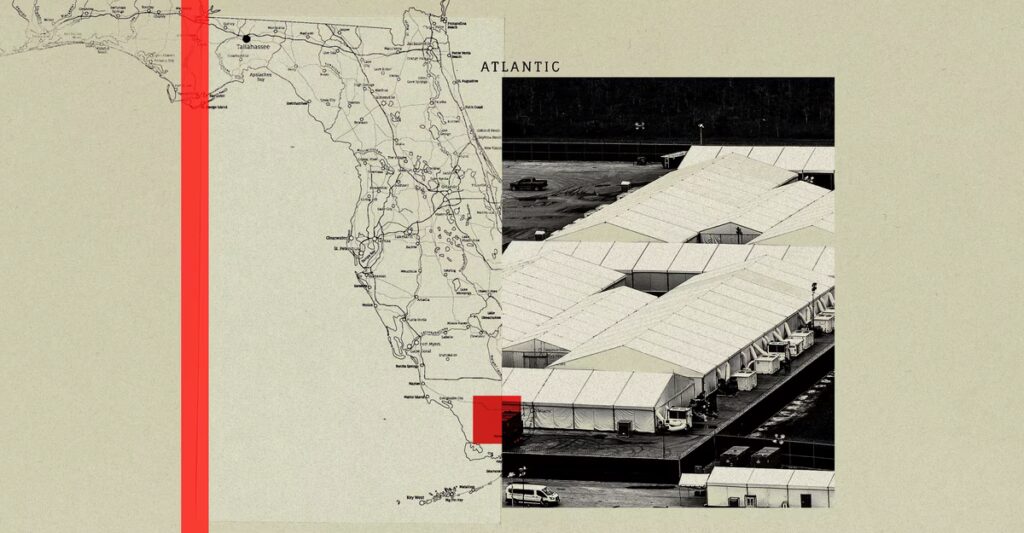
Since the early 1990s, I have visited scores of prisons and jails throughout the United States, as well as the Guantánamo Bay detention camp. The immigrant-detention facility known as Alligator Alcatraz, deep in the Florida Everglades, stands out as a uniquely cruel publicity stunt with an absurdly high price tag, in which much of the money goes into just a few pockets. For almost a year, the facility has been operated under an unusual arrangement: funded by the state of Florida and run by private corporations to detain immigrants on behalf of the federal government. Ultimately, the way Florida and the Trump administration went about creating Alligator Alcatraz placed them in an untenable position, legally and financially. According to recent reports, the facility may soon be shut down. Its history, however, must not be erased.
The Florida Soft Sided Facility South, as Alligator Alcatraz is officially designated, was built by the state of Florida during the summer of 2025 for use by U.S. Immigration and Customs Enforcement. It is located at a remote airstrip in the Everglades, surrounded by the Big Cypress National Preserve. Alligator Alcatraz houses a few hundred employees in trailers and detains about 650 male immigrants in large tents; until a few weeks ago, the number of those being detained was nearly 1,500. By ordering its construction, Ron DeSantis, the governor of Florida, demonstrated both his loyalty to President Trump (whom he had run against for the Republican presidential nomination in 2024) and his strong public support for Trump’s crackdown on immigration. DeSantis expected that much of the cost of Alligator Alcatraz would eventually be reimbursed by the federal government. Trump attended the grand opening with Kristi Noem, then the head of the Department of Homeland Security, who promised that Alligator Alcatraz would be “funded largely” by her department.
But federal funding was held up for months, thanks to an environmental lawsuit by opponents of the facility. Florida has been forced to carry almost all of the financial burden—half a billion dollars, at least, and maybe far more. The state would save money by shutting it down, though closure of the facility would be seen as a defeat for Trump. During his tour, Trump vowed that Alligator Alcatraz would lock up “some of the most vicious people on the planet.”
In truth, perhaps three-quarters of the immigrants detained at Alligator Alcatraz have never been convicted of a crime. They have not been sent there to face criminal charges in the United States or serve sentences for a conviction. They have been detained merely to await the outcome of a civil proceeding—an immigration hearing, a deportation, a request for release on bond. The facility is not supposed to be a prison or a jail. Some of the men held there have previously been convicted of violent crimes. The overwhelming majority have not. Whatever offenses these immigrants may or may not have committed in the past, Alligator Alcatraz has no legal grounds for punishing them now.
They are, however, being punished. An investigation by Amnesty International found “a pattern of deliberate neglect designed to dehumanize” at the facility as well as the use of punishments that “may amount to torture.” Immigrants have described tents that flood with water when it rains, toilets that routinely overflow into living areas, mosquito infestations, faulty air-conditioning, inadequate food, limited access to medical care, random beatings by guards, indiscriminate use of pepper spray in poorly ventilated areas, and a pervasive climate of fear. Televisions, radios, cellphones, newspapers, and most personal belongings are prohibited. The interiors of the tents are brightly lit 24 hours a day, making it hard to sleep. Immigrants are routinely shackled when they leave the tents, wearing handcuffs connected to leg irons and a chain. According to guidelines issued by the Department of Justice, shackles may be used at federal facilities only to restrain violent inmates or prevent the escape of inmates during court appearances and transport.
[Alexandra Petri: Just a tiny, minuscule technicality about the people held at ‘Alligator Alcatraz’]
“There have been credible allegations that detainees at ‘Alligator Alcatraz’ have been punished with confinement in a small cage-like structure known as ‘the box,’ where they are held in stress positions with hands and feet tightly shackled for hours at a time, in direct sunlight with no access to food or water,” Senators Jon Ossoff of Georgia and Dick Durbin of Illinois, both Democrats, wrote to officials at the Department of Homeland Security in March, demanding a formal inquiry.
Florida has refused to disclose exactly how many hundreds of millions of dollars Alligator Alcatraz has cost. I contacted the state to discuss spending on the facility but received no reply. Enough has been disclosed to enable some basic math: It would have been less expensive to buy each of the men detained at Alligator Alcatraz his own one-bedroom condo in Orlando and pay for a personal, full-time guard to keep an eye on him.
Alligator Alcatraz was the brainchild of Florida Attorney General James Uthmeier, an ambitious 38-year-old protégé of DeSantis. During a meeting last June with Homeland Security officials in Washington, Uthmeier offered to build a state-run detention center in the Everglades. He later recalled having “put together a little marketing pitch,” mentioning Trump’s affection for the Alcatraz Federal Penitentiary, a tough, virtually escape-proof prison set on a rocky crag in San Francisco Bay. (It closed in 1963.) After the meeting, Uthmeier posted a slick video on X that showed him walking along the desolate Everglades airstrip with highway-patrol officers. “If somebody were to get out, there’s nowhere to run, nowhere to hide,” Uthmeier explained during a segment on Fox Business. “Only the alligators and pythons are waiting.” For obvious reasons, the proposal drew a huge amount of media attention.
DeSantis and Uthmeier are longtime opponents of immigration. They worked together in 2022 to fly dozens of asylum seekers from San Antonio to Martha’s Vineyard, an exercise in political theater devised to mock liberal sympathy for migrants. In order to build Alligator Alcatraz fast—it went up in eight days—DeSantis relied on the Florida Division of Emergency Management. He had officially declared mass immigration to be a “state of emergency” in 2023, thereby gaining access to a roughly $5 billion fund set aside to deal with hurricanes, floods, and other natural disasters. Uthmeier’s office defended the use of the fund for Alligator Alcatraz: “We are dealing with a storm, and the storm’s name is immigration.”
At the opening of Alligator Alcatraz, Trump inspected its cages, which resemble large kennels, the sides and ceiling made from steel mesh. Each cage contains 16 bunk beds and three toilets with attached sinks, and each tent has eight cages, which allows room for a total of 256 men. The cages visually evoke Camp X-Ray, the original holding pen at Guantánamo, as well as another favorite prison of Trump’s, the Terrorism Confinement Center, in El Salvador, where harshly lit cells hold more than 80 men apiece. Trump liked what he saw at Alligator Alcatraz. “It’s really government working together,” he said.
When the facility accepted its first immigrants, on July 2, 2025, it was already the target of a lawsuit seeking to shut it down. A week earlier, the Friends of the Everglades and the Center for Biological Diversity had sued the Department of Homeland Security and the Florida Division of Emergency Management, arguing that Alligator Alcatraz must close at once because it had been built without an environmental-impact study—mandatory for all federal construction projects. The suit was later joined by the Miccosukee Tribe. The plaintiffs stressed that the detention center had been put in a freshwater wetland near Everglades National Park, a pristine ecosystem inhabited by dozens of threatened or endangered species and not far from a Miccosukee village. The Justice Department responded that federal law didn’t apply: Alligator Alcatraz was a state facility “using state funds on state lands,” and an environmental-impact study was therefore unnecessary. Homeland Security officials denied that any federal money had yet been spent on the detention center.
[Nick Miroff: Why Trump loves megaprisons]
In August, U.S. District Judge Kathleen Williams ruled that Alligator Alcatraz, which “exists for the sole purpose of detaining and deporting those subject to federal immigration enforcement,” was indeed a federal facility. She observed, “If it walks like a duck, quacks like a duck, and looks like a duck, then it’s a duck.” Citing violations of the National Environmental Policy Act, Williams issued a preliminary injunction ordering the closure of Alligator Alcatraz within 60 days. Her ruling became major news nationwide, and ICE began to remove immigrants from the facility. Many Americans likely assumed that it would in fact be shut down and paid no further attention.
But the state of Florida appealed Judge Williams’s injunction, and her order was blocked: Because federal money had not yet been provided, the appeals court suggested, Alligator Alcatraz wasn’t a federal facility. And so ICE resumed the transport of immigrants to the Everglades.
Florida’s victory posed a dilemma. If DeSantis didn’t receive federal funds, he would have to pay for one of the most expensive carceral facilities in the history of the United States. But if federal funds started to be disbursed, the rationale for claiming that Alligator Alcatraz was not a federal site would be undermined, and the environmental issue would resurface.
The Florida Division of Emergency Management has been highly secretive about Alligator Alcatraz’s costs. Some information has been presented in court filings or uncovered by journalists and by one especially diligent state legislator, Anna Eskamani, from Orlando. Florida’s 2025 grant application to the Federal Emergency Management Agency for Alligator Alcatraz is by itself illuminating: The state asked Washington for $1.5 billion. The FEMA application also revealed that Florida was spending about $1.2 million a day to run the facility—and, at times, as much as $3 million a day. The number of immigrants detained there has fluctuated, from a low of about 100 to a peak of almost 1,500, making per-capita spending hard to establish definitively. A conservative estimate of how much it costs to hold a single immigrant at Alligator Alcatraz for a year is about $500,000. By comparison, Florida spends $30,000 a year to house a convicted criminal in a state prison.
Asking private corporations to run an immigrant-detention center at a location in the Everglades with no infrastructure was bound to be expensive. About 60,000 gallons of potable water must be brought daily by tanker truck. Electricity is provided by generators that burn about 21,000 gallons of diesel fuel every day, at a cost of about $5 a gallon. And the absence of indoor plumbing necessitates waste removal on a massive scale. A local, previously obscure, portable-toilet firm named Doodie Calls transports about 45,000 gallons of wastewater from the facility every day. According to documents released through a public-records lawsuit, Florida paid Doodie Calls more than $92 million for a six-month period of Alligator Alcatraz’s operation. The state projected that Doodie Calls would be paid $480 million for about two years of work. By comparison, the construction of a sewage-treatment plant for a city of 10,000 people costs about $5 million.
The uncertainty about who has legal jurisdiction over Alligator Alcatraz—the federal government or the state of Florida—blurs the lines of accountability and oversight. The private companies that Florida hired to build and run Alligator Alcatraz have been allowed to maintain a remarkable degree of secrecy. The names of the camp manager, warden, and assistant warden have never been made publicly available. The use of emergency funds also enabled the state government to circumvent standard procurement regulations. The Florida Division of Emergency Management signed no-bid contracts for Alligator Alcatraz with companies that lack experience in running prisons, jails, or detention centers but that do have ties to DeSantis.
Carlos Duart and Tina Vidal-Duart are a Miami couple who donated at least $1 million to a political-action committee backing DeSantis and $500,000 to one backing Trump. Under the umbrella of their family-owned CDR Companies, disaster-relief firms operated by the couple got contracts worth about $35 million to help build Alligator Alcatraz and operate its medical unit. (A request to CDR for comment received no reply.)
One of the largest Alligator Alcatraz contracts was awarded to Critical Response Strategies, a disaster-relief company formed in 2021 and based in Jacksonville. CRS received $78.5 million to staff and manage the detention center and to train the personnel, even though it had no history of performing such work. This was the largest contract ever given to the company. Weeks before Alligator Alcatraz opened, the Our Team page of the CRS website was scrubbed. It now displays a 404 error message: “The Page You Were Looking for Couldn’t Be Found.” Using the Wayback Machine, the television station Action News Jax found that CRS was linked to a Jacksonville firm, Caplin Ventures. The TV station also linked the firm’s chairman, Ricky Caplin, to about $86,000 in donations to political groups supporting DeSantis.
Caplin is a 44-year-old tech entrepreneur who has partnered with the former NFL quarterback Tim Tebow on a number of Jacksonville business ventures, including a professional soccer team and a faith-based investment fund. When I emailed Caplin and asked about his financial ties to CRS, he did not reply. Nor did Matt Fenner, a co-founder of Caplin Ventures, who is listed as a manager of CRS in its corporate filing with the state of Florida.
[Eric Schlosser: ‘We voted for retribution’]
According to a document posted by the state, CRS has charged Florida unusually large sums to hire staff for the detention center. Including regular hours and overtime, CRS billed the state $496,080 to pay the annual salary of a camp manager, $959,088 for an assistant camp manager, and $687,856 for a warden. The highest-paid official at the Florida Department of Corrections is its director, Ricky Dixon. His salary is $203,434.14.
A few weeks after the first immigrants arrived at Alligator Alcatraz, DeSantis announced the opening of a second state-run detention center, this one at a former prison west of Jacksonville. He gave it the name Deportation Depot. His use of jocular names for detention centers has been imitated by other Republican governors creating state facilities to be used by ICE. Mike Braun opened the Speedway Slammer at an Indiana prison, Jim Pillen opened the Cornhusker Clink at a Nebraska work camp, and Jeff Landry opened the Louisiana Lockup in a disused wing of Angola penitentiary. The Department of Homeland Security is now considering whether to transform commercial warehouses throughout the United States into detention centers, so there might soon be additional naming opportunities.
As to the future of Alligator Alcatraz itself, Trump has not yet offered his opinion. The facility remains popular among anti-immigrant crusaders, and Attorney General Uthmeier’s campaign store sells Alligator Alcatraz bumper stickers, T-shirts, and caps. Markwayne Mullin, the secretary of homeland security, has thus far dismissed reports that Alligator Alcatraz will soon close. “I don’t think we’ve said we’re shutting it down,” he told CBS News a few weeks ago. Laura Loomer, an influential adviser to Trump, strongly opposes its closure. On May 8, Loomer posted on Instagram: “We need to pack this facility with every criminal illegal alien sexual predator, rapist and gang banger and keep them behind bars surrounded by hungry alligators and pythons until they are finally DEPORTED from our country FOREVER!”
DeSantis seems more open to the idea of closing Alligator Alcatraz. He now says that the detention center was always meant to be temporary. “At some point, we will, of course, break it down,” DeSantis said recently. Last week, his administration acknowledged having received a $58 million payment from FEMA to cover some costs at the facility. At least one of the private companies there hasn’t been paid for months. Florida’s Emergency Preparedness and Response Fund has dwindled to $200 million—not enough to keep Alligator Alcatraz running until the end of the year.
Every Sunday, an interfaith prayer vigil is held on the shoulder of Highway 41, across the road from the entrance to Alligator Alcatraz. The vigils started in August, organized by Noelle Damico, a United Church of Christ minister, to bear witness and bring attention to the inhumane conditions at the facility. Buses arrive with congregations from as far away as Tampa, a nine-hour journey round-trip. The participants include members of church groups and synagogues, and the relatives of men being detained out of sight on the other side of the highway. On a blistering-hot late afternoon a couple of months ago, I stood there with them, watching tanker trucks from Doodie Calls come and go.
The scene may not play out much longer. It’s hard to imagine the federal government agreeing to pay more to hold immigrants in Alligator Alcatraz than to imprison terrorists at a maximum-security prison. If the Democrats regain control of the Senate or the House of Representatives, details of the facility’s management may finally receive proper scrutiny. An accounting is due, and it’s not just about the money.
The post The Alligator Alcatraz Boondoggle appeared first on The Atlantic.