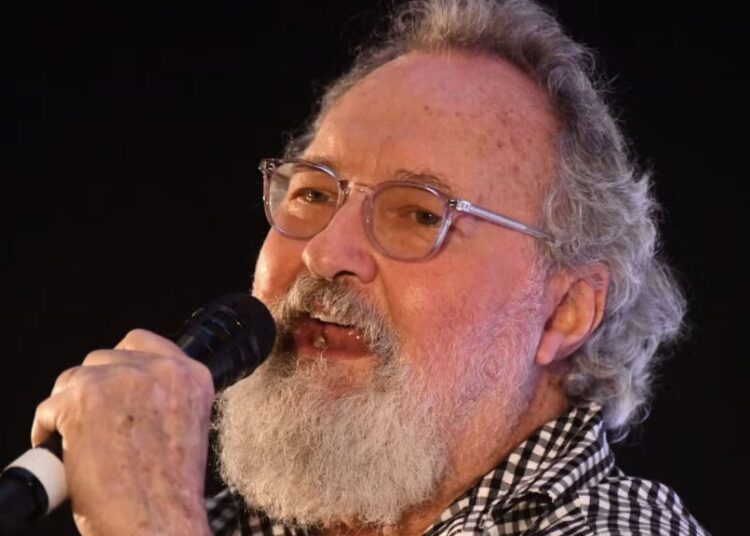
The octogenarian Hall of Famer edged forward in his chair, running on Fanta and popcorn and Swiss chocolate, extending both arms toward the television like a sixth Knicks defender in the closing minutes of his old team’s first N.B.A. finals game in a generation.
“Brunson. Come on. Yeah. Heyyyyyyyyyy!” Bill Bradley shouted at the Knicks star Jalen Brunson, beaming in a blue sweater inside his small Manhattan viewing party as New York retook the lead late in its Game 1 victory over the San Antonio Spurs on Wednesday night. “That’s what you do when you’re a champion.”
He knows something about that.
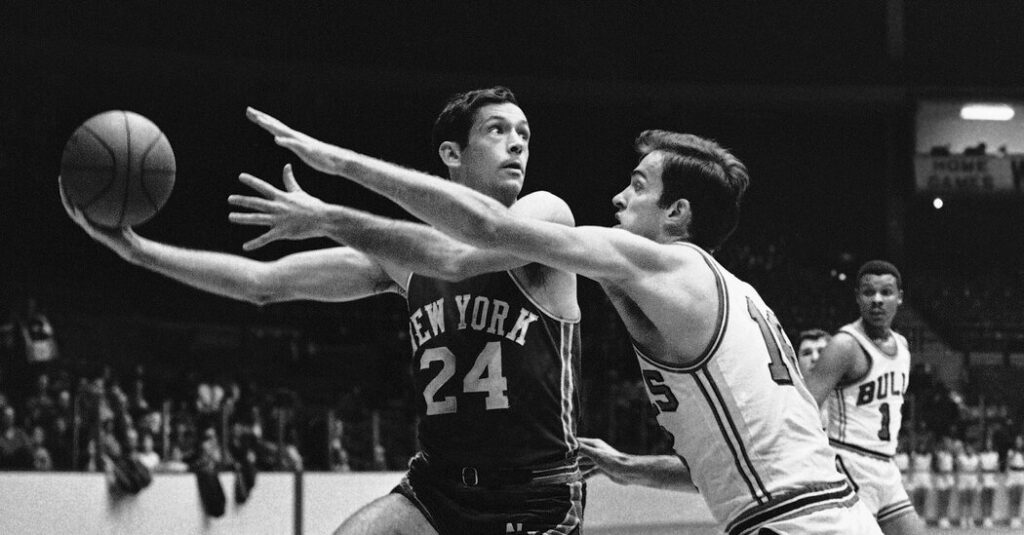
Mr. Bradley, the 82-year-old former United States senator from New Jersey, helped deliver the last Knicks titles in 1970 and 1973, when a three-year drought felt like less of a festering citywide wound.
When this series moves on Monday from San Antonio to Madison Square Garden for Game 3, Mr. Bradley will be there, he said, somewhere beneath his retired No. 24 in the rafters. (The next evening, in this high season of Knicks revelry and reunion, he plans to have dinner with his former teammates Walt Frazier and Earl Monroe, whose numbers hang nearby.)
But with the team in Texas this week, The New York Times asked Mr. Bradley if he would mind some extra company for Game 1, wherever he might be watching. He obliged, asking only that the location of his (very) modest gathering — just Mr. Bradley and his daughter, a finals family tradition — not be disclosed for privacy reasons.
To watch championship basketball with Bill Bradley is to talent-scout at Lincoln Center with Baryshnikov, to hear the whispers of Scorsese at a Sundance screening.
He catches more, overreacts less, processes differently.
“His feet,” Mr. Bradley said of Victor Wembanyama, the 7-foot-4 French game-breaker for the Spurs, whose effortless dunks and boundless shooting range have captivated even casual followers — but whose technical soundness seemed to dazzle this audience. “Watch his feet.”
“See him set up that rhythm?” Mr. Bradley observed later as OG Anunoby of the Knicks sent Mr. Wembanyama off balance with a procession of percussive fakes. “Back, forward, back, forward.”
“Don’t rush,” he said softly, as the Knicks fell behind by double digits in the third quarter. “The key is the flow out of which the shot comes.”
For basketball fans of a certain era and Knicks partisans of all kinds — and Mr. Bradley retains that descriptor, among many others: Rhodes scholar, 2000 Democratic presidential candidate, fierce opponent of a runaway sports betting industry — he remains a figure of outsize fascination.
He was the son of Crystal City, Mo., who became a college prodigy and an international celebrity — the Princeton phenom who taught Sunday school, listened to “The Sound of Music” before games, imagined he was facing Yale to find extra motivation against the Soviet Union in the 1964 Tokyo Olympics. (The Russians called him “Shootnik,” admiringly.)
More than that, Mr. Bradley played a kind of intuitive, egalitarian game that prized ball movement and off-ball movement and selflessness and dwelled little on individual accolades.
“I consciously didn’t do any commercials,” he said on Wednesday after seeing an ad featuring current and former Knicks. “I had this idea that my commitment to the game was a pure commitment, blah blah blah.” (He clarified that he believed unswervingly in that blah blah blah.)
“He dislikes flamboyance,” John McPhee wrote of Mr. Bradley in a famed 1965 New Yorker profile that he expanded into a book, “A Sense of Where You Are.”
What Mr. Bradley likes, still, is kinetic passing, relentless defensive effort, a shared sense of mission.
“Unselfishness, resilience, courage, responsibility,” he said, echoing the themes of one of his books (and sounding almost as if he’d suspend his no-commercials policy to make one for earnest nouns). “I’ve seen enough to know they are a team of character.”
This was one of several flourishes that was perhaps directionally similar but tonally different from the median conversation at rollicking watch parties across the city.
Mr. Bradley registers any small disappointments in moderation. (“Josh,” he said, simply and quietly, as Josh Hart of the Knicks missed an open shot.)
He loves a midrange jumper, devalued in an age of 3-point bombs. (“Eighteen-footers,” he advised as the Knicks trailed.)
He salutes an opponent’s bungled free throw with sarcastic gratitude (“Thank you very much, sir — way to not concentrate”) and second-guesses referees with a senatorial inflection befitting a man who wears khakis and a checkered button-down to cheer his team.
“The person guarding him is fouling him constantly,” he said calmly of a Spurs defender chasing Mr. Brunson around, though he did emit spasms of profanity for particularly egregious officiating.
During breaks, he reminisced about his longtime coach, Red Holzman, and the strategic mind games of Bill Russell, the Celtics great who would later campaign for Mr. Bradley in Iowa and New Hampshire.
“Come on!” Mr. Russell would holler at Mr. Bradley’s defender, according to Mr. Bradley, loudly enough for all parties to hear. “Anybody could stop this rummy.”
Today’s game, trash talk and otherwise, is not quite the same. Mr. Bradley’s N.B.A. had no 3-point line, tighter shorts, a conspicuous dearth of French aliens with eight-foot wingspans.
Mr. Bradley said he had seen only highlights of Mr. Wembanyama before Wednesday. At times, he did not seem entirely sure what he was watching.
“WHAT?” he asked, almost cackling, after Mr. Wembanyama drilled a 3-pointer early in the night.
“Look at that step!” he said later, eyes big and hands at his temples. “Oh my god, that’s an eight-foot step.”
Mr. Bradley was much more composed when the Knicks were wobbling in the second half, proposing a series of achievable-seeming goals:
Play with pace, responsibly. (“Push it, push it.” “Take your time, take your time.”) Shrink the deficit to something manageable — ideally three to five points by the end of the third quarter. (“OK!” he said when the Knicks tied it up by then.)
“Good going, Josh,” he said, reassuringly, as the comeback accelerated.
Clutching the remote, Mr. Bradley rose repeatedly from his chair as Mr. Brunson, who struggled with his shot early and powered stubbornly through apparent knee and ankle injuries like a B-movie boxer, took control of the game in the fourth.
“That’s an announcement!” he said as Mr. Brunson swished a fadeaway. “‘My knee is not that bad.’”
Mr. Bradley said he does not have personal relationships with the current players, but he has admired their postseason, sensing that they understand what it means, as he likes to say, to be “one point on a five-pointed star.”
And isn’t that the fun of all this?
Doesn’t New York itself, he suggested, know its place in that constellation?
“That’s what a team that plays unselfishly and with discipline and with resilience can mean for a city,” Mr. Bradley said, as the sidewalks outside filled with resilient and maybe unselfish and probably slightly undisciplined screamers and dreamers in orange and blue. “They can see themselves.”
Matt Flegenheimer is a correspondent for The Times focusing on in-depth profiles of powerful figures.
The post Resilience, Courage, ‘Blah Blah Blah’: A Legend Cheers His Knicks appeared first on New York Times.