TAIPEI, Taiwan — Chinese authorities have spent decades scrubbing details of the 1989 pro-democracy demonstrations in Tiananmen Square from the country’s memory — most recently deploying artificial intelligence to erase any trace of the massacre from the Chinese internet.
But even within the tightening confines of China’s Great Firewall, some young people are learning details of the events — including the government’s bloody crackdown 37 years ago Thursday — and often in unexpected ways.
In February, when the American figure skater Alysa Liu won Olympic gold medals in Milan, talk circulated in China about her father. Arthur Liu had participated in the Tiananmen Square protests. After the crackdown, he fled to the United States, where Alysa was born in 2005.
When she won the women’s singles and team events, some users on Chinese social media called him a traitor. Others praised him as a single father who had raised a champion.
A poster on the platform RedNote asked why Arthur Liu was so controversial. Anji, a 20-year-old college student from Wuhan, China, who learned about the Tiananmen Square protests from a history teacher, advised users to look up his background.
Within hours, her comment was taken down.
“I initially didn’t think it would be removed, since I didn’t even mention the June Fourth incident directly,” said Anji, who spoke on the condition that she be identified only by her nickname for fear of government reprisal.
On Threads, the social media platform linked to Instagram, a Chinese user read about Arthur Liu and began researching. “All I can say is that I was stunned,” they wrote. “I had no idea there were protests on such a massive scale.”
Analysts say overly zealous censorship of the events of Tiananmen Square has on occasion stirred greater curiosity about what happened.
Liu Lipeng, a former censor for the Chinese social media giant Weibo who now tracks censored information as an analyst for the California-based news site China Digital Times, said Beijing “has already pushed technology-driven surveillance to its limits.”
Past this point, Liu said, “its effectiveness actually starts to decline.”
Inadvertent disclosures about Tiananmen often come through entertainment content, said Margaret Roberts, a political scientist at the University of California at San Diego.
China is remarkable, Roberts said, in that it interacts with the world and has high rates of internet use but “still maintains a highly sophisticated system of information control that significantly shapes how ordinary citizens consume information.”
But “when political information and entertainment are paired,” she said, “this is particularly dangerous and difficult for governments that are trying to censor.”
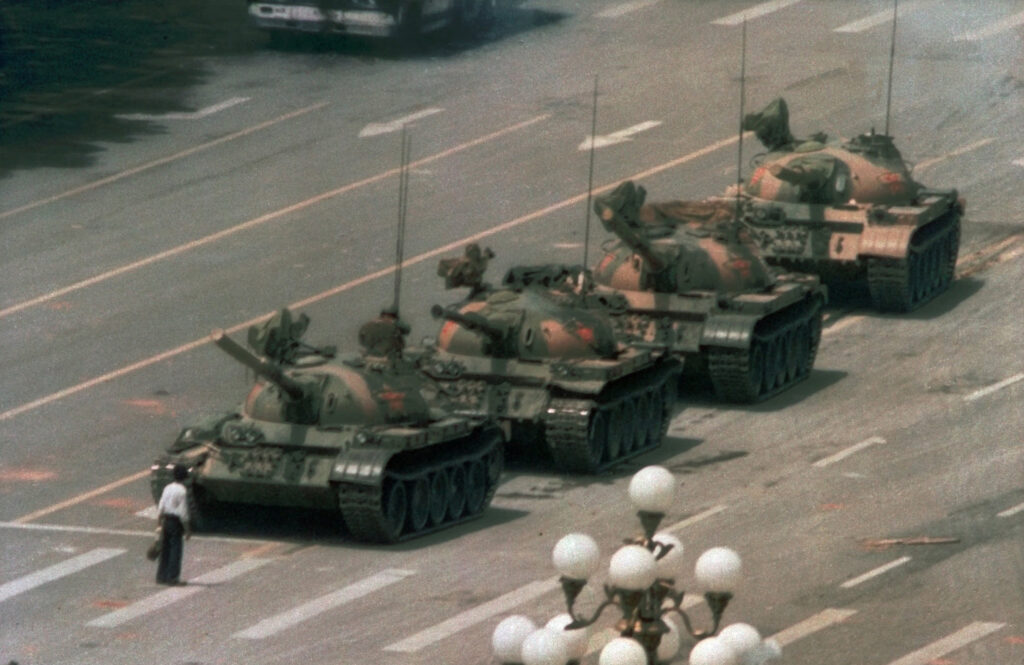
In April 1989, students with a range of grievances against China’s communist government launched pro-democracy demonstrations in Beijing’s central Tiananmen Square. On the night of June 3, authorities sent in the military. Soldiers opened fire; tanks rolled over people. By the next day, the protest was over.
The number of people killed is unknown. The official total, reported that month, was 241, including 218 civilians, 13 police officers and 10 soldiers. Rights activists and scholars have said the actual count could be in the thousands.
Since then, the Chinese government has sought to erase that history. It’s largely absent from classrooms. If it’s taught at all, it’s explained as “political turmoil” provoked by anti-communist forces and Western governments.
Words and images that might relate to the protests and crackdown are filtered and removed from the Chinese internet. Similar red lines now govern the large-language models developed by Chinese AI companies such as DeepSeek, which according to China’s cyberspace administration must not violate “core socialist values.”
When prompted with queries about the events at Tiananmen Square, DeepSeek reportedly has replied that the topic is “beyond current scope.”
Hong Kong once served as a safe zone for discussing the events publicly. But the national security law imposed in 2020 to break the city’s pro-democracy movement has made such talk virtually impossible.
A museum dedicated to commemorating June 4 was shut down, and the annual vigil once held in Victoria Park around the anniversary has been replaced by a “Patriotic Hometown Market.”
Rowena He, a historian and research fellow at the Hoover Institution, said that when she has taught about the Tiananmen Square massacre in the U.S. and Hong Kong, Chinese students have accused her of colluding with Western governments.
“When students are taught that human lives can be sacrificed for economic growth and China’s rise,” she said, “public opinion, especially among Chinese youths, becomes distorted by values fundamentally at odds with the democratic world.”
Given the censors’ success at burying the history, those people who uncover it themselves are often horrified.
A teenage student in Zhejiang province was watching Li Jiaqi live-stream on June 3, 2022, when the influencer showed off an ice-cream cake in the shape of a tank. The show was abruptly cut off.
The student, now 18, was bewildered. She worked her way around the firewall to figure out what had happened.
“When I tore open the truth, what I saw was not only the blood and tears of history, but also the collapse of the worldview I had held for more than a decade,” she told The Washington Post. She spoke on the condition of anonymity for fear of retribution.
She now wants to leave China.
Molly learned about Tiananmen Square in high school. A history teacher shut the doors of their classroom before sharing details. Many of the students were hearing about it for the first time.
Molly, now 25, is glad to see other young people learning about the events through Alysa Liu.
“I’m not sure what reaction this kind of accidental exposure to history will produce,” she said. “Will they stick to their existing views or have their perspectives changed? But either way, I think this is a very unexpected and clever entry point.”
The post Despite censorship, young Chinese are learning the truth about Tiananmen Square appeared first on Washington Post.