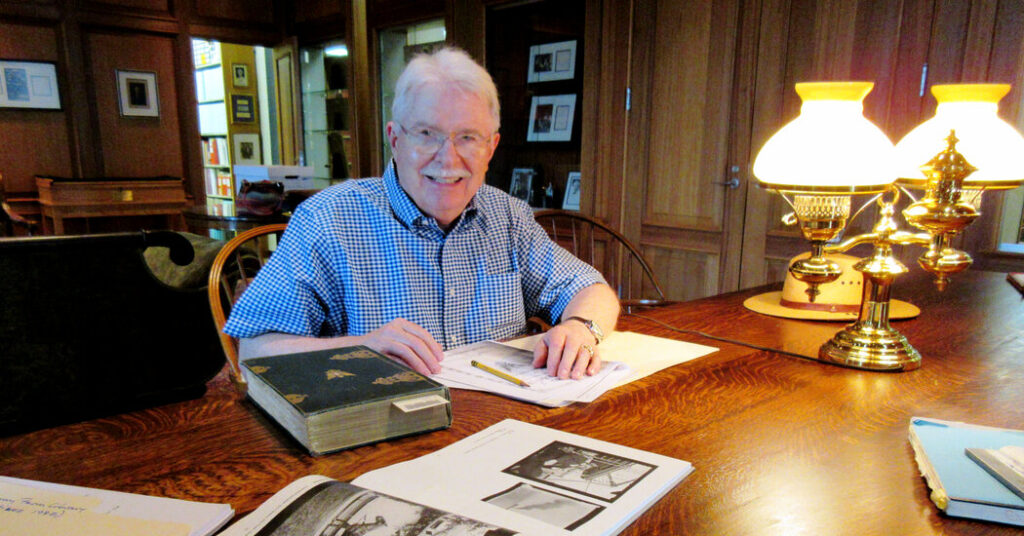
Alan Gribben, a Mark Twain scholar who replaced a racial slur with the word “slave” in revised editions of “The Adventures of Tom Sawyer” and “Adventures of Huckleberry Finn,” igniting an international furor about sanitizing works of literature, died on May 9 at his home in Montgomery, Ala. He was 84.
The cause was pancreatic cancer, his wife, Irene Wong, said.
Renowned by Twain biographers for his decades-long effort to catalog everything that Mr. Twain had read and scribbled notes on, Professor Gribben became an academic outcast in 2011 almost immediately after Publishers Weekly reported on his plan to excise the slur “nigger” from forthcoming editions of the author’s most famous novels.
Professor Gribben, the editor of the Mark Twain Journal and a professor of English at Auburn University at Montgomery, in Alabama, wanted to provide an alternative to schools that had stopped teaching the original texts because of the slur, which appears more than 200 times in “Huck Finn.”
In response, the literary establishment shrieked like the whistle on a steamboat chugging down the Mississippi River.
Michiko Kakutani, the chief book critic of The New York Times, wrote that Mr. Gribben’s effort “ratifies the narcissistic contemporary belief that art should be inoffensive and accessible; that books, plays and poetry from other times and places should somehow be made to conform to today’s democratic ideals.”
Appearing on “60 Minutes,” David Bradley, a professor of creative writing at the University of Oregon, said that using “slave” instead of the slur prevented a teachable moment about how the word degraded Black people and made slavery conceivable in the first place.
“That teachable moment is when that word hits the table in a classroom, everybody goes, ‘Wooh,’” Professor Bradley said. “OK, let’s talk about it. Let’s talk about where it came from.”
Professor Gribben mounted a vigorous defense. Writing in Publishers Weekly, he traced the idea to his time on a lecture series about Mr. Twain’s books. After the events, educators would complain to him about being unable to teach “Tom Sawyer” or “Huck Finn.”
“My aim,” he wrote, “became the rescue of these two novels for students, parents and teachers who have found the works, merely owing to one repugnant racial slur, disturbing to read in our integrated public schools.”
NewSouth Books, an independent publisher, issued the revised novels in 2011. Within five years, more than 20,000 copies had been sold.
Last year, in collaboration with Ms. Wong, Professor Gribben revised both books again, going beyond cutting the slur to render some of the dialect in more contemporary vernacular.
For instance, in Chapter 8 of the original “Huckleberry Finn,” Huck’s friend, Jim, who is Black, says:
The new version reads:
To Professor Gribben, these changes — small to him, blasphemy to his critics — were preferable to having Mr. Twain’s books disappear altogether.
“If Twain is no longer read and taught in the schools and colleges, his literary reputation is apt to fade rapidly,” he wrote last year in the Mark Twain Journal. “The generation that follows this present one may find themselves asking, ‘Who exactly is this Mark Twain?’”
Alan Dale Gribben was born on Nov. 21, 1941, in Parsons, Kan. His parents, John S. Gribben and Ruth (North) Gribben, founded Sun Graphics, a printing company.
His scholarly life began in second grade when he was bedridden with rheumatic fever. His mother, he wrote in an unpublished essay, “took my long recuperation as an opportunity to improve my reading skills and brought me armloads of books from the public library.”
At the University of Kansas, he majored in English and became active in the civil rights movement, leading a campaign to integrate sorority and fraternity houses. After graduating in 1964, he earned a master’s degree at the University of Oregon in 1966.
He moved west for doctorate studies at the University of California, Berkeley, home to the Mark Twain Papers and Project. The project’s editor hired him as a graduate assistant and tasked him with preparing explanatory notes for Mr. Twain’s handwritten notebooks.
He was fascinated by Mr. Twain, especially the mystery surrounding the author’s literary influences. Before Mr. Twain died in 1910, he gave away most of his books, scattering evidence that would have undoubtedly upended his carefully cultivated image as an uneducated “littery man,” as he once joked.
For his dissertation, Mr. Gribben set off on what would become a lifelong quest to find and document every book that Mr. Twain had owned. Driving cross-country in his blue Volkswagen Beetle, he visited libraries, rare book collectors and Mr. Twain’s distant relatives.
In Wisconsin, he got a tip that Mr. Twain’s former housekeeper had kept a cache of 90 books from the author’s library. Before she died, she had given them to her nephew, who had since also died. Mr. Gribben found the nephew’s widow and knocked on her door.
Talking to her, he noticed several sacks of books on her porch that she was donating to charity. He took out one of the books and immediately recognized Mr. Twain’s handwriting in the margins. Flabbergasted, he arranged for the books to be donated to Elmira College, home of the Center for Mark Twain Studies.
“What are the odds that I would arrive on that day?” he later marveled. “What are the odds that she would have put these out that day and that would be the day I came? I am probably the only person in the world who could recognize his handwriting.”
The culmination of Professor Gribben’s lifelong project — “Mark Twain’s Literary Resources” — was published in two volumes, in 2019 and 2022, totaling 1,379 pages. In them, he documented nearly 6,000 books, magazines and other materials that Mr. Twain had read. The subjects included sea voyages, French history, hymns, botany, slavery, detective fiction, insects, India, astronomy, birds, bees and the afterlife.
“What Alan did, it’s like discovering a new planet, because Twain’s universe was revealed,” Joe B. Fulton, a Twain scholar and professor of English at Baylor University, said in an interview. “I don’t think anyone else could have done it. He is in the foremost rank of Twain scholars that we have ever seen.”
Professor Gribben married Ms. Wong, a frequent collaborator, in 1974. In addition to her, he is survived by their children, Walter and Valerie Gribben; a brother, John C. Gribben; and two grandsons.
Eventually, Professor Gribben began flying rather than driving in search of Mr. Twain’s books. Still, he felt trapped by time.
“My brain lives more in the 19th century,” he said. “I am traveling by jet, but my brain is traveling by horse and carriage and stagecoach.”
During the racial slur controversy, Professor Gribben recalled a scene from Mr. Twain’s travel book “Roughing It,” in which the author described his campfire igniting a blaze on the shore of Lake Tahoe.
“Unable to put it out,” Professor Gribben wrote in Publishers Weekly, Mr. Twain “decided that his only recourse was to row his boat into the lake and watch with rapt awe the magnitude of the immense conflagration he had unintentionally sparked.”
The post Alan Gribben, Twain Scholar Who Excised Slur From ‘Huck Finn,’ Dies at 84 appeared first on New York Times.