Timothy Chu is a research fellow at the Hoover Institution’s Bio-Strategies and Leadership Initiative, where Drew Endy is the director.
President Donald Trump has described his Uncle John Trump, who died in 1985, as “a great, brilliant, genius” and “a super genius.” Some may suspect the president is exaggerating. In this case, his description of the electrical engineer and professor may be understated.
For example, two days before D-Day, John Trump was standing on an English cliff facing Normandy, fine-tuning a radar that was part of an extraordinary system for guiding the boats and planes that would soon carry Allied soldiers across the water toward the enemy coast. Two days before this year’s D-Day anniversary, understanding John Trump’s contributions has become more important than ever.
John, the younger brother of the president’s father, Fred, played a crucial role in the development of radar for D-Day and World War II. Radar was hailed as “second only to the atomic bomb” in winning the war. Later, he contributed to the success of the U.S. space program and pioneered methods relevant to semiconductor manufacturing. The longtime professor at the Massachusetts Institute of Technology was honored by King George VI and President Harry S. Truman for his war work, and was awarded the National Medal of Science by President Ronald Reagan.
Trump’s wartime work was set in motion by a 1940 mission authorized by British Prime Minister Winston Churchill, who desperately sought America’s help after Adolf Hitler defeated France. Churchill’s secret mission delivered a crucial radar component — the “cavity magnetron,” a palm-size device that generated microwaves powerful enough for airborne radar — to America. Doing so helped kick-start radar work in the United States and supercharged collaboration between the two nations on critical science and technology. Trump then helped organize America’s most innovative radar lab at MIT to make such improvements real and secure Allied air power.
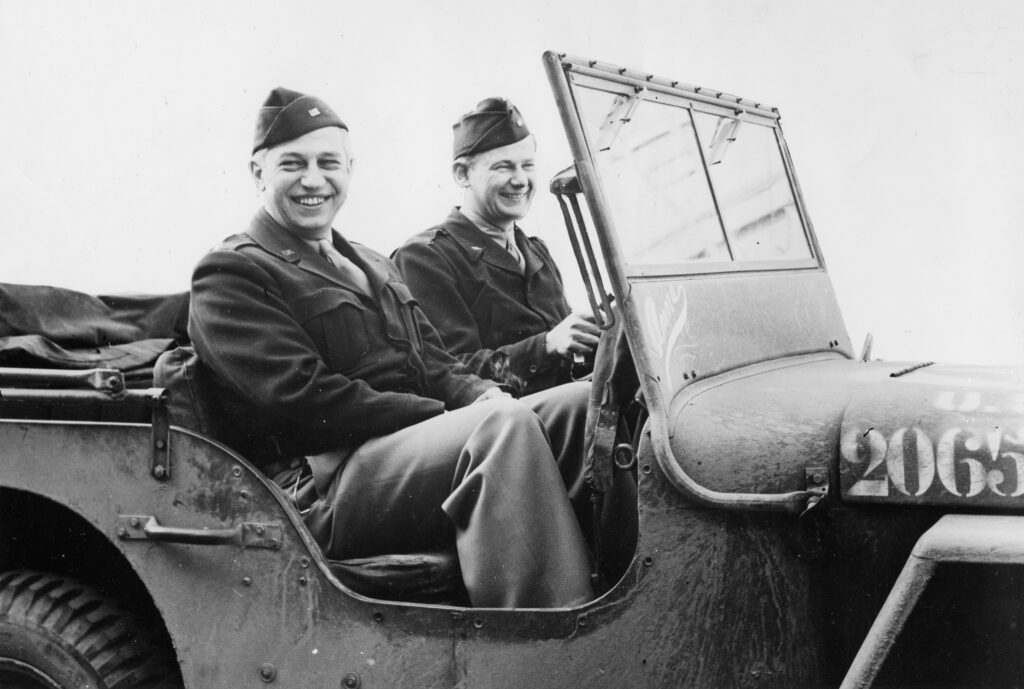
By the time D-Day neared in 1944, Trump directed a secret field lab in England, where he listened and worked closely with America’s troops to prepare MIT radar for battle. American bombers using the radar developed at MIT were able to “see” through clouds and destroy German oil and aircraft factories, helping secure air supremacy by the time Gen. Dwight D. Eisenhower’s invasion force reached the Normandy beaches. Radar also made possible one of the largest successful paratrooper drops in history during D-Day, when planes guided by radar deployed a 23,000-strong force behind enemy lines.
“If I didn’t have air supremacy,” Eisenhower declared afterward in Normandy, “I wouldn’t be here.” As the war in Europe raged, Eisenhower’s top air general said the radar field lab directed by Trump was “one of the most important factors” in America’s air success.
A week after D-Day, a vengeful Hitler unleashed his secret weapon against Britain: the world’s first cruise missiles, known as the V-1. The MIT lab’s radar system — the SCR-584 — was ready, detecting V-1s as they crossed the English Channel and helping guide interceptor planes and antiaircraft batteries.
Writing in his diary on July 19, 1944, Trump described having lunch with King George VI and Queen Elizabeth, where the king “asked a number of questions about radar work in the United States.” Churchill later wrote that “the V-1 had been mastered” by the new radar from the U.S.
MIT radar was also deployed in the Pacific theater, most notably in 1945 on the Enola Gay, in its mission to deliver the atomic bombs that helped bring an end to the war with Japan. Gen. George S. Patton, after a 1945 meeting with Trump to discuss science in war, said, “This is the way wars not only can but must be run from now on.”
After the war, the space race kicked off. In 1962, the U.S. carried out a high-altitude nuclear test, Starfish Prime, which produced fallout and destroyed satellites. NASA feared the resulting radiation could endanger or kill astronauts. Trump was consulted and provided calculations reassuring NASA that continuing crewed spaceflight would be safe between tests. The U.S. space program could proceed at full speed.
John Trump also co-founded one of America’s first venture-backed companies, which developed cancer treatments and advanced a commercial method for turning raw silicon into a semiconductor — a breakthrough for the computer industry.
Today, America is again navigating global competition, technological disruption and the need for scientific moon shots. John Trump navigated all three — and won. Americans would do well to follow the example of a “super genius” electrical engineer. When Americans listen to each other and work together, as John Trump did with soldiers, scientists and generals before D-Day, we can reach the greatest heights.
The post Trump says his uncle was a ‘super genius.’ D-Day proves his point. appeared first on Washington Post.