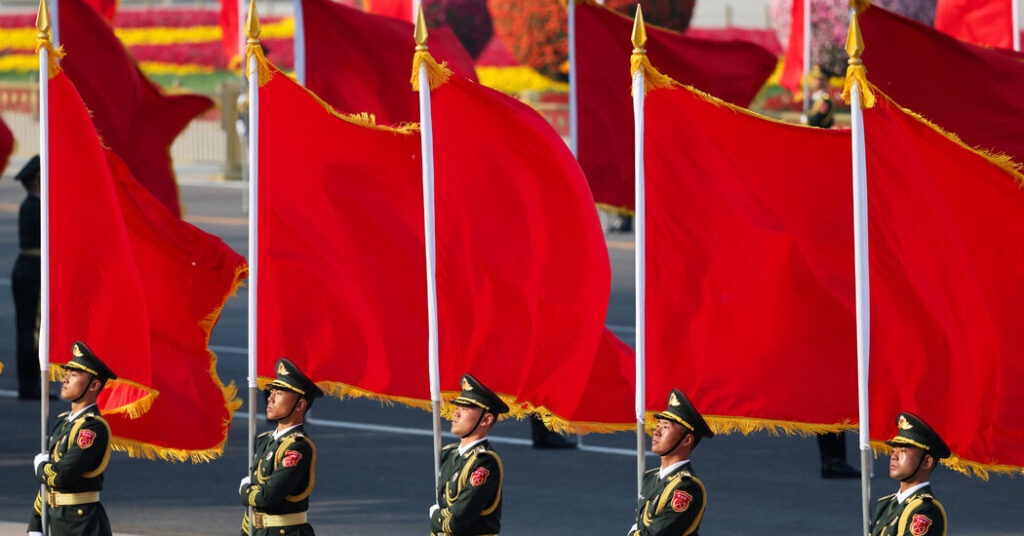
Jensen Huang, Nvidia’s chief executive, has said China’s military doesn’t rely on chips from his California-based company. But an analysis of six years of Chinese records shows that China’s military has been openly seeking Nvidia’s artificial intelligence chips since 2019.
Chinese records reviewed by Wirescreen, a software platform that provides information about Chinese companies, showed that the People’s Liberation Army has stepped up its efforts to acquire artificial intelligence chips, even after the U.S. government restricted semiconductor sales to foreign adversaries including China.
The records document instances when suppliers agreed to deliver those chips under the military’s terms, but they do not document the final delivery. Nevertheless, John Costello, the Wirescreen analyst who wrote the report, said the data showed “directly and irrefutably” that U.S. technology was equipping the Chinese military.
“What number of advanced Nvidia chips in P.L.A. hands does the company consider acceptable?” he asked.
The report draws on a larger pool of data than previously examined and shows how China adapted to and tried to circumvent U.S. technology restrictions in recent years.
Wirescreen examined 3,800 procurement records related to high-end chips and computing. It discovered more than 500 instances when various units of the Chinese military sought Nvidia chips either by name or technical specification.
The technology was sought by nearly every branch of the Chinese military, including units that work on nuclear explosive simulations, carry out offensive cyberattacks and plan war games.
The report was shared with the Trump administration and Congress, which are debating the future of Nvidia sales to China. In December, President Trump, who has become a close ally of Mr. Huang, approved the sale of Nvidia’s second-best chip to China, while demanding a cut of that revenue for the government. But Republican lawmakers who worry that advanced chips could help China’s military have introduced legislation that would strip the White House of sole responsibility for A.I. chip exports.
Mr. Huang has fought chip restrictions and urged lawmakers to allow Nvidia to sell to China. He has said that blocking Nvidia from China, the world’s largest semiconductor market, would surrender the market to rival Chinese products that can now do much of what Nvidia chips do. He has also dismissed worries about China’s military use of the chips as overblown.
Advanced A.I. systems typically run on networks of 100,000 chips or more, said John Rizzo, a spokesman for Nvidia. In the Wirescreen analysis, the numbers of chips requested by the Chinese military fell considerably short of that, which suggests Beijing is relying at least somewhat on domestic chip makers like Huawei as the country seeks to be technologically self-reliant.
Procurement documents have also shown the Chinese military specifically seeking out Huawei chips, as Chinese technology improves, Mr. Rizzo said. He called the idea that China’s military was relying on a small number of Nvidia chips “silly” and “untrue.”
“China has more than enough domestic chips for all of its military applications, with millions to spare,” Mr. Rizzo said in a statement. “Just like it would be nonsensical for the American military to use Chinese technology, it makes no sense for the Chinese military to depend on American technology.”
But public tender documents stretching from 2019 to 2025 show that the Chinese military continued to seek out Nvidia chips for more advanced computing applications. They include Nvidia’s A100, A800, H100 and H800 chips, both before and after those chips were controlled by the U.S. government.
Administration officials and congressional staff were briefed last week on the report’s findings.
Representative John Moolenaar of Michigan, the Republican chairman of the House Select Committee on the Chinese Communist Party, said the report showed how China was trying “to smuggle and steal American technology for military purposes.”
Mr. Moolenaar, who recently introduced a bill to restrict China’s access to American technology, said this was why the United States needed export controls “to protect our advantage in the A.I. race and make sure we are not arming China.”
Congress is weighing several rules that would restrict the foreign sale of advanced technology. One introduced last year, the A.I. OVERWATCH Act, would require the Commerce Department to certify that A.I. chips would not be used to help adversaries’ militaries and would give Congress the power to block chip exports.
In January, the House Foreign Affairs Committee advanced the bill in a 42-to-2 vote. It still needs to clear the full House and Senate, and it’s not clear whether the president would sign it.
Industry experts and government officials have debated whether U.S. technology controls have held back China’s technological progress or are backfiring by encouraging the Chinese government to develop domestic alternatives.
Trump officials rolled back global restrictions on Nvidia chip sales issued at the end of the Biden administration, saying they were stifling U.S. technology firms. But the move made it possible for subsidiaries of Chinese companies located outside of China to legally purchase Nvidia’s most advanced chips, said Chris McGuire, a former State Department official.
On Sunday, the Trump administration issued a clarification of its rules saying that companies needed to obtain a license from the U.S. government to sell controlled chips to Chinese companies anywhere in the world.
China has also continued to develop its domestic technology. Last week, Huawei unveiled a breakthrough in its chip development that it said would allow it to make cutting-edge chips within five years. The company is expected to make millions of chips this year, according to SemiAnalysis, a semiconductor research firm.
China has regulations that encourage its military to use home-grown technology products. Procurement records show that the military has awarded contracts to Chinese companies that rely on Huawei’s A.I. chips, which were a key selling point, according to an analysis by the Jamestown Foundation, a policy group focused on China.
Mr. Costello said Wirescreen’s analysis showed that U.S. restrictions had slowed China’s technology purchases, though the military ultimately developed strategies to bypass them.
“It introduces a lot of friction, makes them compromise, slows them down,” he said.
For example, he said, the Jiangnan Institute of Computing Technology, one of the principal research institutes of China’s Cyberspace Force, appeared to have more trouble obtaining chips after the United States imposed export controls in 2022 and 2023. Some bids that the institute put out for American A.I. technology were not completed, and the group had to relist them in another form.
China’s Cyberspace Force, which is responsible for cyberwarfare, reconnaissance and domestic surveillance, was the largest single buyer among China’s military service branches of American A.I. technology in the documents, and the Jiangnan Institute was added to a trade blacklist in 2019 for developing supercomputers for the Chinese military.
The Chinese military and firms associated with it adapted to the U.S. export controls by finding new ways to acquire the technology, Mr. Costello said. The military reduced some of its technical requirements and used new channels to obtain chips that obfuscated its role. That included bringing in new types of companies to buy the chips, which ranged from established technology firms to shell companies. It took the military about a year to adapt, Mr. Costello said.
A spokesperson for the Chinese Embassy said China had consistently advocated cooperation with the United States and opposed the weaponization of technological and economic issues.
The procurement records provided some clues as to how Nvidia’s technology was used. In January 2024, a Beijing-based division of the military’s cybersecurity unit sought four A.I. servers equipped with Nvidia’s A100 chips. It specified that the equipment needed to support a tool called hashcat, which is used for password cracking.
Mr. Costello said a military unit using A.I. servers to run hashcat software would most likely be using the chips to make it easier to break into password-protected accounts, including potentially training an A.I. system to do hacking.
It’s not clear if some military entities may have been acquiring Nvidia chips to try to break them down and understand their vulnerabilities or to replicate the technology.
The report also documents that research institutes linked to the Chinese military increasingly gained remote access to chips by renting them from commercial data centers.
The Wirescreen research builds on an earlier analysis that found that China’s military was buying American chips to support its push into A.I.
Senator Jim Banks, a Republican from Indiana who is supporting the A.I. OVERWATCH Act, called the Chinese military’s access to U.S. chips a “national security crisis.”
“China is doing everything it can to weaponize A.I. against the U.S. military,” he said. “Giving them access to America’s best A.I. chips will only quicken their efforts.”
Ana Swanson covers trade and international economics for The Times and is based in Washington. She has been a journalist for more than a decade.
The post Chinese Military Sought Nvidia Chips for Years, Report Says appeared first on New York Times.