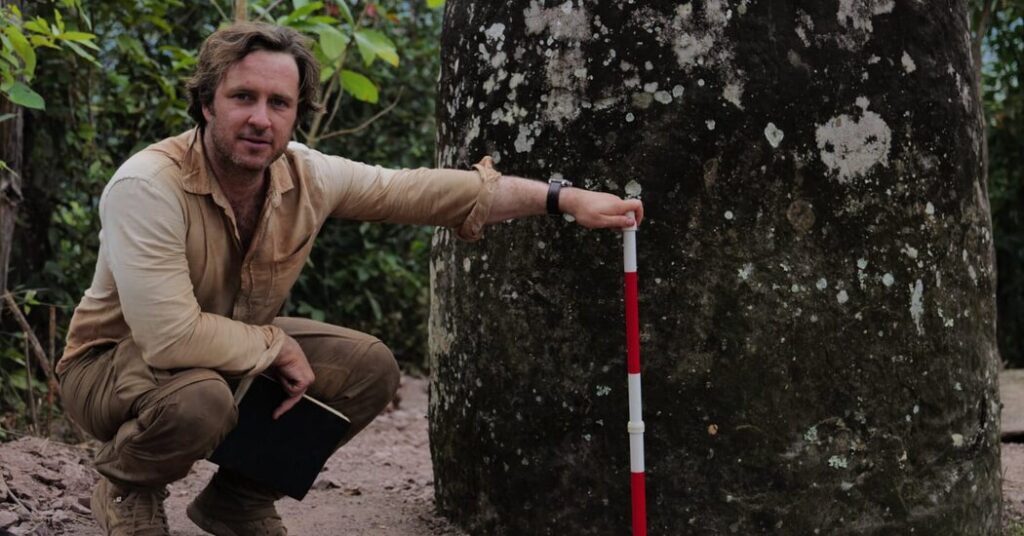
For nearly a century, thousands of massive stone urns scattered across north-central Laos have stood as one of archaeology’s most baffling enigmas. Local folklore said ancient giants had carved the hollowed-out megaliths to brew celebratory rice wine.
But scientists have long suspected a far more solemn purpose: interment of the dead. Now, a study published in the journal Antiquity offers compelling evidence to prove the scientists right.
In the winter of 2022, on the windswept Xieng Khouang Plateau, in an area aptly named the Plain of Jars, the study’s authors became intrigued by a peculiar, squat structure, roughly four feet tall and eight feet wide. They paused to investigate the landmark, which they had walked past countless times.
Looking closely at the stone vessel, they decided to excavate the sediment that had accumulated within its cavity.
“The jar looked a bit like a giant stone cauldron that had collapsed in on itself,” said Nicholas Skopal, an archaeologist at James Cook University in Australia and the lead author of the new paper.
What he and his team found inside ultimately shattered the wine-vat myth and redefined our understanding of early Southeast Asian history. Rather than holding liquid, the vessel they named Jar 1 was essentially a multigenerational crypt packed with the jumbled, disarticulated remains of at least 37 people.
The explorers were caught off guard. “Honestly, it was one of those rare excavation moments where everyone becomes very quiet,” Dr. Skopal said. “We expected archaeology, but not such a dense, intact concentration of body parts.”
Far from a chaotic tangle of bones, the burial site revealed an artfully arranged communal tomb that required careful planning and curation. To maximize the limited capacity of the chamber, the space had been meticulously organized.
Skulls were neatly stacked around the jar’s rim, while the longer thigh bones were laid across the edges. To Dr. Skopal, the tidy, space-saving layout of artifacts pointed to a tomb for an entire family, lineage or close-knit community. “Essentially, it was an ossuary,” he said.
Uncovering the Death Jar
The deceased, whose bones ranged from those of infants to adults, were probably placed into what the scientists call the “death jar” long after their demise.
Researchers believe these Indigenous peoples practiced secondary burial, a ritual in which bodies were first allowed to decompose elsewhere — among other things, by temporary entombment, exposure or smoke-drying — before the bare bones were gathered together and interred collectively, a widespread practice throughout the period in Southeast Asia.
Dr. Skopal suggested that these communities may have used smaller stone vessels nearby for the initial decomposition phase, allowing the flesh to break down before the remains were relocated and permanently laid to rest in the larger jar.
French archaeologist Madeleine Colani introduced the Plain of Jars to the contemporary world in the mid-1930s. Digging inside a limestone cave near one site, she found ash, charcoal and burnt teeth and bone fragments.
She deduced that the cave had functioned as a crematory and hypothesized that the jars were funerary urns designed to hold incinerated human remains. But she found very few organic materials inside the jars themselves.
Dr. Colani dated the basins to the area’s much older Iron Age (500 B.C. to A.D. 500). But radiocarbon testing of Jar 1 showed that it had served as a shared burial center for roughly 270 years, from the ninth to the 12th centuries, just as medieval Asia was undergoing sweeping transformations.
Over the course of three field research seasons, the team led by Dr. Skopal and Souliya Bounxayhip, an archaeologist with the Lao Department of Heritage, uncovered a surprising stash of iron tools, earthenware, stone slabs, a copper-based bell and glass beads.
Chemical analysis revealed that the exotic baubles had traveled from places as distant as Mesopotamia and South India, proving that this wide, upland plateau was far from isolated. As it turned out, the Plain of Jars was a bustling hub of global commerce.
Through quiet, steady exchange, the mountain-dwellers of the region had bridged vast empires, tethering themselves to the wealth of China’s Song dynasty and the vibrant Pagan kingdom in modern-day Myanmar.
One Mystery Leads to Another
While the trailblazing Jar 1 was sculpted from coarse-grained, sedimentary rock, ancient artisans mostly relied on readily available sandstone. The geographical sprawl of the crocks is a puzzle of staggering irregularity: Some stand rigidly at attention across jagged ridges, while others rest flush against sloping mountainsides.
“Larger jars may have had greater social or ritual importance,” Dr. Skopal said, “but we cannot yet say that size equals status.”
Whether this scattershot architectural approach indicated shifting cultural rituals, evolving community traditions or the diverse tastes of distinct social classes remains an open question, though it underscores that this was one of antiquity’s more resilient and resourceful societies.
How had residents found the jars, given how many there are? “The urns were not invisible objects; they were monumental anchors in the landscape,” Dr. Skopal said.
Yet trying to understand the full scope of this civilization remains a daunting task, as countless more relics presumably sit untouched and entirely concealed across the sprawling Laotian highlands. The dense overgrowth remains heavily littered today with live, unexploded bombs, grenades and mortar shells left over from the Vietnam War.
Until now, the purpose of the urns has been the subject of academic guesswork. Nigel Chang, another archaeologist at James Cook University, who specializes in Southeast Asian prehistory, said the unearthing of Jar 1 offers “the most concrete, irrefutable evidence yet of how the vessels actually functioned in ancient mortuary practices.” He describes the finding as “incredibly consequential.”
While the discovery helps clear up one mystery, it fuels a multitude of new ones. Scholars are left with questions regarding who the plateau people were, how they lived and what caused their demise.
The post Giant Stone Urns Hint at the Death Rites of a Lost People in Laos appeared first on New York Times.