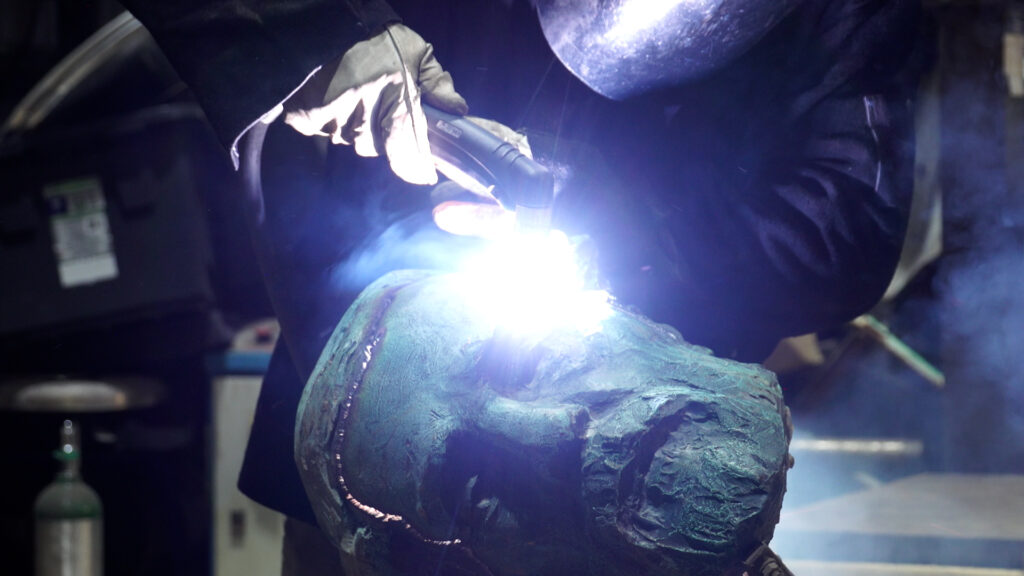
CHARLOTTESVILLE — After white supremacists staged a violent rally around a monument to Confederate Gen. Robert E. Lee in 2017, the city took down the statue and community organizers melted it to ensure it would never rise again. Then they faced a dilemma.
What next?
“If we simply remove the statue and move on, we have not reckoned with anything,” former Charlottesville City Council member Leah Puryear said at a gathering here in March.
The answer has been several years in the making, but a community group is wrapping up a competition to design public art from that raw bronze. The goal: fashion something unifying out of something that caused division for nearly a century.
Cities and counties around the South have wrestled with their Confederate iconography in the wake of both Charlottesville’s Unite the Right rally and the murder of George Floyd by Minneapolis police in 2020. Richmond hauled an army of bronze Confederates to a water treatment plant before loaning severalto museums in California. In North Carolina, several towns shipped their monuments to a new Valor Memorial Parkon private land.
But few localities have gone as far as Charlottesville, where all that remains of Lee is a pile of bronze ingots. Nearly three dozen artists and design firms submitted ideas for reusing that bronze, and the Swords into Plowshares nonprofit has winnowed the group down to three finalists.
“This is not, as some of our detractors say, an attempt to erase history, but rather to kind of tell a fuller version of it by using the materials from the past that have caused a lot of pain,” said Jalane Schmidt, a University of Virginia religious studies professor and co-founder of Swords into Plowshares.
The group faced threats and a lawsuit over its plan to melt the nearly century-old statue of Lee, and had to carry out the job in secret in 2023 out of security concerns. But Schmidt said she is relieved they acted when they did now that President Donald Trump is leading a call to restore Confederate names and iconography in public spaces, such as a memorial he wants erected again in Arlington National Cemetery.
The organizers are aiming for something more complex than simply another statue. They hope to capture the essence of the community and, ultimately, help heal the wounds of history — all in the shadow of Thomas Jefferson’s home at Monticello and his beloved University of Virginia, sites that embody an American legacy of freedom founded on the backs of the enslaved.
“This is an act of reclamation,” said Andrea Douglas, executive director of the Jefferson School African American Heritage Center. “We don’t do this stuff out of vengeance. We do it out of love.”
Volunteers have been collecting oral histories of local residents and researching the origins of Charlottesville’s public spaces to shape the project. The city’s public parks — originally eight for White people and one for Black people — were established about a century ago by philanthropist Paul Goodloe McIntire, who bought the land from former slaveholding plantations. McIntire also commissioned the city’s Confederate statues.
The images of Nazi sympathizers marching around statues of Lee and Gen. Stonewall Jackson during Unite the Right and the death of counterprotester Heather Heyer thrust Charlottesville into a national debate about race and history that remains intense. Trump has fanned the flames since his first term, when he notoriously said there were “very fine people on both sides” of the white nationalist event in Charlottesville.
Such events should inform the creation of the new memorial, Douglas said. “What does it mean to create a site of memory?” she said, mentioning the stumbling stones of Berlin that commemorate places where Jewish people lived and worked before being rounded up and killed during the Holocaust. “You want something to mark that trauma so that people know these are not our values,” she said.
The public can view the proposals at the Jefferson School or on the Swords into Plowshares website, with a winner expected to be announced June 10, the five-year anniversary of the statue’s removal. These are the three finalists for the project, all using bronze from the melted statue:
* MASS Design Group, an architecture nonprofit based in Boston, has proposed an installation it calls “Rooted” in partnership with sculptor Dana King. The design would be based on the African baobab tree, symbolizing wisdom and connection, with seven bronze figures reaching skyward that simultaneously resemble parts of the tree and human figures. Giant sculpted baobab seeds would be placed at other parks and intersections around the city to emphasize connection and “extend the welcoming spirit of the mother tree,” according to the proposal.
* Hood Design Studio of Oakland, California, calls its proposal “Ringing and Shouting,” after African traditions of storytelling. The memorial would feature a giant spiral of stainless steel — inlaid with bronze — encircling a tree. Gradually, in the months after installation, interlocking parts of the spiral would be removed and relocated to encircle particular trees in various parts of the city. The individual rings would be engraved with words and images related to the time period in which each tree was planted. One of these witness trees, for example, is a willow oak located at Monticello that was planted in 1807. Each tree and its ring will become “a circular beacon and site for gathering, remembrance, and activation,” the proposal says.
* PUSH Studio of Washington, D.C., proposes a “Land Forge” project with installations at six city parks and tailored to their history. Two parks would feature 25-foot-tall towers made from rammed earth and bronze that stand like open-sided cones. The height echoes the size of the Lee statue. Four other sites would feature 6-foot-tall pillars constructed of layers of earth and bronze, and all the structures would include granite from the base of the Confederate statue. The process is intended to transform “spaces once overshadowed by monuments to white supremacy into counter-narratives of justice, dignity, and belonging,” according to the proposal.
The post See what artists want to do with Charlottesville’s melted Confederate statue appeared first on Washington Post.