Inside the packed school gymnasium in Whitehorse, nobody made a sound.
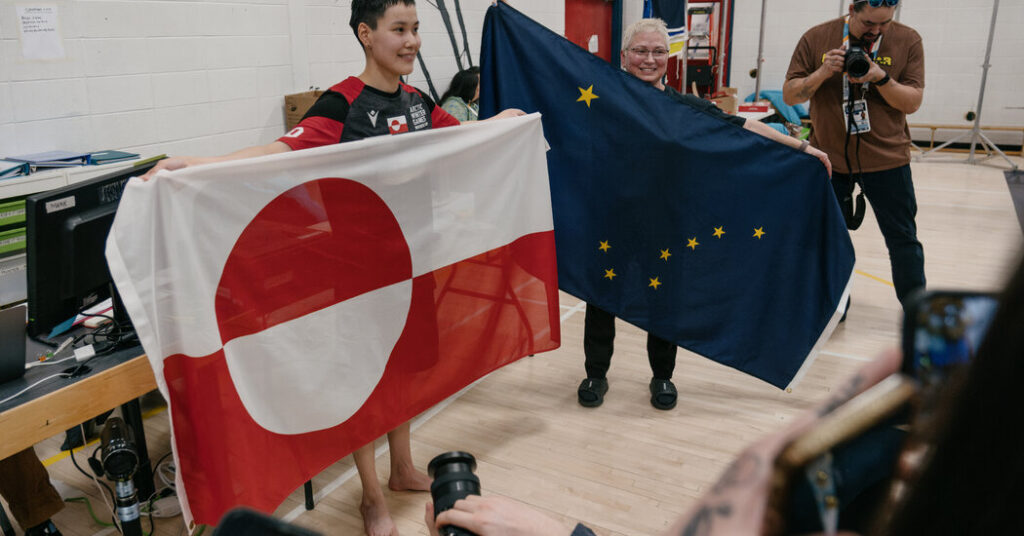
Petra Amossen, 19, from Uummannaq, Greenland, stared intently at a small ball covered in seal fur hanging by a string 6 feet 8 inches off the floor. All she had to do was kick the ball with both feet and land cleanly on both feet to set a world record in a sport not widely known outside Arctic regions: the two-foot high kick.
Seconds later, Ms. Amossen slapped the ball with her toes and landed like a gymnast on the hardwood floor, sending the crowd wild.
Nicole Johnson, the head official and a former two-foot high kick champion from Anchorage, offered Ms. Amossen the flag of Greenland and displayed the Alaskan flag alongside her. A Greenlander and an American, a Kalaaleq and an Inupiat, side by side.
This moment would not have been so poignant in the past.
Since they began in 1970, the Arctic Winter Games have been a sporting event for youths from across the circumpolar North to compete in and to connect. The biennial event (soon to be triennial) features an array of winter sports like hockey and skiing, and also several indoor sports like basketball and futsal.
But Arctic sports, like the two-foot high kick, knuckle hop, Alaskan high kick and airplane, are crowd favorites. They showcase Inuit games based on the skills needed to live a traditional life on the remote and unforgiving tundra.
“If you were out hunting with a partner, you want them to be just as strong and as smart as you, so you’re going to encourage them to be that person for you and you want to be that person for them,” said Ms. Johnson, who set the women’s world record in two-foot high kick in 1989.
“That way of life, through our games, keeps that sense of community.”
Outside the gymnasium, a different game was being played.
President Trump’s threats to take over Greenland, and his talk of annexing Canada and making it into a state, pushed sovereignty and security to the forefront of the agenda among Arctic nations.
Concerns about the future of the North Atlantic Treaty Organization and its protections over the Arctic spurred a new arms race as countries with Arctic territories tried to prepare for a newly uncertain future.
The chill has been felt across a region that is predominantly inhabited by Indigenous people who have long strived to defend their independence and keep the troubles that great powers can bring with them at bay.
But as this year’s Arctic Games began, the tensions were hard to ignore.
While the Games were underway in March, Prime Minister Mark Carney stood inside a military hangar in Yellowknife, Northwest Territories, and pledged 32 billion Canadian dollars for Arctic defense across Northern Canada.
Three days later he met with the leaders of Sweden, Denmark, Finland, Iceland and Norway in Oslo to strengthen trade, energy and security ties with the Nordic countries.
Trump Administration: Live Updates
Updated
- A lawsuit argues Trump’s $1.8 billion fund excludes those he targeted.
- White House approves $9 billion for spy agencies to catch up on A.I.
- Green card seekers must leave the U.S. to apply, the Trump administration says.
At the opening ceremony of the Arctic Winter Games, a Canadian fighter jet roared over athletes and dignitaries. Among them was Peter Hoekstra, the U.S. ambassador to Canada, who spent three hours of pageantry swaddled in a down jacket and a beanie in temperatures hovering around minus 5 degrees Celsius.
Most teams attending the Games felt the political tension. The Greenlandic delegation barred its athletes from talking about politics to the media “to protect and take care of our athletes and performers,” Aviaaja Geisler, their head of mission, said in an email.
The tensions over the Trump administration’s stance toward the Arctic was not the only source of geopolitical strife hanging over the competition.
Yamal-Nenets, a region in Northern Russia, has been part of the Games since 2004 and was scheduled to host this year’s competition, but the Arctic Winter Games International Committee ruled the region ineligible after Russia’s full-scale invasion of Ukraine in 2022.
Tor Vidar Rismo and June Mariell Hansen traveled almost 24 hours from North Cape, Norway, to watch their daughter, Julie, play futsal. She represented Team Sápmi, an area traditionally inhabited by the Indigenous Sámi people that crosses Norway, Sweden and Finland.
Because they live so close to Russia, they said they shared similar concerns to those of Greenlanders and Canadians toward the United States.
Russia can “take Norway in a couple of days,” Mr. Rismo said. Ms. Hansen says she cannot understand how world leaders “think they can take whatever they want.”
Back in the gymnasium, a group of men competed in the knuckle hop, a grueling Arctic sport where competitors in plank position move in a circle around the floor on their knuckles, using their toes to propel them forward.
The motion is intended to mimic the movement of a seal on ice. The crowd claps to the beat of the athletes’ fists punching the ground. Blood and skin are cleaned off the floor after each participant. They show off their blisters and calluses as a badge of honor. Greenlanders, Americans and Canadians beam with pride, hug and high-five each other.
“There are no borders between our Indigenous peoples,” Ms. Johnson said. “We are all there for each other, to support each other, regardless of who is in power in politics. We have zero interest in what leadership says outside of our communities.”
Pat Kane is a photojournalist based in Yellowknife. He lives on the traditional land of the Yellowknives Dene First Nation.
Trans Canada
-
Oil-rich Alberta will hold a vote in October asking its citizens if they want to remain a part of the country, or if they prefer to hold a binding referendum on seceding, Matina Stevis-Gridneff, The Times’s Canada bureau chief, reported.
-
Outside the city of Thetford Mines, Quebec, in a region that once supplied the world with asbestos, workers are drilling underground in search for an unusual and potentially vast new source of clean energy.
-
An Air France plane was sent to Montreal because a passenger from the Democratic Republic of Congo was on board. The U.S. has closed its borders to recent visitors to the African country.
-
When SpaceX goes public, the Royal Bank of Canada will play point on the country’s deep-pocketed government investment funds. RBC is one of 23 banks hired by Elon Musk to take part in the I.P.O.
How are we doing? We’re eager to have your thoughts about this newsletter and events in Canada in general. Please send them to [email protected].
Like this email? Forward it to your friends, and let them know they can sign up here.
The post At the Arctic Games, Canada and Greenland vs. Trump Feels Like Its Own Sport appeared first on New York Times.