As the news of a thwarted terrorist plot against a New York City synagogue quickly spread last Friday, dozens of anxious Jewish leaders joined a Zoom call with police officials.
It was hours before weekly Shabbat services were to begin, and the leaders were seeking reassurances that they could tell their communities it was safe to attend prayer. Safety protocols were given, along with assurances of care and attention.
As the religious leaders began relaying that message to their congregants, another message was being delivered by Mayor Zohran Mamdani. He had just released a video marking Nakba Day, a mournful Palestinian commemoration of their displacement during the creation of Israel in 1948.
The video — which shared the story of Inea Bushnaq, a Palestinian New Yorker who was forced to flee her home as a child — immediately drew fire because it omitted parts of that historical chapter that matter deeply to many Jews, including the role of the Holocaust in the creation of Israel and the participation of Arab states in the ensuing 1948 Arab-Israeli war.
Many pro-Palestinian New Yorkers, including Muslims and some progressive Jews, celebrated the video, saying Palestinians’ perspective and experience had long been overshadowed.
But Mark Treyger, chief executive of the Jewish Community Relations Council in New York, who was on the Zoom with police officials, said he was taken aback by the mayor’s video and its timing.
Mr. Treyger, the grandson of Holocaust survivors, said the video “told a skewed version of history that omitted really important parts.”
A wave of antisemitic incidents across the city has created a sense of escalating crisis for many Jewish New Yorkers. Mr. Mamdani, a progressive Democrat and longtime pro-Palestinian activist who is also New York’s first Muslim mayor, has responded to incidents as they have occurred. But he has struggled to connect with many Jewish leaders, who are overwhelmingly pro-Israel.
Some of those leaders say that an accumulation of episodes in recent months has strained their relationship with City Hall. They include Mr. Mamdani’s appointment of critics of Israel to roles in his administration that have historically gone to members of the Orthodox or ultra-Orthodox community who are generally supportive of Israel. Most recently he tapped Miriam Grossman, an anti-Zionist rabbi, as a faith liaison.
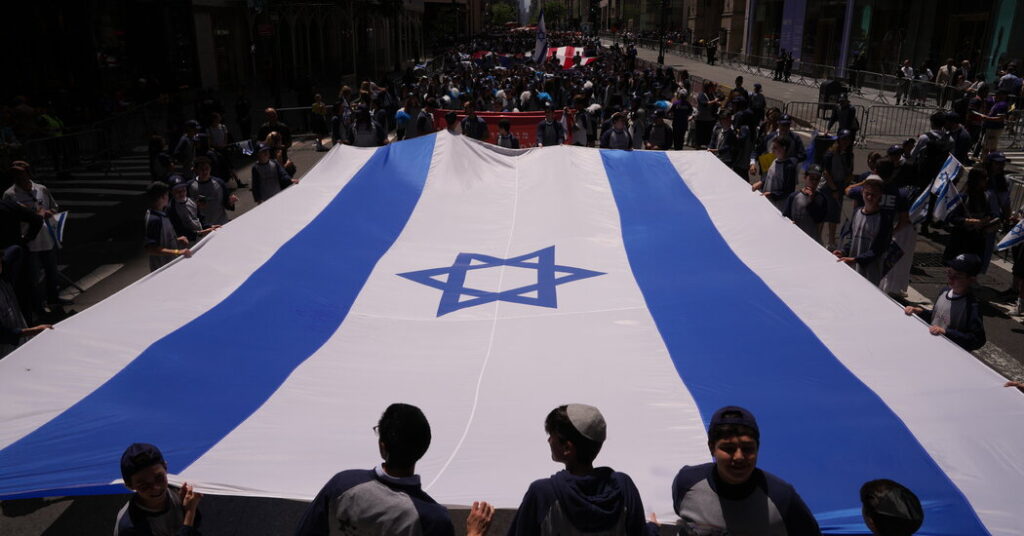
Mr. Mamdani has said he will skip an annual parade honoring Israel on May 31, in a break from mayoral tradition. He has also taken the opportunity to frequently speak about Israel and Palestinians, including during a St. Patrick’s Day speech and in a social media post condemning the Israeli arrest of several New Yorkers during a raid on an activist flotilla.
Many of those leaders critical of the mayor acknowledged that recent antisemitic incidents — the thwarted terror plot, swastika graffiti in Queens and Brooklyn and expressions of open support for Hamas and Hezbollah at some chaotic protests of Israeli land sales — had been outside the mayor’s control.
But they say the release of the Nakba video had been entirely in his hands, and view the episode as a breaking point in their already fraying relationship with City Hall leadership.
“There is a way to have done this that acknowledged the legitimate Palestinian pain of the creation of the state of Israel, and this was not it,” said Amy Spitalnick, chief executive of the Jewish Council for Public Affairs, who has worked collaboratively with Mr. Mamdani in the past.
“What he did here went so far beyond that in a way that I worry is normalizing some pretty bad tropes and rhetoric, never mind the ahistoric details.”
Pro-Israel Jewish leaders said they were also dismayed that the Nakba video had been released right before sundown on a Friday, when many observant Jews turn their phones off for Shabbat. The video had been watched roughly 11 million times by Thursday afternoon.
A spokesman for Mr. Mamdani said his office had originally intended to release the video earlier on Friday, but had been forced to delay its rollout when news broke of the thwarted attack on the city.
Many pro-Palestinian New Yorkers feel their perspective on the conflict has long been ignored by many American politicians, who have prioritized pro-Israel views.
“The reality is that what was done to Palestinians in 1948 in order to create the modern state of Israel is not accepted or acknowledged by most Western governments,” said Sumaya Awad, the granddaughter of Nakba survivors and a Palestinian writer and activist.
She said many Americans were unfamiliar with the Nakba, and argued it was important to “acknowledge that it happened and that it matters.”
Mr. Mamdani defended the video on Monday, saying “acknowledging any people’s pain does not preclude you from the acknowledgment of another people’s.”
“When it comes to New Yorkers like Inea and so many others, not only has their pain never been acknowledged, but so often we have seen that even their identity is up for debate,” he said. “And my message to each and every New Yorker is that this is a city for you and that we will continue to be proud of everyone who calls it home.”
In separate remarks, he said “my door is always open” to Jewish leaders, whether or not they voted for him or agree with his views.
“It is part of a commitment to be the mayor for every New Yorker,” he said. “And that means a mayor for those who voted for you, who didn’t vote for you, who didn’t vote at all.”
Many of the pro-Israel groups most critical of Mr. Mamdani’s Nakba Day video have been locked in conflict with him since the mayoral campaign, when they vocally opposed his candidacy.
His relationship with pro-Israel groups has been defined ever since by a series of controversies, including over his criticism of events advertising real estate in Israeli settlements, his revocation of pro-Israel executive orders issued by his predecessor, Mayor Eric Adams, and his appointment of Jewish aides who have been critical of Israel and pro-Israel groups.
But Jewish New Yorkers are not a monolith. Mr. Mamdani won election with the support of progressive Jewish groups who continue to back his agenda, including his advocacy for the Palestinians and the Nakba Day video.
And his sharp criticism of Israel, once a somewhat fringe position in the Democratic Party, is now mainstream as a majority of Democrats denounce the country and its current leadership and policies.
Beth Miller, the political director of Jewish Voice for Peace Action, a progressive ally of the mayor’s, said she found the video to be a “beautiful and incredibly moving” recognition of a painful chapter of history.
And Sophie Ellman-Golan, a spokeswoman for Jews for Racial and Economic Justice, praised it for talking about the Palestinian experience in a way few elected officials typically do. She said she was “kind of baffled” by the outrage from some Jewish groups, “because this really does not have anything to do with us.”
“In American politics, the conversation has for so long been about Jews and Israelis that the inclusion of Palestinians makes it feel like something is being taken away, but nothing is being taken away,” Ms. Ellman-Golan said. “Acknowledging one person’s pain is not denying the pain of others,” she said, echoing the mayor.
But the divisions within Jewish New York, and the discontent of pro-Israel Jewish leaders, were on display at Gracie Mansion on Monday night during an event to celebrate Jewish Heritage Month.
Mr. Treyger and representatives of other prominent Jewish groups, including the UJA-Federation of New York, which describes itself as the world’s largest local philanthropy, boycotted the event. The leaders of the groups had been planning to skip it but had intended to send staff members until the video was released, they said.
Bob Kaplan, a rabbi and retired member of the Jewish Community Relations Council in New York, was supposed to deliver the invocation at Gracie Mansion. He also decided to boycott the event after the video was released, according to two people familiar with his decision. Mr. Kaplan did not respond to a request for comment.
City Hall officials expressed concern about the possibility of widespread absences, according to one person involved in those conversations. But the event itself was buzzing with activity as a Who’s Who of Mr. Mamdani’s Jewish allies munched on canapés of cheese blintzes and burekas.
The crowd included people from Israel-skeptical progressive groups like Jewish Voice for Peace and Jews for Racial and Economic Justice, as well as members of the ultra-Orthodox Satmar movement, which has thrown their storied organizational muscle behind Mr. Mamdani.
When it was over, the mayor’s office released footage and videos that featured a cross-section of New York Jews at the event, from secular liberals to Orthodox rabbis.
But some came to the event with mixed feelings. Alana Zeitchik, whose cousins were taken hostage during the Hamas-led Oct. 7 terror attack on Israel, said she did not want her attendance to be seen as an endorsement of the mayor.
“In this room is not a full representation of the Jewish community,” said Ms. Zeitchik, who is Israeli. She added: “I’d love to see more mainstream Jewish Zionists represented here.”
Emma Goldberg contributed reporting.
Liam Stack is a Times reporter who covers the culture and politics of the New York City region.
The post Gulf Widens Between Mamdani and Pro-Israel Jewish Leaders appeared first on New York Times.