Mac Barnett, the national ambassador for young people’s literature, was running late. He’d been at Little, Brown to celebrate the launch of “Make Believe,” his first book for adults, then hopped on a subway to Books of Wonder, one of New York City’s few bookstores dedicated to young readers.
At 2 o’clock on a Tuesday afternoon, the place was empty except for a handful of employees. As Barnett breezed in on a wave of apologies, everyone snapped to attention. Remember when Andy walks into his bedroom in “Toy Story” and the playthings fall into position? Like that.
Barnett, 43, is the award-winning author of more than 70 books for children, including chapter books, board books and graphic novels. But picture books are his favorite form, and the focus of his yearlong tenure as a leader at a tense time in children’s publishing.
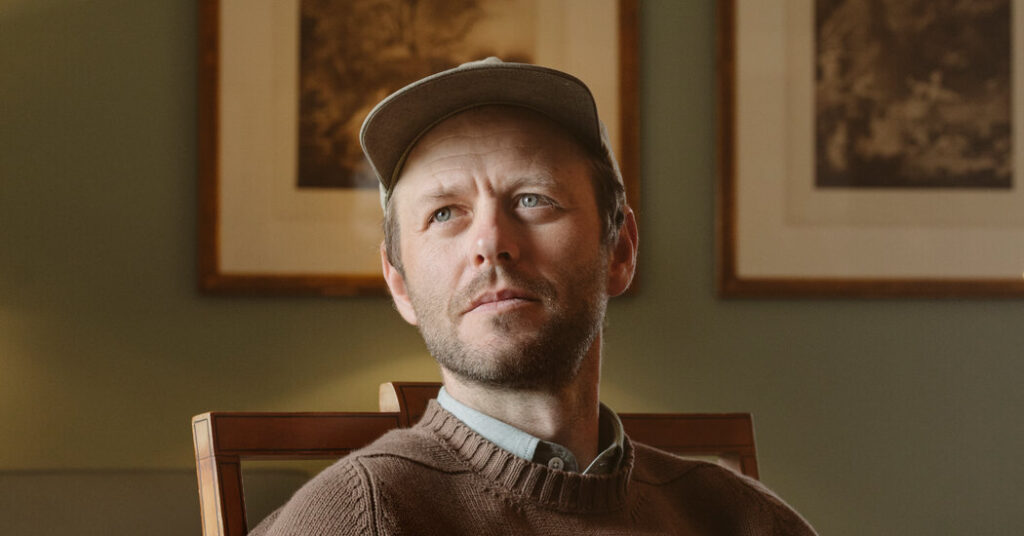
Wearing loafers with no socks and a cap from Mount Analog Bookshop in Oakland, Calif., where he lives, Barnett was kinetic and authoritative — not pleased with himself, exactly, but comfortable with his own expertise.
“Picture books are why I started writing for kids,” he said during an interview. “I’m interested in launching a cultural re-evaluation of the picture book as an art form. It’s this dance between text and image, empowering the kid to notice things that adults don’t see.”
In “Make Believe: On Telling Stories to Children,” he expounds on this point. A New York Times reviewer described the book as “compulsively readable,” a “succinct defense” of Barnett’s career, which he “approaches as a ministry.”
Books of Wonder was the first stop in an eventful 48 hours that would allow Barnett to evangelize to his new audience. To urge adults to let kids revel in picture books instead of leapfrogging over them; to encourage imagination over the joyless tallying of minutes for a reading log; to argue that libraries should not be swapped for maker’s spaces. (“I’m all for a 3-D printer. Can we find another place for it?”)
Barnett would visit the Library of Congress, where he shares an office with the U.S. poet laureate. He would sign books at East City Bookshop in Washington, D.C. And he would speak at a celebration for the opening of the Source, the library’s new 4,000-square-foot interactive center for kids and teens.
But before Barnett got in the groove of his tour, he got caught up in a backlash that blazed across Instagram, Facebook, TikTok and Substack.
Already embattled by book bans, library budget cuts and the specter of artificial intelligence, a subset of the children’s publishing community united on one point: It did not like how, in “Make Believe,” Barnett writes that “94.7 percent of kids’ books are crud.”
Think the children’s book world is all rainbows and butterflies? Think again.
Time for reading aloud
Barnett was raised by a single mother who was often exhausted after being on her feet all day.
In a phone interview, Julie Barnett recalled that her son was always the first student at preschool drop-off; she had to be at her nursing job by 7:30. Timing was tight.
“I had an ulcer every day on that commute,” she said. “I was uber-sensitive about doing this right, not having me or Mac be painted with the brush of the quote unquote broken home.”
Relying on recommendations from “The Read-Aloud Handbook,” Barnett prowled garage sales for books. She used Wite-Out to obscure previous owners’ names, then inscribed her purchases to Mac. His favorite was “But No Elephants,” by Jerry Smath, which she still knows by heart.
Barnett kept those picture books on a shelf in the dining room long after she stopped reading to her son. “I never got the sense that they were lesser, or sub-literary, or something to be outgrown,” Mac Barnett writes in “Make Believe.”
He studied writing with David Foster Wallace at Pomona College and, while working at a summer camp, discovered that he really enjoyed reading to kids. It’s still one of his favorite activities, he said, a guaranteed source of peace.
Barnett and his wife, Taylor Norman, a children’s book editor, now have a 5-year-old son with whom they take turns reading every night. If their son picks one of his books, Barnett said, he’ll head to the kitchen to grind coffee so as not to hear how the jokes land.
When I asked about children and technology — who hasn’t noticed the replacement of books with iPads? — Barnett said: “We have this terrible habit of blaming kids for our failures. You see a kid on a screen and you’re like, ‘Kids are on screens all the time.’ They’re reflecting the world back, the world that we made.”
He went on: “We’re not reading to them, and then when kids are reading less we blame kids. The good news is, we can fix it.”
While bullish on the importance of daily reading, Barnett is sympathetic to the overstretched caregiver.
“It’s not possible in every family. It’s not possible every day,” he said. “I fall asleep mid-book sometimes and my son is still awake. I get it.”
‘The longest job title in the world’
Barnett was thrilled when he got word in the summer of 2024 that Carla Hayden, then the librarian of Congress, had named him national ambassador for young people’s literature.
“It’s the longest job title in the world,” Barnett said, repeating a joke from his book. “That’s how you know it’s important.”
He is the ninth author in the role. The program is a partnership between the Library of Congress and the literary nonprofit Every Child a Reader; previous honorees include Jon Scieszka, Jacqueline Woodson, Jason Reynolds and Meg Medina.
Barnett doesn’t have an embassy or diplomatic immunity, but he is in possession of a bronze medal that he’s required to wear to five official tour stops throughout the year. He declined to share the details of his contract and compensation, as did Brett Zongker, chief of media relations at the library, who noted in an email that the ambassador is paid as an independent contractor “not utilizing appropriated funding from Congress.”
When I asked Barnett how changing political winds have affected his work, he said: “You feel it in the way you feel it. It’s not the main thing parents are wanting to talk about. They want to talk more about iPads. But you do feel it.”
When I asked Zongker whether Barnett is allowed to weigh in on book bans and D.E.I. efforts, he wrote that the library has asked ambassadors “to keep their signature projects focused on some vital aspect of children’s literature and to avoid politicizing the position.”
The percentage of ‘crud’
But it wasn’t a political issue that got readers riled up. “Make Believe” sparked a firestorm with a single line.
On Page 22 of the 102-page book, Barnett explains Sturgeon’s Law, in which the science fiction writer Theodore Sturgeon stated that “90 percent of everything is crud.”
Building on this idea, Barnett writes: “I have a nagging fear that children’s literature suffers from a slightly higher crud percentage than literature as a whole. So I now offer Barnett’s Addendum to Sturgeon’s Law: Maybe more like 94.7 percent of kids’ books are crud.”
Fellow children’s authors were aghast: How could their national ambassador say such a thing?
Tracey Baptiste, the best-selling author of more than 30 books, wrote on Instagram, “Children’s books are under sustained political attack and this statement from someone holding an official, visible role in children’s literature does not land as a neutral critique.”
Others compared Barnett to Robert F. Kennedy Jr. (dismissive of vaccines) and Timothée Chalamet (dismissive of ballet and opera). Many felt that Barnett’s criticism of books intended to teach a lesson or impart a message was dismissive of works by marginalized authors.
In an open letter to the Library of Congress and Every Child a Reader, nearly 300 members of the children’s literature community asked: “When Barnett rails against the ‘didacticism’ of some books, we wonder who defines didactic? For Black and brown authors, for queer and trans authors, we have seen that very word used as a cudgel and dog whistle to decry the necessary diversification of children’s literature.”
Sally Kim, Barnett’s editor, said that Barnett was using Sturgeon’s Law in a humorous, hyperbolic way.
“In the context of the section,” she said, “it works. But most people encountered it as a one-liner or a screen shot.”
The reaction left Barnett distraught.
“I feel terrible,” he said. “I was hyperbolic, glib. I get why writers and illustrators feel betrayed. It was a failure of writing on my part. I got loose at the exact time I should have been tightening my argument. That’s on me. That line is not in the spirit of the book.”
Barnett released a similar statement via the Library of Congress. Betsy Bird, an author and prominent librarian, was unmoved.
“He hasn’t said he was wrong,” she said. But, she added, “under no circumstances should Mac quit,” as some have suggested. “I could easily see the Trump administration establishing a new person in his place and, boy howdy, I don’t think we want that.”
Or, Bird noted, the ambassadorship could be eliminated altogether.
A gaping chasm
When I met Barnett at the Library of Congress, he was a shadow of his publication day self — cap lower on his face, smile not quite reaching his eyes.
Say what you will about how Washington, D.C., has changed: the tradition of the eighth-grade class trip is still going strong. All around the building, backpacked adolescents vamped for selfies while trailing their guides.
By the time we reached Barnett’s office — he wasn’t quite sure how to get there — we were down to two Library of Congress chaperones (from four). Both were solicitous when Barnett gave himself a shot in the stomach (he has Type 1 diabetes), but neither offered to leave the room.
Before exiting the library, we stopped by the Source, which was being fine-tuned for an evening event. Barnett wasn’t involved in the creation of the exhibit, but he smiled gamely for photos in front of a card catalog.
Then we were off to East City Bookshop, where Barnett signed copies of “Make Believe” for a line of adults who told him, one after another, what his books mean to the children in their lives. Most shoppers were unaware of the controversy raging online.
“I think a lot of the most aggressive discourse is from people who have not read the book,” said Amy Andrews, the store’s children’s books buyer.
“Make Believe” is a No. 1 Indie Next pick, meaning it has the support of independent booksellers across the country. It debuted at No. 9 on the New York Times best-seller list.
When I left the bookstore, Barnett was sitting at a table, still signing.
The aftermath
Over the next two weeks, Barnett had done eight more book events — New York to Miami, Los Angeles to Seattle — and was en route to Duluth, Minn., for the second official engagement of his ambassadorship. He’d answered many questions about the crud line; he’d followed the conversation online; he’d had time to reflect.
“That passage was especially hurtful to hard-working writers who are still fighting to have their voices heard,” he said by phone from his rented Toyota Corolla, which he’d parked to take my call. “Part of the ambassador’s job is to be celebratory, to uplift. This is an amazing moment in kids’ books and there are all these people working so hard to make robust, diverse, thriving, lively literature for kids.”
He doesn’t know how the uproar will change his relationship with the children’s book community. He doesn’t have any advice for people undergoing public excoriation; he’s still in the weeds. He’s excited to get back to writing for kids.
In the meantime, Barnett made sure to make clear that, while not speaking for the Library of Congress, “I am unequivocally opposed to book banning. I support authors writing the books they want to write and kids reading the books they want to read.”
He continued on to Duluth.
Later I texted one final question: “Do you think you were wrong to say 94.7 percent of kids’ books are crud?”
Barnett responded, simply, “Yes, I should have used a different argument.”
Elisabeth Egan is a writer and editor at the Times Book Review. She has worked in the world of publishing for 30 years.
The post Does Mac Barnett Have the Best Job in Kids’ Books? Or the Worst? appeared first on New York Times.