As European leaders begin to consider the possibility of talks with President Vladimir V. Putin’s government over ending Russia’s war in Ukraine, they have begun to debate a big question: Should they pick an envoy to talk with Mr. Putin?
But before that, they are trying to wrangle an even more fundamental one. How would they go about negotiations?
Foreign affairs officials from around the 27-nation European Union are expected to weigh the possibility of discussions with Russia next week at a meeting in Cyprus — including what talks might focus on and what red lines Europe would maintain.
They are not expected to settle definitively on an official envoy at the meeting, according to three diplomats and two officials speaking on condition of anonymity to discuss internal matters. Still, the idea of picking either one person or a small group to liaise with the Kremlin could come up.
What is remarkable — and a major shift in recent weeks — is that the possibility of talking to Russia is even on the table.
European nations suspended most political contact with Russia after the nation’s full-scale invasion of Ukraine in 2022, and have long said the time wasn’t right to speak with Mr. Putin because he wasn’t serious about ending the war.
Maintaining that policy has become increasingly difficult.
American negotiators have been working toward some sort of peace plan for months, but progress has been halting as they have faced repeated distractions, most recently amid the joint Israeli-U.S. attack on Iran.
What’s more, Europeans have lacked a seat at the table during critical discussions, and so have had little reassurance that their American counterparts are negotiating with their interests at heart.
Given that, European leaders are considering ways to talk to Moscow to make sure that any peace deal to end the war in Ukraine is an agreement that both Kyiv and the continent as a whole can live with. Increasingly, they seem to think that to exert more influence, they may need to speak with one voice during future negotiations.
“It’s about the fundamental lack of trust and lack of confidence that Europe has in the United States,” said Mujtaba Rahman, managing director for Europe at the Eurasia Group, a consulting firm.
António Costa, the president of the European Union’s political arm, helped to kick off the scramble for a European envoy when he said publicly on May 7 that he was “talking with the leaders to see the best way to organize ourselves” for when “the right moment” to talk with Russia arrives.
Mr. Costa said Europe should not “disturb” the U.S.-led peace process, but noted that he and President Volodymyr Zelensky of Ukraine had been talking about a European presence in discussions with Russia.
Then, on May 14, President Alexander Stubb of Finland said in an interview with a Lithuanian broadcaster that the time was “approaching” for Europe to be directly involved in the negotiations, because Russia was experiencing setbacks on the battlefield.
Also, Mr. Stubb said, “If you’re not around the table, you’re going to be eaten on that table. I think it’s better to engage in some kind of dialogue.”
Mr. Zelensky has since affirmed that he and Mr. Costa have talked about the need for a specific envoy.
“Europe must be involved in the negotiations,” Mr. Zelensky wrote on Facebook earlier this week. “It is important for it to have a strong voice and presence in this process, and it is worth determining who will represent Europe specifically.”
The Kremlin has officially maintained that it is open to negotiations with any nation regarding the conflict in Ukraine. But there was long a strain of thought in Moscow that any real negotiations must be held with Washington.
Recently, conditions have shifted. Progress on U.S.-led Ukraine talks has stagnated. Washington is more focused on the Middle East and other issues. And Europe is by far Kyiv’s biggest funder, especially as it funnels a 90-billion euro ($105 billion) loan toward Ukraine to support its continued war effort.
Moscow has suggested that it is open to talks with a European representative.
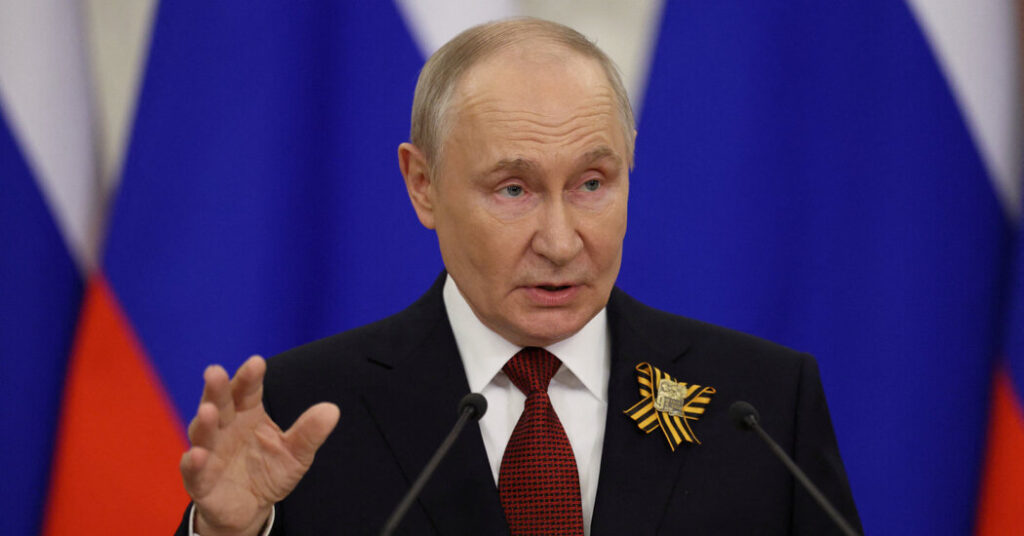
“Let the Europeans choose a leader whom they trust, and who hasn’t spouted any nasty remarks at us,” Mr. Putin said at a news conference in early May.
Europe now has more influence over Ukraine than Washington does, said Konstantin V. Remchukov, a Moscow newspaper editor with Kremlin connections, who said in an interview that is what explains Russia’s openness to negotiating with Europe.
“There are influential people that believe the conflict must be brought to a close by the end of the year,” Mr. Remchukov said. “However, you cannot simply end the conflict just like that, because Ukraine is currently — more than ever — under the guardianship of Western Europe, specifically Germany and Britain.”
Some in Russia continue to argue against negotiating with Europe. Vadim Poegli, a columnist at Moskovsky Komsomolets, a pro-government tabloid, wrote this week that Europeans are only interested in talking to the Kremlin because they believe Russia is going through a moment of vulnerability.
“They can only be convinced otherwise on the battlefield,” he wrote.
Nor are all European leaders convinced that opening talks with Russia would be simple.
“Russia’s attitude is this: That what we do not gain on the military field, we will come behind the table and demand,” Kristen Michal, Estonia’s prime minister, said in a May 9 interview in Narva, just across the border from Russia.
Even though big uncertainties remain about whether Europe will pick an interlocutor and how Russia would engage with one, early guessing abounds at who that person might be.
Mr. Costa, who already holds a key political leadership role at the European level, is one option that has appeared in news reports in recent weeks. Mario Draghi, the former Italian prime minister and European Central Bank chief, is also frequently raised, as is Angela Merkel, the ex-German chancellor, and Mr. Stubb.
The European diplomats and officials who spoke on condition of anonymity have noted that any discussions on the matter are in their infancy, and that any names floating around are largely speculative.
Mr. Putin said earlier this month that Gerhard Schröder, a former German chancellor, could represent the European view. European leaders roundly dismissed that idea on account of Mr. Schröder’s closeness to the Kremlin. It is likely no accident that Mr. Putin, who speaks German and was stationed in East Germany during his time in the K.G.B., would suggest someone from Germany, which has become Ukraine’s biggest backer in Europe.
Kaja Kallas, the European Union’s top diplomat and a native of Estonia, called Mr. Schröder a “high-level lobbyist for Russian state-owned companies.”
She seemed to suggest herself for the position at a recent news conference, saying, “I think I could see through the traps that Russia is presenting.”
Ms. Kallas would normally be a natural choice for the job as she is the European Union’s top foreign affairs official. But she is seen as so stridently anti-Russian by the Kremlin that Moscow might quickly reject her.
Ms. Kallas has said that the possibility of talks with Russia will be on the agenda at the upcoming informal meeting of foreign affairs officials, which will be held in Cyprus next week. Both she and many other European leaders have maintained that before they make plans to talk to Russia, it will be necessary to decide what they want to talk to Russia about — and whether they definitely want to engage.
“More important than the who is the what,” Paula Pinho, the European Commission’s chief spokeswoman, said on Wednesday. “What is it we want to ask from Russia?”
Koba Ryckewaertcontributed reporting from Brussels; Motoko Rich from Rome; and Oleg Matsnev from Munich.
Jeanna Smialek is the Brussels bureau chief for The Times.
The post Before Europe Anoints Someone to Talk to Putin, It Debates What to Talk About appeared first on New York Times.