Conservatives routinely use images of encampments and boarded-up storefronts to criticize progressive policies on the coasts, but 80% of the country’s 341 “persistent poverty” counties are in the South.
In fact, the highest concentration of poverty is in states that have been entirely controlled by conservatives for well over a decade. We’re talking Alabama, Georgia, Mississippi … you know, a lot of the same states that attacked the United States during the Civil War. The same states that opposed civil rights for Black people 50 years ago. The same states that are racing to redraw congressional maps with the intention of stripping political power away from Black people today.
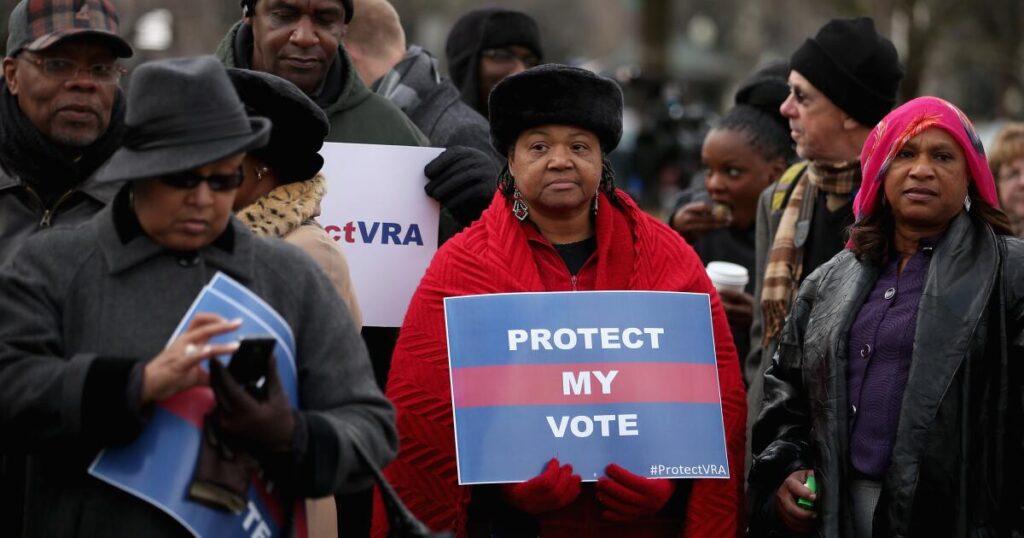
This week the NAACP launched “Out of Bounds,” a campaign calling on Black athletes, fans, alumni, and families to withhold athletic and financial support from public universities in states that have moved to redraw congressional maps. The boycott is in response to a series of Supreme Court rulings — beginning with Shelby County vs. Holder in 2013 — that have weakened the Voting Rights Act of 1965.
Shelby, by the way, is not even among Alabama’s 19 most impoverished counties. All of those are in the Black Belt, a region of the country dominated by abandoned cotton plantations and former sharecroppers. Shelby, on the other hand, is predominantly white and among the state’s most affluent. So when county leaders sued the U.S. government, it wasn’t to gain power for disenfranchised residents as much as it was to strip it away from their poorer neighbors.
Nearly 42% of the country — an estimated 141 million people — currently live in states where Republicans control the governor’s mansion and both state chambers of the state legislature. Not all of them target their Black residents as blatantly, and as ruthlessly, as Alabama, which has largely succeeded in keeping Black residents poor and concentrating wealth in white counties. Yet it happens enough in red states that a map of the counties experiencing persistent poverty for the past 60 years overlaps with a map of the former Confederacy. And that map overlaps with a map of the states the century-old NAACP is targeting with its boycott.
Should Black athletes take up the call?
Yes. Everyone should.
Between 1932 and 1965, the following events unfolded in the world of sports: Jesse Owens makes a mockery of Hitler’s white superiority theory in 1936; Joe Louis becomes heavyweight champion of the world; Kenny Washington breaks the color barrier in the NFL; Jackie Robinson does the same in baseball; and a college senior by the name of Arthur Ashe wins the NCAA singles titles. And yet, despite witnessing all of that success, the leaders of the Southeastern Conference, which began in 1932, stayed committed to racial segregation. Of course, that would be astonishing if not for the fact that the schools that originally made up the SEC were based in former Confederate states.
And even after the conference integrated, Kentucky’s Adolph Rupp refused to recruit Black players for years. He did this even after a team from the former Confederate state of Texas won the NCAA title with an all-Black starting lineup.
Racism doesn’t just harm the intended target. It’s like a gun that fires bullets in every direction, including back toward the gunman.
The past decade of political attacks conservatives waged against critical race theory and “woke” were never about moving us into a post-racial society. The attacks were always in pursuit of the vision of former Alabama Gov. George Wallace: a segregated society. The same is true of the recent push to redraw congressional maps heading into the midterm.
This is why I suspect many Black athletes will heed the NAACP’s call. Not because they are “woke” but because they are paying attention.
There have always been Black athletes — from heavyweight boxing champion Jack Johnson in the early 1900s to Lew Alcindor (the future Kareem Abdul-Jabbar) in 1968 to the WNBA players in the bubble in 2020 — who have been willing to use their platforms to address racial injustice.
However, the reason we continue to have these inflection moments is because too many white people continue to view America’s racism as a problem for Black people. As if the racially motivated upheaval surrounding congressional maps doesn’t affect everyone. This disconnect epitomizes why Rupp has an arena named after him in Kentucky and Gov. Ned Breathitt — who worked with Martin Luther King Jr. and in 1968 made Kentucky the first Southern state to outlaw racial discrimination in public accommodations and employment — is in relative obscurity. Perhaps if we told more of America’s true history, we would discover more of America’s true heroes.
Because even though the South lost the Civil War, the grievances of the defeated in some states continue to outweigh what is in the interest of those states and the country.
If boycotting sports in the South can help end this senseless cycle, that would benefit all of us.
YouTube: @LZGrandersonShow
The post Should Black athletes boycott racist states? Yes. Everyone should. appeared first on Los Angeles Times.