A few days after my noise injury — I usually call it acoustic trauma, or a head injury if I want a phrase that people can understand, or a traumatic brain injury if I really need to drive the point home — I opened my apartment’s metal mailbox with its metal key.
There was a faint squeak. I’d been opening the same mailbox with the same key for years. I’d never before heard a squeak. I also felt the squeak. It was like a needle piercing my eardrum.
There tends to be a delayed reaction to an auditory injury, so it took a week or so before the pain blossomed into its true horribleness and exploded through my life like a bomb.
That was before I knew what it was, or even what it was called. The otolaryngologist diagnosed hyperacusis and said, “We have nothing to offer you.”
Few people have heard of hyperacusis, and it doesn’t even have a clear definition. So it was surprising to see that this wretched condition is now a movie star.
“Everybody has one hidden talent” proclaims the poster for “Tuner.” In the film, hyperacusis allows the ex-musician Niki to hear such faint sounds that he is able to crack a safe just by listening to the combination lock, as if the condition were the aural equivalent of X-ray vision. It’s not.
Niki calls hyperacusis “an allergy to loud noises.” It’s not that either, but at least that’s a reasonable way to describe something so incomprehensible.
There are assorted inadequate definitions, all related to sensitivity and intolerance to sound. Even the most accurate term, noise-induced pain, doesn’t do it justice.
For sufferers, nearly all sounds are louder than they should be, often to the point of pain and beyond. The pain — burning, stabbing, jabbing — is brutal and unforgiving.
People with mild cases complain they can’t empty the dishwasher: The clinking causes pain. So do backup beeps, ringing phones and even a toilet’s flush. People with severe cases are in unrelenting pain all the time, even in silence.
Hyperacusis is almost always joined by a constellation of ear abnormalities, including tinnitus and the clogged, pressure-y feeling known as aural fullness, for which science has no good explanation.
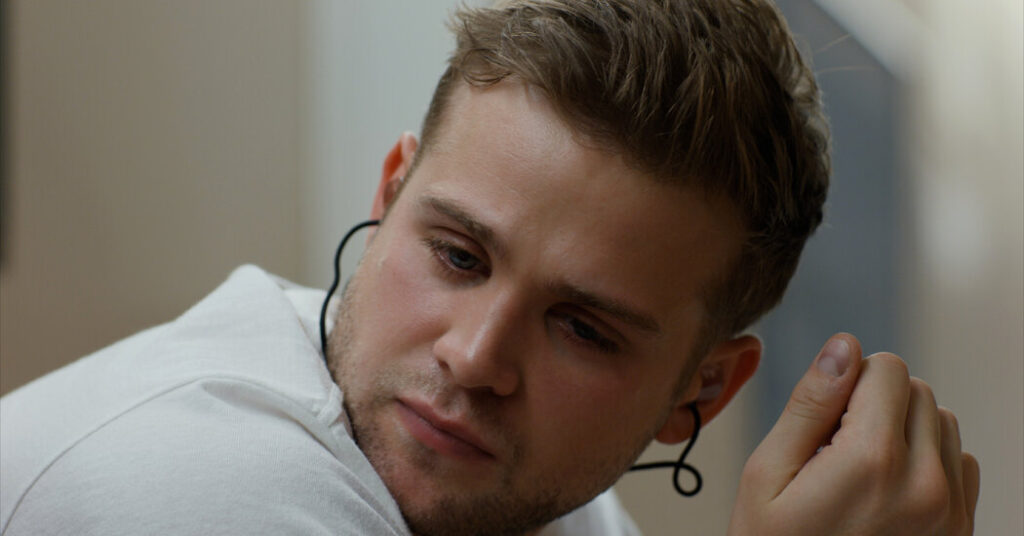
In “Tuner,” the elder Harry (Dustin Hoffman) is a piano tuner and former jazz musician with hearing loss who has taken on Niki (Leo Woodall) as his apprentice. Niki, once a piano virtuoso, is never without earplugs or protective earmuffs (or both) as a buffer against the inescapable noise of the world. At one point, he says, the sound of his own voice was agonizing.
It’s no surprise that both men have noise-induced hearing problems; noise is a potent neurotoxin.
Niki can no longer play. I’m not sure how he could even be a piano tuner, since the plink of piano keys is tough to tolerate, or how he could be a safecracker, willingly listening for high-pitched metallic whirs and clicks.
What’s more, Niki communicates effortlessly through two layers of ear protection. Such protection, while necessary, makes speech mostly unintelligible. (The filmmakers removed much of the noise-reducing padding from his protective earmuffs, and drilled a tiny hole into each custom-made earplug so he could hear properly.)
Niki also has perfect pitch, which has nothing to do with hyperacusis and is probably a genetic quirk, but at least it impresses his love interest, Ruthie (Havana Rose Liu), a student composer.
Niki visits her apartment to tune her piano.
Of course, at a key moment the oven overheats and the smoke alarm shrieks. Alarms, like airbags and sirens, are three so-called safety features with auditory destruction built right in.
“Tuner” gets a lot of things right. Niki’s ears ring, at least sometimes. He is constantly on the lookout for hazardous sounds; he can’t work amid background noise; and he needs to explain his condition because nobody understands. So it’s clear that the filmmakers had knowledgeable consultants.
What “Tuner” gets wrong is the degree of severity and the ease of reinjury. Hyperacusis results in a continuum of pain, but even mild cases are so debilitating that they feel severe. Some people improve slowly with the tincture of time, but all it takes is one noise insult to wipe out years of progress.
As Niki gets entangled with bad guys, he encounters two scary things: Surprise noise and weaponized noise. There’s a barking dog, an air horn and a gunshot. He grimaces. He winces. He holds his ears. But he recovers quickly. In real life, those noises could permanently worsen and incapacitate him.
My own apartment — possibly the quietest in the city — has soundproof windows. I don’t leave our four walls without ear protection. I’m usually OK with just protective earmuffs — I look like an airport baggage handler — but sometimes I add earplugs underneath. If a siren approaches, I duck into a store or run down a side street. I can get hurt by a microwave beep.
My injury came from prolonged exposure to a loud ventilation fan, similar to a vacuum cleaner running nonstop. Others have been injured instantaneously by a seemingly benign impulse noise, like an errant shout landing close to an unlucky ear. Some, like me, had a thunderclap moment and felt something break inside their head.
Like Niki, I was always functional, even as I was delirious with pain. My saving grace was that I could work from home because I could always talk on the phone without worsening. Not everyone can.
Making an entertaining film about a hero with hyperacusis seems impossible. It would be too boring, with him stuck alone in a room trying to avoid noise. “Tuner” manages pretty well, though with a whole lot of poetic license.
The post A New Film Makes My Hearing Condition a Superpower. It’s Not. appeared first on New York Times.