When Wilde’s opened in late October, taking over a corner space in Los Feliz with room enough for 10 tables, crowds showed up from day one. They huddled in line under the building’s eves through an unusually rainy fall. The buzz around the place simmered and concentrated into a single word: “British.”
No question, some quintessential British comforts took a spotlight. Bangers and mash. Welsh rarebit. Tall meat pies, their pastry designs rendered as Victorian crown molding. Sticky toffee pudding for dessert. Scones and sausage rolls as staples rolled out for casual daytime service.
“British,” though, was repeated so often its meanings vacuum-sealed around Wilde’s identity, ultimately squeezing more tightly than would prove helpful, or accurate. The restaurant is a different one, and a better one, than it was seven months ago: more expansive as a dining experience, and more specific in its cooking.
No one could mistake Wilde’s menu now for pub grub. Spring arrived and so did lightness, swells of vegetables and a more subtle sense of refinement.
Chef Natasha Price, who partnered with her childhood friend Tatiana Ettensberger to create Wilde’s, was born in England. The meaty, starchy bromides of British cooking were a part of Price’s life even after moving with her parents to Los Angeles at an early age. She hadn’t been drawn to making them earlier in her professional career, but family memories and affinities kept surfacing as she was writing Wilde’s first menus. She thought of the dishes as anchors to what would be an evolving style, and their heartiness made sense for winter’s shorter days and cooler nights.
Price and Ettensberger couldn’t have anticipated the restaurant’s onslaught of attention. Their space is tiny: 10 tables plus a few window seats amounts to a capacity of 30 or so people. The coziness had magnetism, and their aura of ambition brought new energy to the established rows of restaurants along Hillhurst Avenue. They’d decided to accept limited reservations, setting aside the bulk of tables for walk-ins. Lines and wait lists grew, and they persist.
Also, local and national media lately have had fun pronouncing a “British invasion,” bestowing winking exoticism on newcomers, pulling apart cliches around the culture’s notoriously brown-beige, gravy-slicked benchmarks. (Across town, Tomat in Westchester dips categorically into the British repertoire, one standout being an incredible take on stargazy pie, a Cornish seafood pastry, as an occasional special.)
Some first-flush stars have rightly stuck around, like the toasty Welsh rarebit and its slick of cheddar sauce pungent with ale, Worcestershire sauce and mustard powder. Is it modern British? Cal-Brit? Labels are so temping, and so reductive. Wonderfully, the closer Price moves toward a fluid definition of her culinary heritage, the greater the kitchen achieves consistent, delicious precision.
I’m thinking of a substantial starter composed around three mounds of Dungeness crabmeat. Preparation for the daffodil-yellow sauce pooling between them begins by roasting crab shells filled with olive oil, garlic, saffron, lemon peel and thyme. Price then blends those laced fragrances with more crab meat, olive oil and egg yolk to give the mixture body. Its initial inspiration was her grandfather’s love of British dressed crab, in which the lighter and darker meats of the European brown crab are combined and served in a shell. But here, finished with blanched snap peas, fennel and red onion, she has thrust a classic into a context that’s all her own.
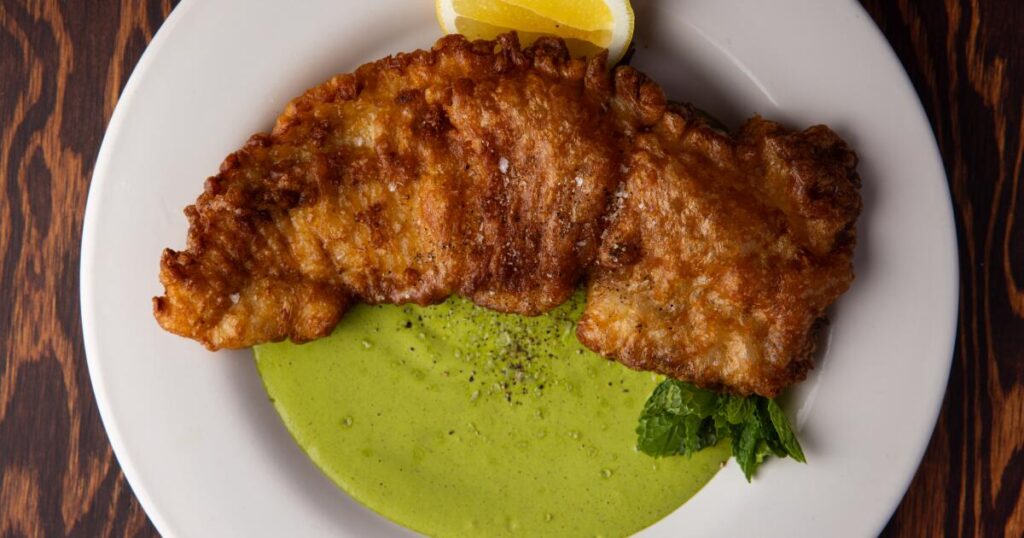
Same with her stretch-of-the-imagination play on traditional fish and chips, which starts with a wide hunk of skate (or sometimes rockfish) fried in a fluffy-crisp sheath of beer batter. The sauce again makes the dish. It’s very green, a nod to the mushy peas often served in London’s chip shops.
No legumes in this one: The base is malt vinegar aioli blitzed with herbs, especially mint, thinned with lemon juice and glinted with a blend of turmeric, cumin, cardamom and other spices — an allusion to the curry sauce that became popular alongside fish and chips in Northern England in the 1970s.
In texture and flavor, this alloy exists somewhere between hollandaise and tonic. It baptizes the skate with all its brightening, enriching qualities.
Not wanting to be too on the nose, the restaurant sells the chips separately. Rebelliously, the “chips” are also really steak fries. I’ve liked them more as the month goes by, when they’ve started arriving thoroughly salted and fried long enough that they’ve blistered and cracked.
Ettensberger, who previously worked at Chinatown drinking destinations Lasita and Cafe Triste, builds a concise, affordable, French-leaning wine list designed to frame, rather than fight, the stacked shades of spicing into which Price increasingly leans. An $89 bottle of 2023 Vin Noe “Pattaya” white Burgundy, for example, had buttery-lemony backbeats that sipped gracefully alongside a springtime meat pie that, when halved, spilled creamed chicken wafting tarragon.
Wilde’s chef de cuisine Sarah Durning, previously a butcher at Gwen and pastry chef at Dunsmoor, works with rancher Oliver Woolley of Peads & Barnetts to oversee the restaurant’s whole hog program. Once more, the choices center restraint and subtlety. This isn’t an unctuous pig pummeling in the vein of yesteryear’s gastropub fads. Pork isn’t exactly secreted into the menu’s corners but shows up sensibly: a loin entree warmed with sage, a terrine offset with cherries, cracklings as croutons in a little gem salad.
Marrow beans, soft and porcelain-colored and known for pairing well with meats, slow-cook with ham hocks into a brothy, herbaceous stew that erases borders in its rustic goodness. I taste the English countryside, sure, but also France and Italy and the American South.
The pork, ground and sharply seasoned, appears most reliably inside the crackly-topped sausage rolls served during the restaurant’s daytime service Thursdays through Sundays. At night the room is low lights and angled shadows. In the morning, sunshine draws the eye to sweet watercolors and antique sconces that decorate the walls, and a pane of stained glass that sees through to the kitchen and its blur of bodies in chef’s aprons. The menu bridges breakfast and lunch: oat porridge with poached strawberries and hazelnuts, a bacon sandwich on plush onion bread that’s most satisfying with its optional fried egg, smoked trout toast and slices of tea cake.
In an interview, Price mentioned she and Durning experimented with many scone recipes before landing on big billowing rounds with visibly flaky layers. British customers often cry foul, telling staff that this is more of an American biscuit.
“Yeah, it kinda is,” Price responds. But it’s great with clotted cream and strawberries.
To manage daytime demand, the restaurant recently installed a wide window for placing orders. In the transition they’ve discontinued a French toast special I was obsessing over, mainly for the custard underneath that was so thick and thrumming with vanilla that I wanted to take home a pint and churn it into ice cream. A thinner version glosses forkfuls of Durning’s textbook sticky toffee pudding at night.
I was quizzing Price about the differences and she said, “Yes, the one at dinner has, as my mom would say, more of a ‘pouring cream’ consistency.”
Pouring cream. Delightful. That’s the kind of British exoticism that I hope Wilde’s, as it continues to unfold, will help normalize in Southern California.
The post The new crown jewel of Los Feliz excels at British food. But that’s just for starters appeared first on Los Angeles Times.