Elon Musk’s SpaceX officially kicked off its march to Wall Street on Wednesday, filing the S-1 paperwork required for its hotly anticipated IPO.
Although the S-1 didn’t reveal key figures investors are waiting on — such as SpaceX’s estimated stock value and anticipated public share price — it did offer the first close-up look at the financial details and strategies behind Musk’s rocket company and AI business, xAI.
Here are the biggest takeaways from the filing.
There’s an incentive to build a ‘human colony’
Making life “multiplanetary” is at the forefront of SpaceX’s mission, and Musk has a massive financial incentive to make it so: 1 billion shares of SpaceX.
The filing shows that, among market-cap milestones, SpaceX will have to establish a “permanent human colony on Mars with at least one million inhabitants” for Musk to access the package.
Musk will also still have to be employed by SpaceX at the time of this milestone achievement, and the shares would be split into 15 tranches.
Still, it’s a highly unusual compensation trigger for an otherwise not normal IPO.
Anthropic is paying a lot for SpaceX’s compute
Anthropic is paying SpaceX $1.25 billion a month through May 2029 for access to the rocket company’s compute capacity, the filing showed. That’s about $15 billion in revenue coming from Anthropic.
The compute refers to SpaceX’s Colossus and Colossus II, massive supercomputers and data centers designed for training AI.
The filing said the agreement for cloud and compute services begins in May 2026.
Musk has massive voting power
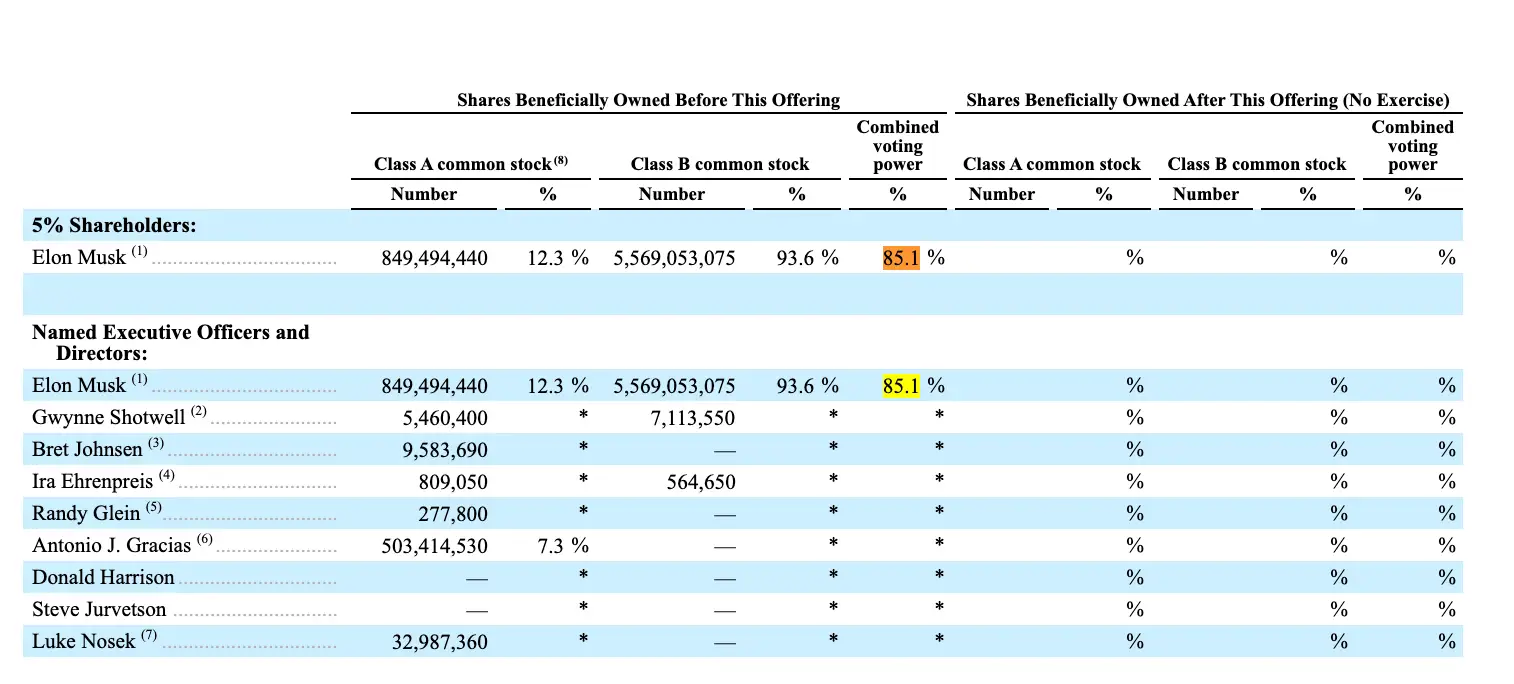
Voting rights in stocks mean each share owned gives the shareholder one vote on eligible matters. The S-1 revealed that Musk, who serves as the company’s chief executive, Chief Technical Officer, and Chairman of the board, holds 85.1% of the combined voting power on company matters, based on his 5,569,053,075 shares.
Grok’s CapEx was higher than Starship’s
“For the three months ended March 31, 2026, capital expenditures for our Space segment was $1,052 million, for our Connectivity segment was $1,332 million and for our AI segment was $7,723 million,” the S-1 reads.
That means spending on xAI’s projects, like Grok, was higher than SpaceX’s rocket division’s spending, which includes its Super Heavy and Starship rockets.
The numbers were starker in 2025, with the Space segment spending $3,832 million and the AI segment spending $12,727 million, according to the filing.
Read the original article on Business Insider
The post The biggest revelations from SpaceX’s S-1 filing appeared first on Business Insider.