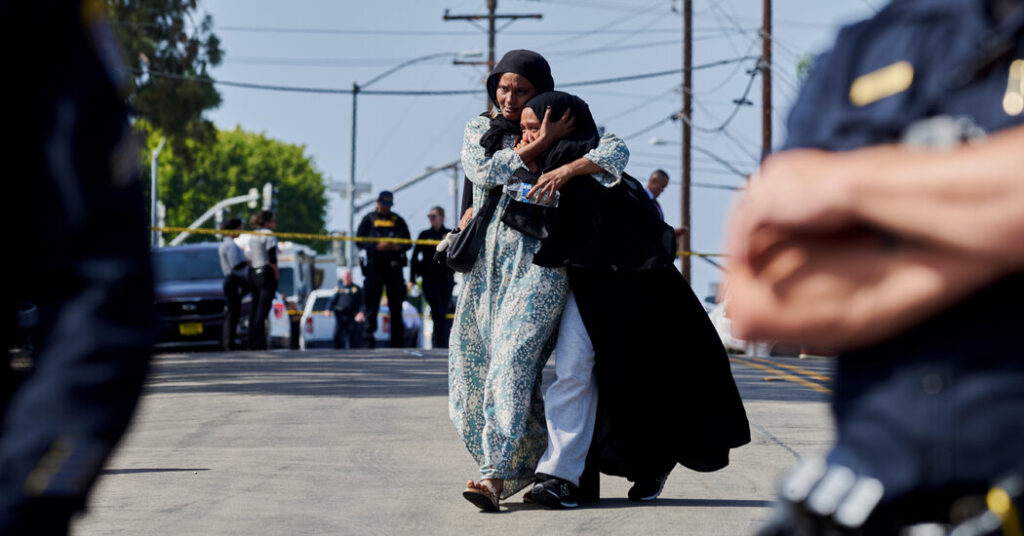
The young men who killed three people outside a San Diego mosque complex this week had expressed hatred for all types of people, inspired by vitriol and conspiracy theories they found online, law enforcement officials said. But it was Muslims they chose to target.
To some, the killings seemed like an inevitable result of a swell of Islamophobia in the United States and around the globe. Anti-Muslim rhetoric on the right has become louder, with Republican politicians raising concerns about new Muslim schools and growing Muslim communities, and at the most extreme, suggesting Muslims don’t belong here.
Muslema Purmul, 43, whose children attended school on the mosque campus, said her 12-year-old son was feeling gloomy, angry and sad. “Then he said something that really hurt us,” Ms. Parmul said, her voice breaking. “He said, ‘I feel unwanted.’”
Ms. Purmul, a longtime member of the community who knew all three of the shooting victims, said that her son had gone on to observe, “If this were to happen to anyone else, everyone would make a much bigger deal about it.”
Hatred against Muslims is a longstanding problem. But the escalating conflict between Arabs and Jews in the Middle East, the war in Iran, and the reverberations of both throughout American politics, have ushered in a new phase of overt discrimination and fears of violence. Politicians like Representative Randy Fine of Florida have enthusiastically embraced Islamophobia, saying it is rational and more of it is needed.
President Trump himself has a history of criticizing Muslims and Islam, and has recently posted about the war in Iran in inflammatory terms, including a message on Easter in which he promised that “a whole civilization will die.” In another message he signed off, “praise be to Allah.”
This week, Laura Loomer, an adviser to President Trump, suggested on social media that all Muslims should be deported and called them an “invasive species.”
Her remarks showed how mainstream Islamophobia had become, said Nader Hashemi, the director of the Alwaleed Center for Muslim-Christian Understanding at Georgetown. “These used to be fringe movements, people who were at the margins of society,” he said. “Now Laura Loomer has direct access to the White House.”
He added, “So no surprise, then, that these things get internalized by people who then commit these acts of violence.”
Abigail Jackson, a White House spokeswoman, said the Trump administration had repeatedly condemned political violence and that Democrats were “smearing their opponents as Nazis, fascists and more.”
Imam Taha Hussane, the director of the mosque, said that it had been steadily adding security features in recent years, including a tall metal fence and cameras. “Looking at what’s happening, the madness of this world and the dehumanization of the Muslim community, you do expect something like this,” he said.
The Council on American-Islamic Relations received more civil rights complaints last year than it had recorded in any year since 1996, according to its most recent report. The Islamophobia Index, a measure of the public’s endorsement of negative stereotypes, rose from 2018 to 2025, with a marked increase between 2022 and 2025. The index was created by the Institute for Social Understanding, which provides research and education about American Muslims.
Earlier this month a Congressional subcommittee held a hearing on the dangers of “the rise of Shariah law in America.” Shariah law is a term for Islamic religious rules.
There has been a corresponding rise in antisemitism and violent episodes targeting Jews. That trend has drawn bipartisan concern, and denouncing antisemitism has become a cause for many on the right, even as others embrace or ignore white nationalists espousing antisemitic views. Some Muslims say that, by contrast, the discrimination they face has been met with complacency or worse.
Even as Muslim Americans have won more visibility and political power in parts of the United States, there has been increased vitriol against them. The campaign and election of Zohran Mamdani, the first Muslim mayor of New York City, was accompanied by millions of negative social media posts and commentary from public officials that called Mr. Mamdani, among other things, a terrorist, a jihadi, and a supporter of Shariah law. In late January, Representative Ilhan Omar of Minnesota, one of two Muslim women serving in Congress, was attacked by a man with a syringe.
On college campuses, Muslims have expressed worries about discrimination and harassment, documented in several extensive reports commissioned in the aftermath of the protests over the war in Gaza. At Harvard, Muslim students told school investigators that physical assaults, online harassment, and the publishing of their photos and personal information had created “an atmosphere of intimidation” at the school, according to the 2025 report of the university’s task force on anti-Muslim bias.
A similar task force at the University of California, Los Angeles, warned that President Trump’s return to power had “emboldened off-campus vigilantes as well as repressive faculty on our campus to step up their harassment of those speaking about or teaching Palestine.”
Many students who spoke to the Harvard task force said the school had not done enough to protect students, while the U.C.L.A. task force accused the school’s chancellor, Julio Frenk, of prioritizing the work of a parallel committee to combat antisemitism.
“The asymmetry of your response to the two task forces is glaring,” members of the group that focused on anti-Muslim sentiments wrote to Dr. Frenk in March 2025.
The university recently announced steps to combat antisemitism, and this week, a university spokesperson said that U.C.L.A. had taken “concrete action to address all forms of hate and to cultivate a campus grounded in mutual respect and safety.”
Muslim leaders and advocacy groups have also found themselves increasingly accused of supporting terrorism, a trope that gained potency after the terrorist attacks of Sept. 11, 2001.
At the time, some Islamic groups came under intense scrutiny over their interactions with those who had planned and carried out the attack. Two of the 9/11 hijackers had posed as recently arrived foreign students and had sought help with issues like finding housing at the Islamic Center in San Diego, the same mosque where Monday’s shooting took place, according to the 9/11 Commission report. The report called their mosque acquaintances “well-meaning” and found no evidence that the key mosque member who helped them had known of the hijackers’ plans.
On Monday, Ms. Loomer brought up the connection, seeking to tie the mosque complex to the 9/11 terror plot and citing its leaders’ more recent defense of Palestinian violence against Israel.
In Texas, where Republicans are increasingly warning of incursions by “radical Islam,” Gov. Greg Abbott has labeled CAIR, one of the nation’s largest Muslim rights groups, a terror organization.
In a statement this week following the shooting, CAIR’s director, Nihad Awad, called on public figures not to fuel “hatred and division that inevitably inspires acts of violence.”
“There is a stereotypical trope that there’s something unique about Islam and Muslims that produces violence unlike any other religious tradition,” Dr. Hashemi said. “It’s dangerous; it’s factually unsustainable; it is a gross distortion.”
Mr. Hashemi recalled that in the days following 9/11, President George W. Bush visited a mosque and drew a line between Islam and terrorism in what became known as his “Islam is Peace” speech. Muslims “love America just as much as I do,” Mr. Bush concluded. The speech was widely viewed as calming anti-Islamic violence and sentiment.
By contrast, Mr. Hashemi said current leaders have displayed an adversarial, combative attitude toward Muslims. President Trump himself has called Somali-Americans, a predominantly Muslim community, “garbage.”
Still, on Tuesday, Vice President JD Vance condemned the attacks, noting that he and his wife have often visited the neighborhood around the mosque on trips to San Diego.
“I don’t know a single person who would say anything other than what I’m about to say, which is that that type of violence in the United States of America is reprehensible,” he said, “and I encourage every single American to pray for everybody who was involved and affected by it. We don’t want that to happen in our country.”
Alan Blinder, Mark Arsenault and Tyler Pager contributed reporting.
Shaila Dewan covers criminal justice — policing, courts and prisons — across the country. She has been a journalist for 25 years.
The post San Diego Attack Follows Alarm About Rising Islamophobia appeared first on New York Times.