For four decades, Chung Kyung-jo donned the uniform of the South Korean Army, rising to three-star general while guarding against North Korea.
But on a rain-soaked Wednesday, as two women’s soccer teams from either side of the border clashed on the field, there was no question where his heart lay: with the athletes from Pyongyang, the capital of North Korea.
He was not alone. The North Korean team traveled with no supporters of their own, but civic groups in the South organized volunteers to cheer for both sides, determined that the visitors would not feel unwelcome. The efforts to warm the atmosphere extended beyond the stands; outside the stadium, a traditional dance troupe performed, beating drums and brass gongs as it called out the names of both teams.
General Chung’s support came from filial connections. His family had lived in Pyongyang before fleeing Communist rule during the 1950–53 Korean War. He was born in the South in 1952. But the pull of his northern roots never loosened. It is a bond shared by millions in South Korea whose families were torn apart by war, leaving loved ones stranded beyond what would become the world’s most fortified border, never to be seen again.
For them, the rare visit by the North Korean club resonated like no other team’s visit could. And for General Chung, Pyongyang’s Naegohyang Women’s F.C. — whose name means “my hometown” in Korean — was the closest thing he would ever have to a home side.
“We can’t go to the North and we can’t meet its people, so this is as close as I can get to see people from my hometown,” said General Chung, who watched from the stands as rain lashed the stadium. “The two Koreas may argue over ideologies, over who is living better, but to generations like mine, blood is thicker; it overrides all of that.”
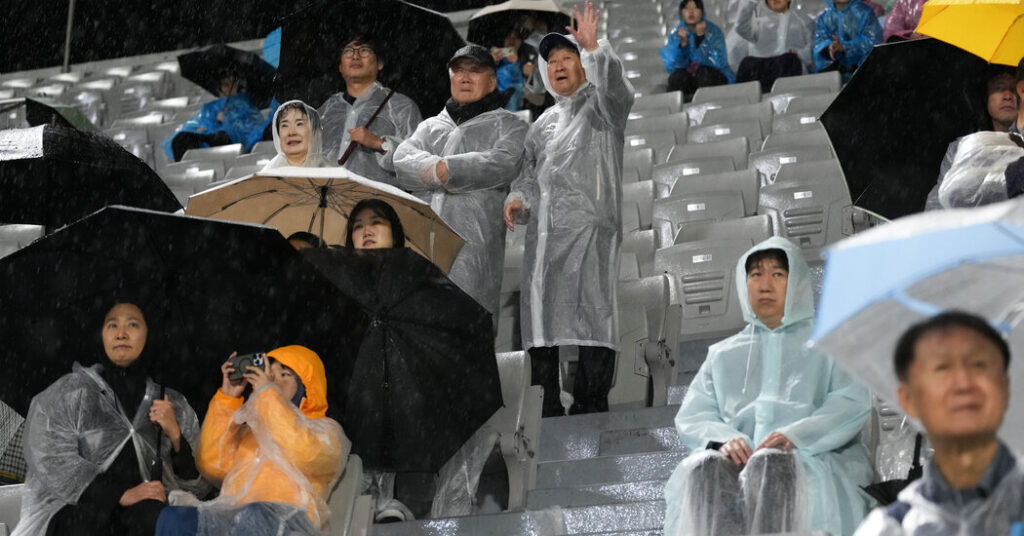
Despite the downpour, a few thousand spectators in raincoats showed up at the Suwon Sports Complex — a rare turnout in South Korea, where women’s soccer draws sparse crowds. A corner of the stadium pulsed with drums and chants of “Suwon!” for the home team, Suwon F.C. Women.
The match, a semifinal of the Asian Football Confederation’s Women’s Champions League, carried a weight far heavier than a trophy. On the Korean Peninsula, where the war never officially ended, sports are never just contests of skill. With no phones, mail or internet connecting the two sides, the arrival of North Korean athletes like Naegohyang feels almost surreal — a fleeting glimpse of compatriots long out of reach.
Naegohyang were the first athletes from the North to set foot in the South in nearly eight years. Over the years, sports have occasionally served as a fragile bridge, a way for the two governments to test the waters of diplomacy.
This time, however, the bridge seemed more fragile than ever. South Korea’s impeached former president, Yoon Suk Yeol, is on trial on charges of sending drones into the North to provoke military tension and justify his imposition of martial law, which lasted less than six hours. Meanwhile, Kim Jong-un, the North’s leader, has renounced reunification — which was a longtime goal — branding the South a “most hostile enemy” and ordering his troops to harden the border.
The tension was palpable even before kickoff. The North Korean team refused to share a hotel with the home team, forcing the South Koreans to scramble for new lodgings at the last minute. In the stands, fans were forbidden from waving the “unification flag” — once a staple of inter-Korean sports — and neither side was permitted to fly a national flag.
On the field, the rivalry was raw. The home team’s head coach, Park Kil-young, likened a match with the North Koreans to a war “without guns,” defined by aggressive tackles and verbal barbs.
“We will run, run and run some more to live up to the trust and expectations of our people, parents and siblings back in our fatherland,” Naegohyang’s captain, Kim Kyong-yong, said during a pre-match news conference. Her South Korean counterpart, Ji So-yun, responded with equal grit: “North Korean athletes are physical and use a lot of profanity. We can’t back down: If they curse, we curse back. If they kick, we kick back.”
In the end, the visitors won 2-1, after Suwon missed a penalty kick that would have allowed them to level the score.
Most of the volunteer cheerers were elderly, sitting quietly under raincoats. For them, Naegohyang’s visit stirred a bittersweet longing for reunification, even as politics made that dream seem ever more distant. In Korea, hometown roots run deep — especially among older generations, who often cite the saying: “Even wild animals, when they die, turn their heads toward their birthplace.”
“When I watched the North Korean players, I felt as though some of them might be my cousins, or their friends,” said Choi Jong-dae, 91, who had fled south during the Korean War alongside his father and a brother, leaving the rest of his family behind.
Holding Naegohyang’s team flag in one hand and Suwon’s in the other, Kwon Nak-ki, 81, said he cheered whenever either side did well. “It felt like reunification at heart,” he said. “I hope politicians on both sides can learn from the yearnings of ordinary people.”
For younger South Koreans, the sentiment is typically more distant. Lee Do-yi, 25, a college student from Seoul, said reunification has become a fast-fading concept among her cohort — “almost anachronistic,” in her words. “We seldom think about North Korea,” she said. “But seeing the North Korean players today made me realize there are real people living just north of us.”
For General Chung, who retired in 2012, the match was deeply personal. His parents began their life in the South selling canned goods from U.S. military bases. They eventually settled near the border, clinging to the hope that they would someday return home to a unified Korea. That day never came.
Still, South Korea continues to appoint governors for five provinces in the North to assert its territorial claims there and keep hopes of reunification alive. General Chung serves as the symbolic governor of one of those provinces, South Pyongan.
As he watched the Naegohyang players run, he relived the memory of his parents, who could recall their ancestral hometown with vivid details even as age dimmed the rest of their minds. He hoped that the North Korean team’s visit would lead to more exchanges across the divide.
“Naegohyang’s trip isn’t just about a sports game,” he said softly. “It brought a message of hope.”
Choe Sang-Hun is the lead reporter for The Times in Seoul, covering South and North Korea.
The post The South Koreans Cheering for a Visiting North Korean Soccer Team appeared first on New York Times.