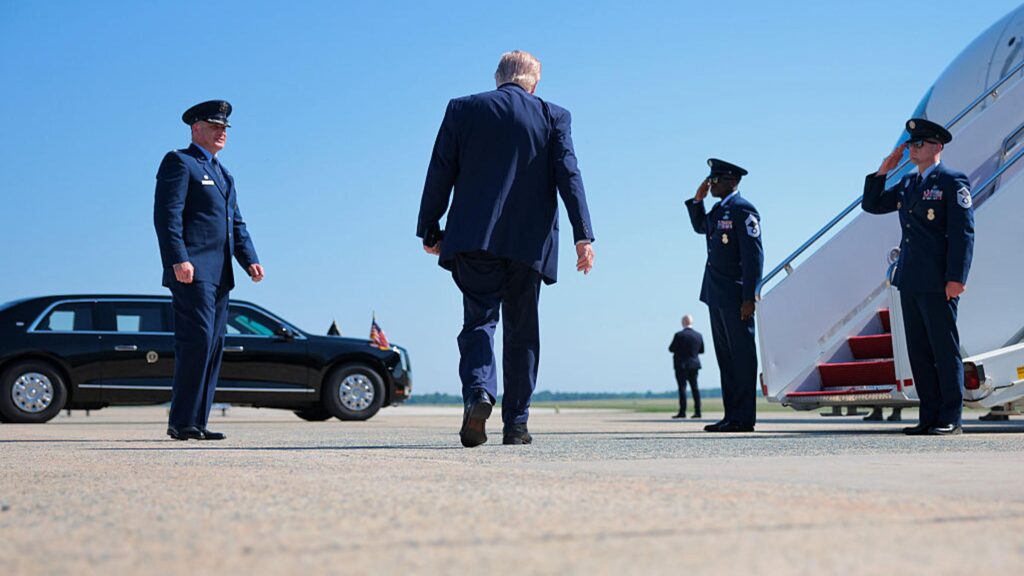
President Donald Trump has labeled numerous Americans—from Republican lawmakers to patriotic policy experts—as “stupid” and even “treasonous.”
Such behavior has led many to question Trump’s sanity and to offer the President some labels in turn, including “unhinged,” “lunatic,” and “clearly insane.”
It is easy to understand why Trump’s erratic actions and head-spinning reversals have raised questions about his mental health. For instance, on social media, Trump posts manic and divisive conspiracy theories, false allegations, and insults against his adversaries. Some former associates and partisan rivals even suggest Trump has experienced a pronounced cognitive and emotional decline.
But as a long-standing critic of Donald Trump’s leadership impact, and as someone who has known him for over 30 years, I assert that he is no “crazier” than he ever was. Trump’s penchant for exaggeration, self-promotion, and misrepresentation is hardly new.
These traits have long been chronicled, including in Tim O’Brien’s bold prophetic Trump Nation: The Art of Being the Donald; Maggie Haberman’s The Making of Donald Trump and the Breaking of America; and David K. Johnston’s The Making of Donald Trump.
And nearly a decade ago, the book edited by psychiatrist Bandy Lee entitled The Dangerous Case of Donald Trump, produced 27 mental health experts who questioned Trump’s fitness for high office. These experts suggested Trump showed signs of narcissism, sociopathic tendencies, and a fixation on the haunting legacy of his punishing father.
I have known Donald Trump for decades—longer than many members of the first or second Trump Administrations have known him. Trump seemed almost comically delusional to me in the mid-1990s when I joined Steve Forbes and his publisher, Jeff Cunningham, to visit the Mar-a-Lago estate in Palm Beach, which Trump had acquired in 1985.
Built a century ago by cereal heiress and socialite Marjorie Merriweather Post, the 20-acre property with its 126-room, 62,500-square-foot Gilded Age mansion seemed to be the ideal venue to launch a new high-end resort. At the time, I thought Trump’s grandiose visions for Mar-a-Lago were unrealistically fanciful. Surely this scheme would go the way of his failed casinos, airlines, and other imploded ventures. I was wrong.
Thus, I learned to take Trump’s antics seriously. This is why, in 2004, I warned that Donald Trump had tapped into an underappreciated part of the American national character that would drive him to run for president. Jeff Zucker, then the CEO of NBC Universal, would share each episode of Trump’s TV show The Apprentice a day before it aired, so I could write a review of the show—and of Trump’s leadership style.
Episode after episode, I was alarmed by how Trump treated women. And I also challenged the premise that a leader’s success should be anchored on a contestant’s ability to get their own team members “fired.” However, my warnings fell on deaf ears.
Some even argued that Trump’s leadership style was a harmless welcome relief from prevailing business leaders. “What’s lost on [Sonnenfeld] and so many others is that Mr. Trump’s brand of leadership, narcissistic and autocratic as it seems, strikes audiences as more palatable than the corporate shenanigans that have been in the spotlight on the public stage in recent years,” wrote Frank Rich.
After years of tension, Trump and I buried the hatchet once he changed the premise of The Apprentice to feature fallen celebrities who no one would care to emulate as leaders. This was the origin of his shift towards The Celebrity Apprentice.
In 2005, I brought Trump to a Yale CEO Summit, which I founded and lead. A dozen of the biggest business leaders warned me that if Trump arrived, they’d walk out in disgust. Trump arrived, and they walked out. Several of those people still lead their companies, but they are no longer walking out on Trump. Indeed, while very few business leaders supported Trump’s candidacies in 2015, 2020, and 2024, they dissent very quietly now.
In fact, in the spring of 2015, Trump called me often as he considered his candidacy for the presidency. I advised against it.
“Yes, Melania also said I should run,” Trump replied—the opposite of my recommendation.
I was a longstanding Hillary Clinton supporter, as he knew, and as he had been. I told Trump that I suspected he would earn no more than 20% of votes and that his campaign would implode like Ross Perot’s. Again, I was wrong. I underestimated him.
When Trump launched his campaign, he did so with a whirlwind of racist insults and attacks on heroes like John McCain. His deputy Hope Hicks would call me to help tone him down from his firestorms of manufactured rage–in vain.
Perhaps for comic relief, I was often invited to a salon-style dinner of largely deep-pocketed GOP financiers in the Connecticut home of later Trump economic advisor Larry Kudlow. As we went around the room during one of these post-dinner discussions in August 2015, everyone was asked to guess who would win the GOP nomination.
The guests tossed out the names of Jeb Bush, Ted Cruz, Carly Fiorina, and others. I suggested that they were overlooking the elephant in the room: Donald Trump. The crowd laughed. Kellyanne Conway, then helping lead the Cruz campaign, told everyone I was naïve, arguing that Trump would never win as much as 2% of women GOP voters. They all agreed that Republicans would unify around a “Dump Trump” strategy. I warned them that they were wrong.
I believe Trump to be a mercurial, vain, self-promoting purveyor of glitz. He has made his name beyond a checkered New York real estate career marked by multiple bankruptcies by bringing a certain view of class to the masses, with a simple but brutalizing recipe for success that seemed accessible to all. He was fully self-aware and deliberate in his actions then, and I believe he is now too.
For instance, time and time again, he deliberately taps into populist anger. When I interviewed Trump in September of 2015, he told me that he was considering going to the left of Bernie Sanders—until he realized that going to the right was faster.
As I document in my book, Trump’s Ten Commandments, Trump always relies on the same unorthodox disruptive tactics. His greed, grandiosity, divisiveness, and shifting agenda methods are not new.
To be sure, we all suffer whiplash when President Trump pivots from conjuring imminent national security threats regarding the status of Greenland, Venezuela, Cuba, and Iran—despite the lack of evidence of any immediate danger. This is not insanity. It is Trump’s deliberate ability to change the public dialogue from his losing hand on domestic topics, which he does not want to discuss.
Similarly, his divide-and-conquer tactics have successfully decimated any dissent within the GOP. All other national leaders try to draw the nation together in times of tragedy, but Trump uses them to create foils and to finger-point. This is not because he has gone mad. It is because it keeps working for him.
And when Trump threatens to destroy thousands of years of Persian civilization, so that the other party believes whatever the negotiated solution is a far better resolution than where things were headed, this is not a sign of poor mental health. Rather, this is a clear example of Trump’s go-to negotiation style: begin deliberations with threats.
The only thing Trump seems to worry about losing more than money is the durability of his pride and reputation. His insatiable desire to brand everything—from boats, to ballrooms, to bills—exceeds some of the most egomaniacal leaders in history, but these are not new qualities.
Donald Trump is unpopular in large parts of the nation and mocked around much of the world. But in many ways, he is no different from other unorthodox figures seeking fame and immortality. In my book The Hero’s Farewell, I documented how this mythical quest for immortality is common across cultures, continents, sectors, and centuries among those who seek folk hero status. Percy Bysshe Shelley’s poem Ozymandias, about the severed head of a self-worshipping pharaoh, helplessly buried and forgotten in the desert’s sands of time, with an adjacent plague warning that warns wanderers to fear him, reminds us of the futility of this goal. This is why I ultimately believe that while Trump’s dangerous lifelong “megalomania” may not endear him to many, it does not indicate insanity either. Instead, it indicates a clear pattern.
The post The Truth About Donald Trump’s Sanity appeared first on TIME.