When you buy a “gaming” accessory, you’re often buying a product that offers a little more oomph—a few extra perks or advanced features—catered to gamers who spend hours clicking away, trying to win. They may not be particularly chic, but these gaming peripherals are all about maximization, whether that’s a gaming keyboard, a gaming headset, or a gaming mouse.
Gaming desks are now a growing category. These furniture pieces accessorize your game room or home office while also minimizing distractions, so gamers can focus on gameplay. They often are designed to match their accompanying gaming chairs and their distinctive race car seat aesthetic. Various gaming-focused companies like Secretlab and Corsair offer some of the more comprehensive gaming sit-to-stand desks on the market—even Ikea has a few—but now esteemed furniture brand Herman Miller is entering the fray through its sub-brand, Herman Miller Gaming.
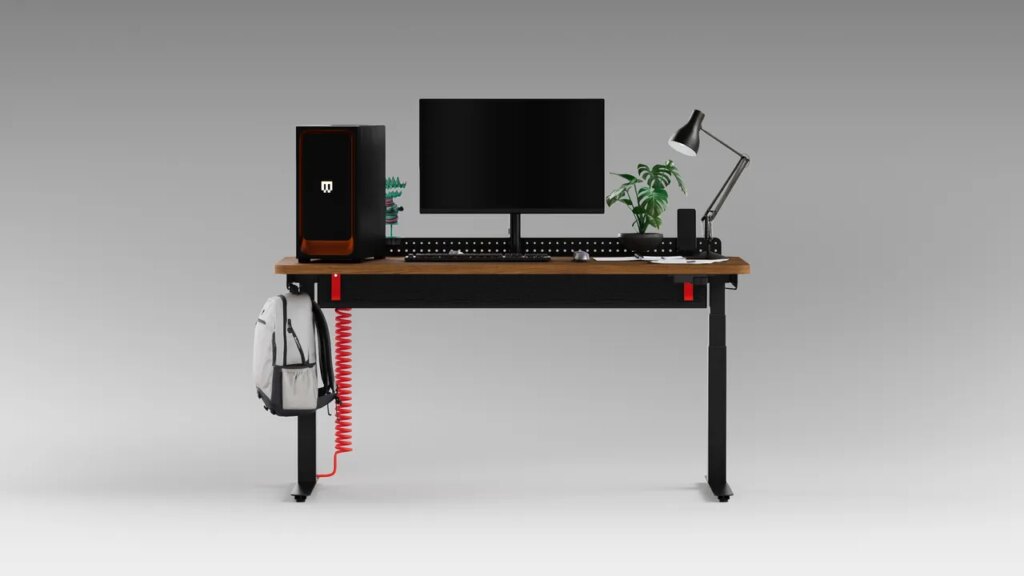
The Herman Miller Coyl is the company’s first standing desk built for gamers. True, the company also sells Motia-branded gaming desks that were adopted after Herman Miller acquired the furniture company Fully. But this is its first in-house design, and it’s easy to tell the various desks apart thanks to the Coyl’s three main design elements: the trough, the coil, and the dial.
First, the trough. This is the giant space underneath the desk, towards the back, where gamers can store all those unsightly wires and cables that run from their peripherals to their gaming PC. Most standing desks today offer some kind of way to route cables through the desk, but that’s child’s play compared to this. Very much like Secretlab’s Magnus Pro desk, the trough is unusually wide to accommodate plenty of cables and power strips. What’s also nice is that you can raise the desk to its max height and pull down the felt cover to access the trough from the front, like a mechanic working on a car, without needing to awkwardly fish for cables from the back of the desk or pull the whole desk away from the wall.
Then there’s the desk’s namesake, the coil: a distinctive red wire that runs from an outlet to the desk to power the motors and anything else you plug into the integrated power strip. It’s an intentional design. Rather than let the cable dangle as it awkwardly stretches to your outlet, the coil design keeps it taut.
“Coils by nature solve a problem, which is how do you keep a space clean and tidy, that has a variable length between two things,” says Steven Harton, senior product manager at Herman Miller. He says the design choice was inspired by the coiled cables on vintage tech like telephone handsets and early mechanical keyboards. The result is fun and orderly.
Finally, there’s the rotary dial. This is the height adjustment mechanism on the Coyl desk. Rather than using traditional paddles or levers to make the desk go up or down, Herman Miller employs a dial that feels like something you’d find on an old-school stereo—or a really nice gaming mouse. It lets you fine-tune the desk’s height to a 10th of an inch. (A display shows the table’s exact height.) That level of detail is an ode to the kind of precision gamers are fond of, digging into settings to maximize performance.
“Sensorially, how it feels and the feedback you get is an elevated experience relative to a button or a toggle,” Harton says. “When you use a dial, there’s a resistance to it that’s delightful.” We’ll have to wait for Knob Feel’s verdict on exactly how delightful it is.
There are other niceties. The Coyl desk has integrated hooks on either side, which gamers can use to hang their headphones or a backpack. An optional back panel upgrade adds a classic pegboard to the desk, allowing gamers to add small shelves and hooks to hold their gaming controllers, small plants, lamps, or their favorite Funko Pop. There’s also the option to add other Herman Miller accessories like monitor mounts.
The base version of the Coyl desk starts at $1,095. Add the cable management trough, and it’ll cost $1,495, and with the back panel, it tops out at $1,635. The rounded laminate desktop comes in four colors: black, white, walnut, and ash. You can program up to four height presets for the desk.
It may be advertised as a gaming desk, but Harton thinks the modern gaming environment is multifunctional—not just for gaming, but for consuming, working, and relaxing. That, and the fact that the desk is drummed up by a furniture company and not a gaming brand is likely why the design may not feel very gamer-specific compared to other options on the market.
But the Coyl doesn’t break new ground. In fact, it doesn’t really offer all that much more than many of the gaming standing desks of today. It doesn’t have a classy four-leg design, instead sticking with the T-shaped legs synonymous with most standing desks. The all-metal Secretlab Magnus Pro has a system of magnets that lets you neatly route cables, attach headphone holders, and even add a strip of magnetic LEDs for the full RGB look gamers are known for. When it first debuted, Corsair’s Platform:6 gaming desk—now discontinued, likely due to some structural issues with the desk’s design—came with a rail system that let gamers attach streaming gear like cameras, lights, and microphones and slide them around for the best Twitch setup.
Herman Miller’s solution is slightly more functional than your average standing desk, but it prioritizes a friendly aesthetic more than anything while commanding a higher price. At least the desktop comes with a 12-year warranty. (The base and mechanical parts are covered for seven years, and electrical components are covered for five years.) It goes on sale today.
The post The Herman Miller Coyl Standing Desk Is Built Just for Gamers appeared first on Wired.