“Thank God someone is doing something for those indigents.”
Across an elegant Bel-Air dining table, a real estate developer raised his wine glass. Not daring to say a word, I tapped mine against his. I knew his firm had just bought up land in downtown Los Angeles, tightening the noose around vital social services, the last lifeline for his so-called “indigents.”
At the time, I was the youngest violinist ever hired by the L.A. Philharmonic, groomed from childhood to perform and excel for the city’s wealthy elite. Just blocks from Walt Disney Concert Hall, tens of thousands of people slept outside on Skid Row — the largest concentration of unhoused Americans in the country.
For the last 17 years, I have made music between Disney Hall and Skid Row — performing Beethoven for billionaires on Grand Avenue, and playing for those living on San Julian Street — surviving the worst days, months and years of their lives.
Yet, on that street somehow named for the patron saint of hospitallers and fiddlers, amid people recovering from addiction, incarceration and generations of crushing poverty, I’d encounter some of the most incredible human beings — and musicians — I’ll ever meet.
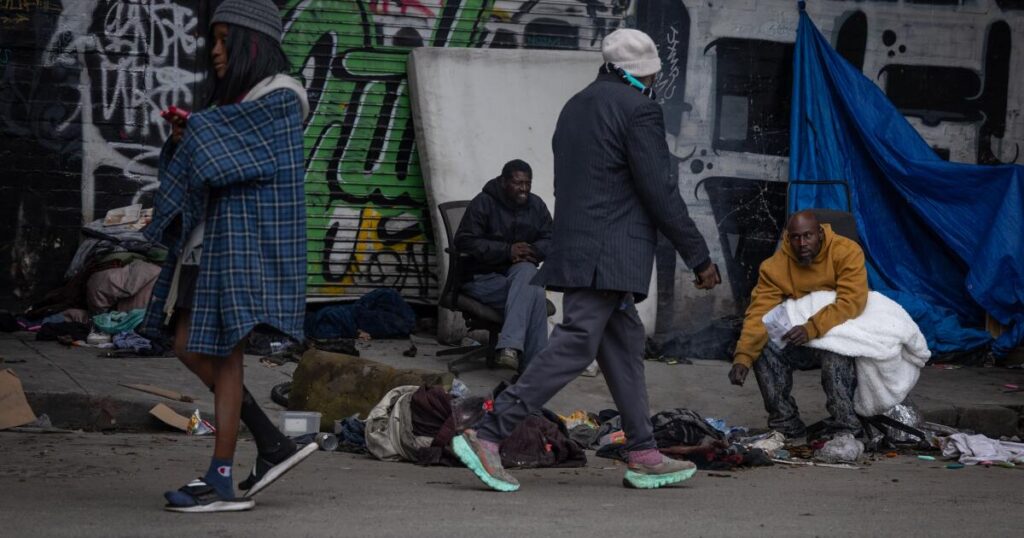
A homeless combat veteran — and an excellent tenor — once told me that Skid Row is the end of the line, where “people come to die.” This is the Skid Row that comes to mind for most: acute crisis, newest arrivals, tents and tarps, the Skid Row of news conferences and poverty porn.
When candidates in the L.A. mayoral race mention “Skid Row,” they’re referring to the visible crisis. They have plans for that Skid Row — sweeps, shelter beds, Inside Safe, encampment clearances. We’ve seen similar plans from previous mayors fail again and again — public spending on homelessness in L.A. has surged into the hundreds of millions of dollars annually over the last decade, while more than 75,000 people across L.A. County still remain unhoused.
What almost nobody running for the mayor’s office says is that Skid Row is not simply one of America’s largest homeless communities, and a crisis that needs to be solved. It is also one of America’s largest informal systems of rehabilitation, recovery, psychiatric triage, reentry and mutual survival that needs to be sustained.
A clinical outreach worker told me that Skid Row can also be the beginning of a new life. When I first started cold-calling clinics and shelters in 2010, wanting to put on concerts for people who would never be able to afford a ticket to see the Phil play at Disney Hall, I was overwhelmed by what I found: the Midnight Mission, the Union Rescue Mission, the Downtown Women’s Center, the clinics and reentry programs — organizations doing this work long before the current generation of politicians held office, all staffed largely by people recovering from their own years on Skid Row.
I’ve watched every mayor in L.A. run on homelessness, and I’ve seen hundreds of millions of tax dollars dissolve into lawyer fees, bureaucracy and craven photo-ops. The truest integrity I have found in this city lives in its underpaid social workers, security guards and shelter staff.
And then there is the Skid Row nobody campaigns on: the one that keeps people from ending up on the street, and the one that keeps people from returning to the street once they’ve left. The people in a 400-square-foot apartment with the Skid Row Housing Trust, a Section 8 unit east of Interstate 110, a sober living facility in South L.A. — whose stability depends on a housing voucher, a medication refill, a counselor who still answers the phone. One missed paycheck, one psychiatric break, one hospital visit from San Julian Street.
This is where L.A. keeps failing — and has been failing longest, because it is the least visible. Homelessness is not a crime. It is collective apathy made flesh. This is the consequence of a city that looks away: The poorest are left to carry the weight of a failure that belongs to all of us.
A woman I once met was living on that third Skid Row. She rode three buses a day across L.A. just to keep her name on a housing wait list, and still made time to sit in the front row of every Street Symphony concert at the Midnight Mission, in a freshly laundered pink tracksuit, calling me “Sugar.” Between movements of a Brahms Quintet, she told me how the clarinet sounded like light coming from the ground.
After the concert, she took my hand and told me how she’d lost her job when a corporate merger eliminated her position, and then she had lost her apartment.
“Homelessness is a full-time job,” she said. At the end of concerts, this woman would sometimes slip a folded $20 bill into my pocket. It was money from her General Relief — a mere $221 per month. Meaning, it was $20 she’d have to do without, for the rest of the month. I would plead with her to take it back. She never did. “No, baby” she’d say. “This is my concert.”
That is the part of Los Angeles I wish more people understood. Not just the suffering, but the humanity that survives inside it. Not just the tents, but the fragile ecosystems of care holding thousands of lives together every day.
The man with the wine glass is still out there, raising a toast to “doing something” for the “indigents” from a room insulated from the consequences — and the city has been governing from that same remove for 50 years. We criminalize and displace the people whose suffering makes us uncomfortable, because their fragility mirrors our own, and that is easier to clear than to confront.
The next mayor gets to decide whether L.A. protects the ecosystem that has spent decades doing what no policy has managed. That ecosystem doesn’t solve homelessness, but it refuses to let the people inside it disappear. The future of this city will not be determined by how effectively we hide suffering. It will be determined by whether we can build a Los Angeles where fewer people disappear from one another in the first place.
Vijay Gupta, a violinist, is a recipient of the MacArthur Fellowship, the founder of Street Symphony and the author of “Restrung, A Memoir of Music and Transformation.”
The post L.A.’s mayoral candidates aren’t interested in the real Skid Row appeared first on Los Angeles Times.