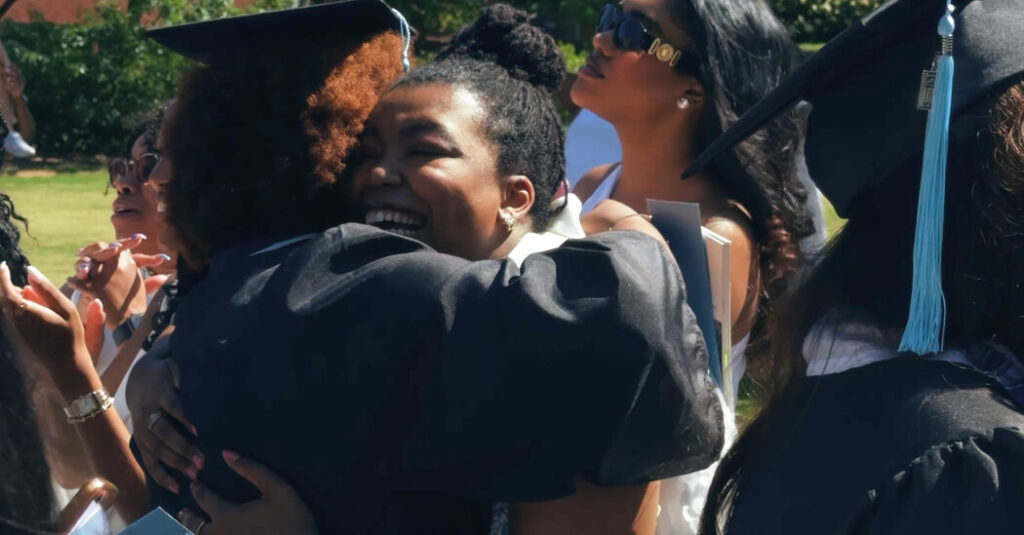
It’s the time of year when high school seniors walk across the graduation stage, steps closer to where they will go to college in the fall. Many factors go into deciding where to attend. How far do you want to be from home? How big a school do you want to go to? How much will it cost?
And perhaps most important: How welcome will you feel?
For Black and other minority students, college decisions felt different this year. The Trump administration has put higher education at the center of its efforts to dismantle diversity, equity and inclusion initiatives. And with the broader judicial and legislative attempts to roll back the hard-fought achievements of the civil rights movement, it’s working to erase the past. Building on the Supreme Court’s 2023 decision to effectively end race-based affirmative action in higher education, the government has forced schools to further redefine how they consider and address racial inequality. In practice, that can make it that much harder to to fit in.
Ten years ago, when I was making my own college decision, the education landscape felt less oppressive. It was the tail end of the Obama administration, and though racial dynamics are never not fraught in this country, the public language about embracing identity felt to me, as a high school senior, decidedly hopeful.
Still, I chose to attend Spelman, a historically Black college for women. In my sophomore year there — a few months into Donald Trump’s first term — I wrote a guest essay that made the case for choosing a historically Black college. “There is something powerful about attending an institution that was built for you,” I wrote at the time.
In this decidedly more oppressive, even less hopeful moment, historically Black colleges and universities feel more important than ever. They offer students something both radical and deeply ordinary: the chance to begin adulthood in a place where their lives are assumed to be central to the story.
I grew up in a largely white school system, and my heart had been set on attending an Ivy League school. I changed my mind in part because I began to see that I’d lost something by being the first, the only, the different, the exception. I wanted to be among other Black women for whom my presence needed no annotation. Soon after setting foot on campus as an admitted student, I felt I was being adopted into lifelong belonging within Spelman’s unique fortress of collective ambition. By the time I left the admitted students’ weekend, the decision to attend felt less like a choice and more like a return to something that had been waiting for me.
When I started to share that I was attending Spelman, both white and Black people in my hometown questioned my decision. Some were directly discouraging. Many people often assume, despite much evidence to the contrary, that H.B.C.U.s are unable to match the resources of historically white institutions. I remember being asked if attending one narrows, rather than expands, a student’s exposure to the world. It seemed that the unspoken assumption was that proximity to majority-white colleges was the natural measure of breadth and that a pedagogy built around Black life must be narrower by design.
In fact, my collegiate experience was rooted in an intellectual breadth that filled in gaps left by my previous education. Spelman enveloped me in an education grounded in self-knowledge, historical context and an understanding of how power moves through institutions and everyday life. Through signature courses like African Diaspora and the World, I learned not just Black history across the globe but also how to think across disciplines. The structure of this and other foundational courses that informed the school’s liberal arts core curriculum taught me how to question inherited narratives, situate identity within history and approach new environments with agency. Spelman gave me a global consciousness.
In my experience of living in Montgomery County, Md., because of willful ignorance or inherited indifference, historically Black institutions often went unnoticed, even when they were plainly accessible. When Spelman College visited my high school, I was the only student to attend its information session, already intrigued by the prospect of a school where my difference would not be my defining feature.
H.B.C.U.s endure as landscapes of preservation and safety, in addition to academic excellence. There has been at least a 160 percent increase in applications since I applied to Spelman a decade ago. It is a campus where the decision to attend reads less like a trend and more like a response. Asked about the application surge, Ingrid Hayes, Spelman’s senior vice president for enrollment management, said, “Students are looking for places where they don’t feel like an afterthought, an asterisk or like they need to explain themselves.” Deciding to matriculate happens when young people look around the room and realize that they would rather build the room themselves than wonder if they belong there in the first place.
“There is definitely a sense of wanting to connect back with people with a culture similar to mine and learn more about it, since I didn’t really grow up in a primarily Black area,” Lo Ward, a high school senior from Avon, Conn., told me. “Looking toward diversity is something I’m trying to do, because that’s not really an experience I’ve had in my life.” She thought about several H.B.C.U.s and is deciding between two.
H.B.C.U.s hold steady against the churn of political retreat and cultural amnesia. These schools operate on the premise that educating Black people is a pathway to autonomy, dignity and collective power, as their students uniquely read the world to recognize how race, gender, class and power shape experience. Spelman, Howard, Hampton and over 100 schools like them are expansive in their insistence that Black life is worthy of imagination without qualification. They account for only 3 percent of colleges and universities in the United States but nearly 20 percent of African American college graduates. They are the alma maters of around 40 percent of Black engineers and members of Congress and 50 percent of Black doctors and lawyers.
Spelman College is now in its 145th year. This political moment “looks very similar,” Spelman’s president, Rosalind Brewer, told me, to the tail end of Reconstruction. When the pendulum appears to have swung back to antagonism toward racial equity, H.B.C.U.s like Spelman preserve the intellectual and civic inheritance of Black Americans precisely when the broader culture moves to forget it. And they continue to make something new.
Skylar Mitchell is a writer and communications strategist.
The Times is committed to publishing a diversity of letters to the editor. We’d like to hear what you think about this or any of our articles. Here are some tips. And here’s our email: [email protected].
Follow the New York Times Opinion section on Facebook, Instagram, TikTok, Bluesky, WhatsApp and Threads.
The post The College Where I Wasn’t an Afterthought appeared first on New York Times.