In Boots Riley’s new movie, I Love Boosters, hard-up shoplifters wage war against a derivative fashion billionaire who relies on sweatshop labor and drops racist epithets almost as often as she calls herself a visionary. Societal loneliness is cured by way of a pyramid scheme led by a prosthetics-laden Don Cheadle, and a giant ball of eviction notices stalks people through the streets of San Francisco like the boulder chasing Indiana Jones in Raiders of the Lost Ark. There’s a soul-sucking demon, a boss who allots his employees 30-second lunch breaks, a frantic heist, and an action sequence involving ruthless Claymation villains. Riley calls it a “feel-good” film.
To those unfamiliar with the 55-year-old filmmaker’s work, tying that adjective to a movie that confronts so many evils might sound puzzling. But anyone who has seen his last two projects, 2018’s telemarketing satire Sorry to Bother You and the offbeat 2023 Prime Video series I’m a Virgo, will know exactly what he means. Because despite Riley’s sociopolitical grit—he has long identified as a communist, as reflected by the Coup, the hip-hop group he has fronted since 1991—he is a playful spirit whose art is as surprising in its surrealist humor as it is blunt in its civic messaging.
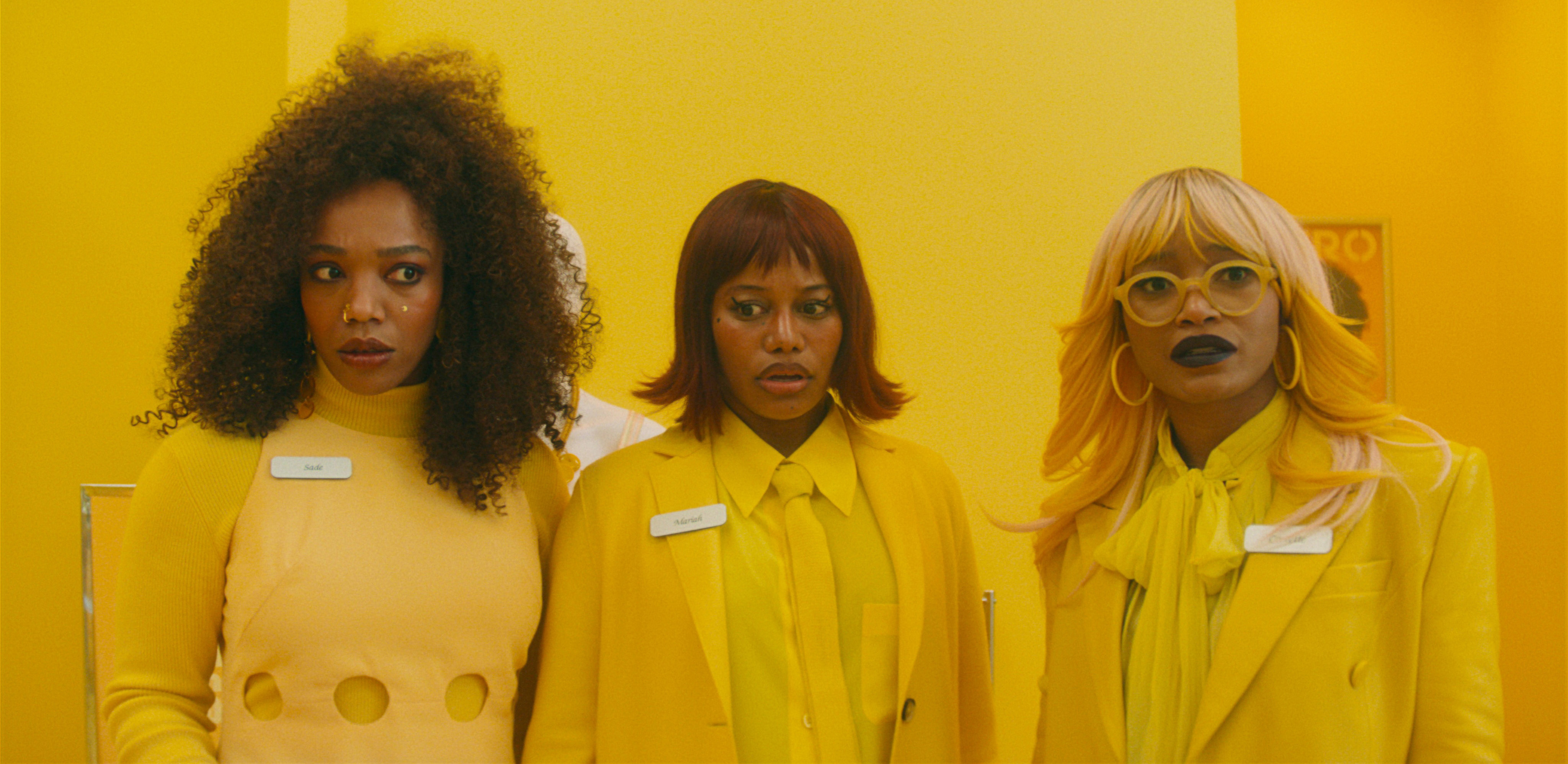
I Love Boosters is Riley’s most madcap effort yet, and that’s saying something considering we’re talking about an artist whose debut movie featured a mob of genetically modified human-horse hybrids. Boosters‘ zigzags revolve around a small, shambolic band of so-called boosters—who steal merchandise and resell it at discounts—led by Corvette (Keke Palmer), an aspiring designer whose idea was ripped off by the aforementioned fashion megalomaniac, Christie Smith (Demi Moore). The Robin Hood-lite bandits, who also include Taylour Paige’s Mariah and Naomi Ackie’s Sade, target Christie’s ridiculous monochromatic retail stores, eventually allying with factory laborers in China to take down her exploitative brand of capitalism. That mission involves a teleportation device, human transmogrification, and a luxury high-rise with an absurd 45-degree slant.
“I think this is my best work that I’ve ever made,” Riley says. “It’s talking about the connections between workers all over the world—specifically two regions at first, but then growing to this worldwide strike that’s turning into something that is actually starting to change policies. I think that has to do with where the world is right now.”
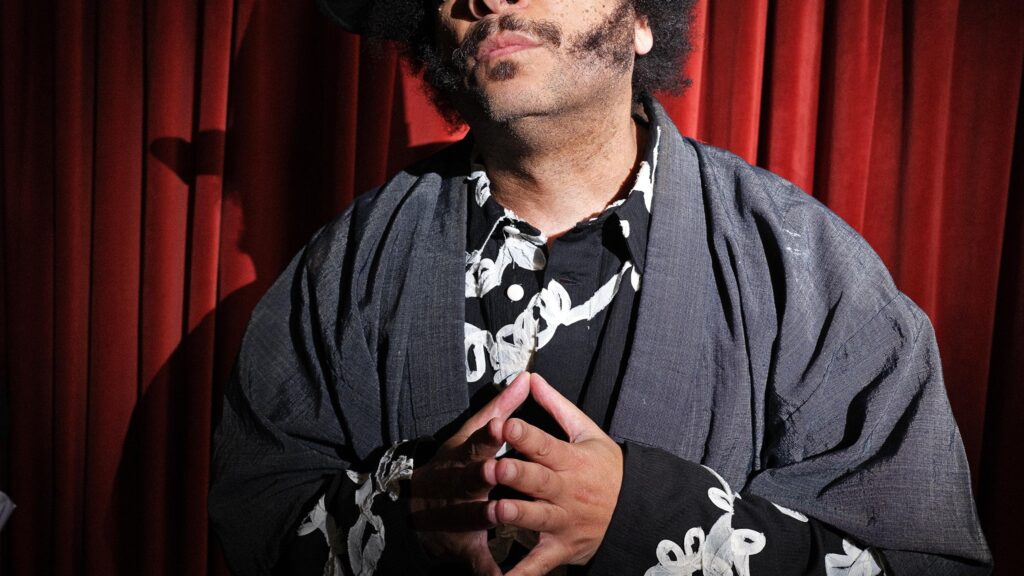
Like Sorry to Bother You and I’m a Virgo before it, I Love Boosters smuggles serious ideas into a winningly unserious package. Which makes sense: For all his issues-based philosophizing, Riley has a laxness about him. He wears comically tall hats, not unlike his friend Erykah Badu, who is thanked in Boosters‘ end credits. I meet him at a coffee shop in Downtown Austin a couple of weeks after the film opened South by Southwest there to a lot of rowdy fanfare. During our conversation Riley discusses workers’ rights, American power structures, and the Trump administration’s handling of the crisis in Gaza with a bright-blue oversized bowler on his head and a loud orange rhinestone jacket on his back. Palmer says he wore some sort of zany headgear to set every day during the shoot. (Much of Riley’s collection comes from Uptown Yardie, a small British company whose founder incorporates his Jamaican heritage in the designs.)
“He’s like an intellectual that is totally chill,” Palmer says of Riley. “Like when you’re watching a movie and you see that somebody has this really cool professor who teaches you math but it’s actually about life. I was soaking up everything.”
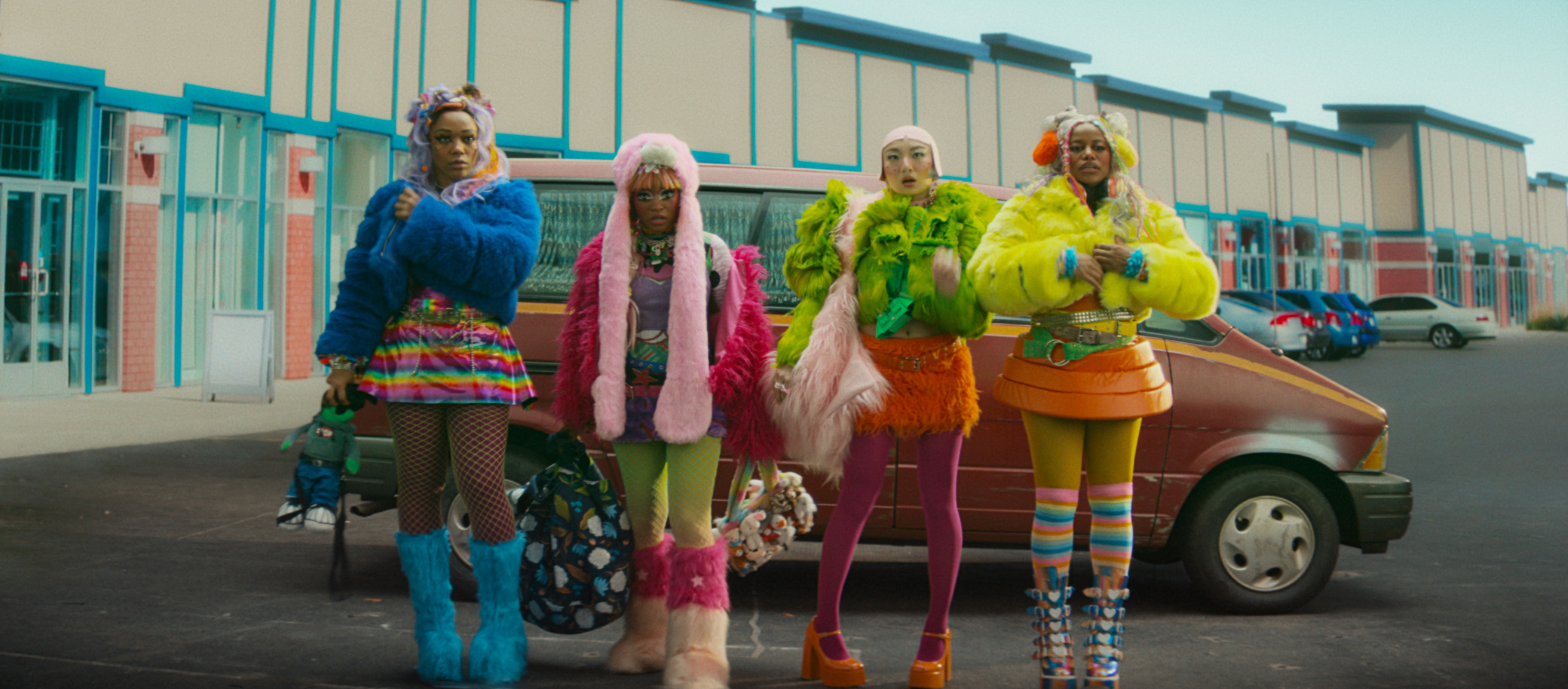
Riley started writing I Love Boosters in 2019. It came to him in part through personal history. In a Coup song of the same name from 2006, Riley raps, “This lady took me to her apartment/ It looked like the Macy’s sportswear department/ Clothes on the chairs, on the couch, andon the carpet.” This is apparently a true story from 30-some years ago, and a similar interaction opens the film: Corvette meets a fella at a bar, invites him over for a presumed hookup, and instead offers to sell him stolen goods that “go for one-third of what you’ll get at the store.”
Meanwhile, Corvette is squatting in an abandoned fried-chicken joint. That setup is familiar to Riley, too. Before and during the making of Sorry to Bother You, he and his now-wife and kids were squatting in a house the bank had foreclosed on in Oakland, the city Riley has called home since he was a kid. He’d rather pour his cash into his art, which he’s done since the Coup began performing. After his first movie won widespread acclaim and brought in a respectable $18 million on a $3 million budget, he sold four script ideas to production companies, including I Love Boosters and a forthcoming adaptation of Anne Washburn’s Mr. Burns, a Post-Electric Play. Only then could Riley finally afford to buy a house. He paid in cash.
Scrappiness has long been central to Riley’s identity. “I always think of myself as a very able-bodied person,” he says. “I can figure out how to get some rent paid, but I’m trying to carve away time to make the art I want to put out. These are necessary things. Maybe it’s not the same as someone who’s like, ‘I’m just trying to live, and this is the best I can do.’ I still have a certain amount of privilege. A lot of people who work at restaurants would be like, ‘Boots Riley, you eat here for free!’ I could survive. I have a good network.”
Riley got his first taste of insurgency at age 15, when he and a few friends staged a 2,000-student walkout after their local school board threatened to hold classes year-round. Later, when he started the Coup, he ignored the music-industry types who cautioned him that socially conscious rap wasn’t particularly commercial. (Those advisers were mostly correct, though the group did accrue strong critical plaudits and land a little airplay on MTV and BET, counting Tupac and Rage Against the Machine guitarist Tom Morello among its fans.) And when Riley was pitching I Love Boosters to investors, he had to figure out how to squeeze an effects-heavy chase sequence into a relatively modest $20 million budget without shortchanging his vision. For what it’s worth, this is the most expensive movie that Neon—the trendy studio behind Parasite, Longlegs, and Anora—has released to date.
“When I’m going through hardships to make my art, you kind of feel like, ‘I’m paying my dues,’” Riley says. “The struggle is part of the process. You gotta have something that you’re more passionate about than the art itself, though—something that you are so passionate about that you gotta tell everybody.”
For Riley, that passion is revolution. If one micro-theme unites his work, it’s this: Change comes not through individual action but through collectivism. Sorry to Bother You and I Love Boosters both end in uprisings targeting corporate malfeasance. The shoplifting trio in the latter movie expand their operation from a way to make ends meet to a global campaign, picking up confederates in a rebellious Chinese factory operative (Poppy Liu) and a labor-organizing cashier (Eiza González). Riley is a firm believer that living an alternative lifestyle or simply shirking a couple of worldly ills is not enough to constitute activism because it does not create meaningful progress.
“For me, the rebellion comes when you can change the actual system,” he says. “We can paint bridges a different color, and that may have some value, but that’s not going to change the problem.”
Riley posits that art can help. After Sorry to Bother You came out, he heard from someone in Baltimore whose coworkers mounted a labor strike inspired by the movie. As he sees it, people are becoming more willing to speak out against the ruling class, whether that means everyday employers or government elites. He cites this year’s demonstrations in Minnesota, during which thousands of obstructionists rebelled against ICE’s deportation tactics. I Love Boosters takes dissidence to an even greater extreme, turning Riley’s radical streak into dense, maximalist razzmatazz.
Lakeith Stanfield, who headlined Sorry to Bother You and has a juicy supporting role in I Love Boosters, feels proud to have watched Riley evolve over the past decade. They first met at the Sundance Film Festival, where the director pleaded with the actor to read his debut script. Stanfield, who had starred in Straight Outta Compton, Atlanta, and Get Out, was skeptical, as any established performer might be of a first-time filmmaker. But he was bowled over by the originality he saw on the page. Now, Riley doesn’t need to beg for anyone’s attention.
“He has so many ideas, so many projects stored up in his head that he could just roll it like a roulette wheel and pick which one will be next,” Stanfield says. “This movie was spearheaded by a guy who has only grown in his imagination and his gumption, so it was really special to watch him work in a bigger capacity.” But on set or off, Stanfield says, “He’s always Boots the activist, Boots the opinionated, Boots the imaginative.”
The post How Boots Riley Made a ‘Feel-Good’ Movie About Capitalist Exploitation appeared first on TIME.