When a Chinese court ruled late last month that a tech company had illegally laid off a worker after replacing him with artificial intelligence software, it delivered an implicit warning to other employers.
“The development of artificial intelligence technology should be applied to liberating labor, promoting employment and improving people’s livelihood,” the Hangzhou Intermediate People’s Court wrote. “Labor law allows employers to undertake technological changes and upgrade their operations, but it should also take into account the protection of workers’ legitimate rights and interests.
The case — the third time the Chinese government has highlighted a ruling siding with workers displaced by A.I. — underscores how Beijing is contending with the need to balance its ambitions for the widespread use of A.I. with the unemployment that might accompany it.
China has invested billions to become an artificial intelligence superpower and raced to integrate the technology across a broad range of industries. But those aspirations have run headlong into a growing political problem: anxiety over the workers who could be displaced by the realization of Beijing’s technological drive.
“The deeper tension is between this all-out push for A.I. diffusion into the economy, and wanting that to not actually impact any jobs,” said Matt Sheehan, a senior fellow at the Carnegie Endowment for International Peace.
Governments around the world are wrestling with how A.I. will disrupt labor markets. Officials in Japan, the United Kingdom and South Korea have floated versions of a universal basic income for workers who have been replaced by technology.
In China, the debate has become especially acute amid a sluggish economy and persistently high youth unemployment — about 17 percent — that has fueled disillusionment about opportunities for upward mobility. More than 200 million workers have already been pushed into low-paying, demanding jobs in the gig economy.
Against that broader backdrop of economic anxiety, fears about A.I. technology replacing workers have intensified, especially after a robotaxi in Wuhan struck a pedestrian, Mr. Sheehan said.
“Despite being an authoritarian country, the Chinese government is actually very attentive to what people are thinking and feeling and saying on the internet, and they feel like they need to respond,” he said.
The trio of court rulings has offered an early glimpse of what that response might look like. In each case, the courts said employers remained responsible for keeping workers on the payroll, even if A.I. had rendered their jobs redundant. Judges have repeatedly ruled that replacing workers with A.I. is voluntary cost-cutting that does not justify mass layoffs.
Chinese policymakers appear eager for both workers and employers to get the message. The Hangzhou ruling in favor of the tech worker replaced by A.I. was given a special designation signaling that it should serve as a model for future cases.
In that case, an employee identified in filings only by the pseudonym Zhou had worked as a quality assurance supervisor at an A.I. company until the technology replaced him. When the company offered him a new role that would cut his salary to 15,000 renminbi per month from 25,000, he refused and was fired. The court ruled his employer had failed to properly accommodate him.
Jiang Xiaotong, the lawyer who represented Mr. Zhou, said he “not only suffered a blow to their income but also experienced acute professional anxiety, becoming deeply apprehensive about their future career prospects.”
Mr. Zhou is “middle-aged and faces significant family and financial pressures,” she said. He is one of the midcareer professionals in China struggling to weather a difficult job market that prizes youth.
Ms. Jiang said the court’s decision to designate the ruling as one that other courts can follow was significant.
“Now that a precedent-setting case has been established, people are far more willing to take up the weapon of the law to defend their legitimate rights and interests,” she said.
In a similar case in Beijing, an arbitration panel ruled in favor of a map data collector whose entire department was laid off and replaced with artificial intelligence. The panel found that the company’s adoption of A.I. was a voluntary move to remain competitive and did not warrant the employee’s firing.
Companies that benefit from technology must, at the same time, adopt “social responsibilities” and protect worker rights, the panel ruled.
Government rhetoric around the deployment of A.I. initially stressed the technology’s benefits to workers. Recently, however, official statements and commentaries by state news outlets have begun to acknowledge artificial intelligence as a potentially corrosive force in the job market.
“The government was really pushing this diffusion agenda,” said Ruby Scanlon, a research associate at the Center for a New American Security. “Increasingly, there’s been a lot more rhetoric and nudges and policy documents to the idea of actually creating a backstop for employees.”
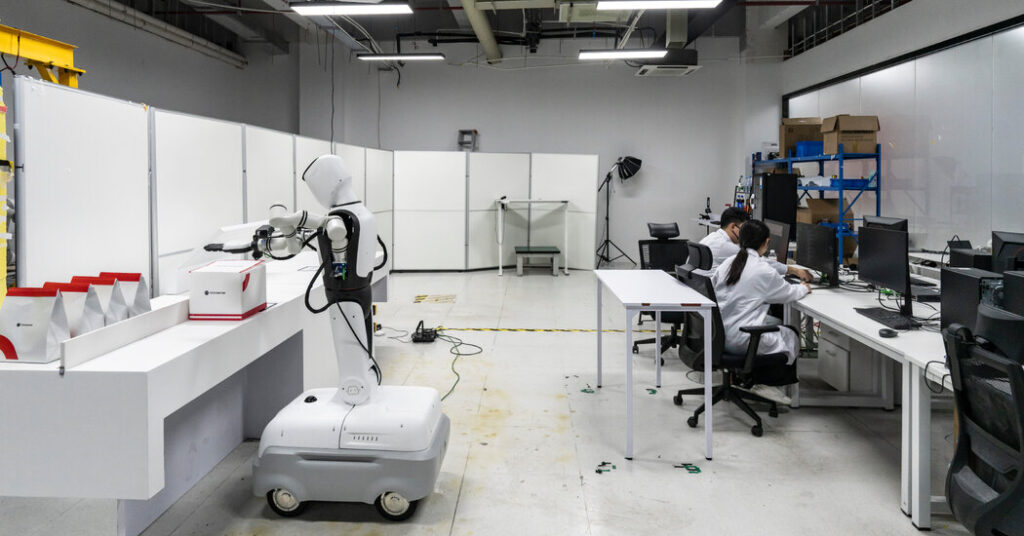
In China, robots and A.I. have already played a disruptive role in two of the nation’s largest employment categories: manufacturing and food delivery.
More than two million robots were already working in Chinese factories as of 2024. And in Beijing, Shanghai and Shenzhen, Meituan, the nation’s largest food delivery service, has experimented with using small autonomous robots to deliver food. In Shanghai, Meituan delivers over 1,000 meals a day using those robots, according to promotional materials published by Nvidia.
With those changes in mind, China’s Ministry of Human Resources and Social Security announced in January that it would roll out policies to address “the impact of artificial intelligence on jobs,” including “targeted employment support for key industries.”
A handful of party officials have proposed sweeping government intervention, such as encouraging employers to offer vocational training to help workers adapt to an A.I.-centric job market. Liu Qingfeng, a tech firm founder and member of the National People’s Congress, has called for a government led “A.I.-unemployment insurance program” to create a safety net for displaced workers.
For now, though, the focus appears to remain on encouraging companies themselves to hold off on layoffs.
“Truly visionary companies will leverage the technological advantages of A.I. to explore new avenues and create new jobs, making technology a driving force for corporate development,” a commentary in March from Xinhua, the state news agency, opined. “Those companies that equate A.I. with ‘reducing staff’ may seem to lower costs in the short term, but in reality, they lose the core competitiveness of talent accumulation and further erode employee trust.”
Li You contributed research.
Catie Edmondson covers Congress for The Times.
The post China Wants A.I. to Flourish, but Not at the Expense of Jobs appeared first on New York Times.