For the first year of Trump’s second term, the administration’s approach to AI could basically be summed up by the phrase “let them cook.” The Tech Right argued that resisting regulation was an inherently conservative stance—so Trump and officials like David Sacks happily cheered on the AI industry as it built ever-more-powerful models, disrupted industries, and propelled the stock market to new heights.
But that pro-tech contingent in Trump’s White House is now in danger of being overtaken by an AI safety movement within MAGA. Sacks announced he was stepping away from his White House role in March. Within the last couple of weeks, reports have emerged that influential figures like Trump’s chief of staff Susie Wiles and Treasury Secretary Scott Bessent have been pushing for AI guardrails.
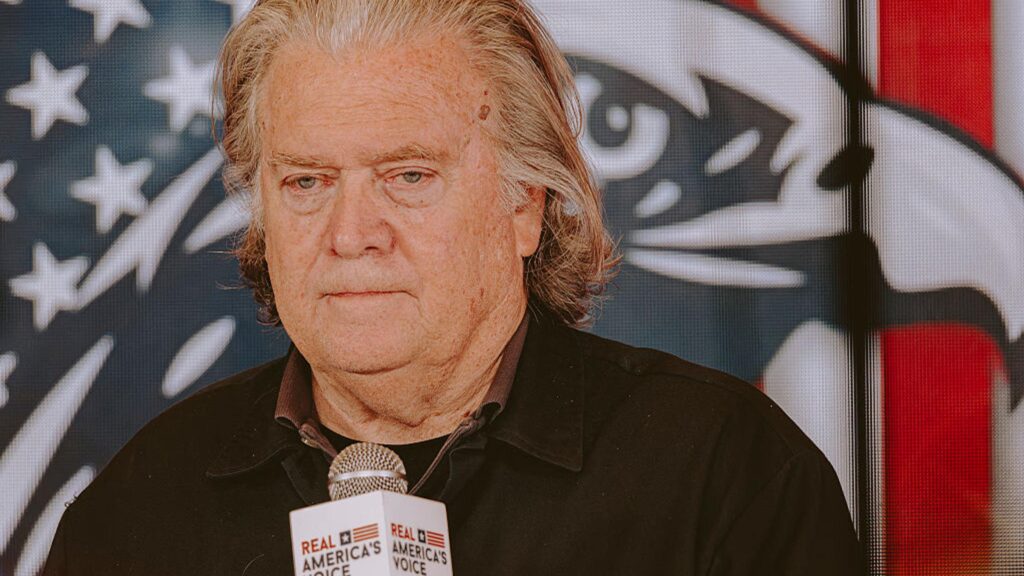
And on Friday, a group of over 60 self-described “America First leaders,” most prominently Steve Bannon, wrote an open letter to President Trump imploring him to support the mandatory testing of powerful AI models before their release—a policy that would be even more stringent than Biden’s AI rulemaking. “We cannot trust these companies to police themselves,” the letter, which was also signed by over 30 pastors, reads.
That this group is gaining traction—and feels emboldened to call for aggressive policy measures—marks a remarkable turnaround from last year, when J.D. Vance dismissed AI safety in favor of “AI opportunity” at a Paris AI conference. Brendan Steinhauser, who is the CEO of the Alliance for Secure AI and signed the letter, says he’s seen a relatively rapid momentum shift toward AI safety in the administration recently. “We feel really quite good about the conversation today versus even three or four months ago,” he tells TIME.
This shift has been driven by a couple of key factors. First, Anthropic announced its Mythos model, which has proved extremely adept at exposing software vulnerabilities, leading cybersecurity experts to argue that cutting-edge models need to be controlled.
Read More: ‘Too Dangerous to Release’ Is Becoming AI’s New Normal
Second, waves of recent polling have shown that Americans, including conservatives, remain very negative on AI and its potential impacts on jobs, information and education. Last week, the Institute for Family Studies and YouGov released a poll showing that American voters support the idea of the White House vetting AI systems for safety by a margin of 20 to 1. As the midterms approach, the “let them cook” philosophy to AI could become increasingly untenable.
“If we don’t develop good policies on this and a good message on these issues, we’re going to be on the wrong side of this politically,” Steinhauser says. “We’re already facing headwinds as Republicans, and so we can’t give the Democrats another opportunity here.”
But the MAGA AI safety bloc has by no means won the battle for influence. One accelerationist in the administration fired back in the press, and a website page about the Trump administration’s vetting of some AI models mysteriously disappeared a few days after being posted.
Of course, all of this comes down to what Trump himself believes. On Friday, Trump told reporters that he had discussed AI guardrails with Chinese President Xi Jinping during his trip to China. But he remained extremely vague about the details and generally supportive of AI; tech leaders like Nvidia’s Jensen Huang accompanied him on the trip. “AI is fantastic,” Trump said. “So many things can happen in terms of health, medicine and operations, everything … military.”
The post Could MAGA Turn Trump Against AI? appeared first on TIME.