The egg is one of nature’s greatest little brainstorms. The largest single cell of any species, the egg is a self-contained engine of incubation, doing away with the need for a living womb to keep a growing organism safe, nourished, oxygenated, and alive. All of that happens automatically inside a shell that can be as small as a pea for a hummingbird and as large as a melon for an ostrich. Human beings, for all their engineering smarts, would be hard-pressed to invent something so simple and elegant and keenly imagined. Until now.
On May 19, Dallas-based Colossal Biosciences, which last year made headlines when it effectively de-extincted the dire wolf, announced that it had hatched a flock of 26 live chicks from fully artificial eggs. The technology behind the breakthrough can be later applied to bring back the dodo and New Zealand’s giant, flightless moa—both on Colossal’s de-extinction “to do” list.
“Every new scalable system for de-extinction is ultimately a biology problem wrapped in an engineering problem,” said Colossal co-founder and CEO Ben Lamm, in a statement that accompanied the announcement of the hatchings. “Restoring species like the South Island giant moa isn’t just about reconstructuring ancient genomes…it requires building an entirely new incubation system.”
Designing an artificial shell is not easy because a natural shell is deceptively complex. Made principally of calcium carbonate arranged in a crystalline structure, a typical egg shell is no more than 0.4 mm thick, and covered with up to 17,000 tiny pores to allow for gas exchange with the ambient atmosphere—carbon dioxide out, and oxygen in. There are, too, a pair of slick inner membranes in the egg that perform another critical function, protecting the growing chick from invading bacteria. But those membranes have to be exceedingly thin.
“Evaporation is an important part of chicken development,” says Chris Lambert, Colossal’s hardware and engineering manager. “A precise amount of water each day needs to exit the egg, so that membrane is 20 microns thick. A single human hair is about 100 microns.”
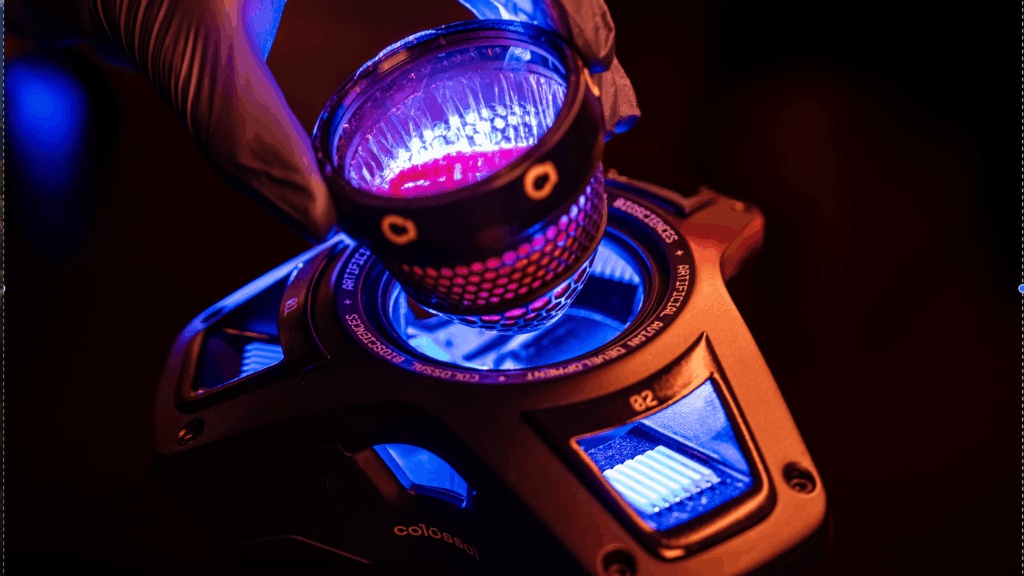
The egg Colossal invented was very different. The inner membranes were made of vanishingly thin silicon using a proprietary technology that Colossal is planning to patent. The shell itself was only about two-thirds of a shell—a titanium structure that resembles nothing so much as a soft-boiled-egg cup with its top missing, albeit with hundreds of hexagonal pores to allow for gas exchange. Once a few dozen of the titanium eggs were manufactured, Colossal gathered fertilized chicken eggs from an avian farm the company owns and operates and transported them to the lab. There, the scientists gently opened the top of the egg and transferred the yolk and the white and the tiny embryo onto the titanium egg cup and covered the cup with a transparent lid. The embryos were about three days past fertilization when they were transferred, meaning that they had 18 days remaining in their three-week incubation cycle.
“We place the egg into an incubator that controls the environment,” says Lambert. “We then collect visual images at periodic milestones to understand how development is progressing.” When the incubation period was done, the chicks began “pipping,” using their beaks to break through the membrane just the way an ordinary chick breaks through its shell. Eventually, the 26 chicks were moved to the same Texas farm from which their eggs were collected, where they can live out their five to 10 year lifespan.
There is, of course, no need fior a new technology to create chickens, as the egg does a perfectly adequate job of producing the 27.6 billion of them that are alive around the world on farms and in hatcheries at any one time. But Colossal has its eye on another animal entirely. In July, the company announced that it intended to de-extinct the 12-ft.-tall, 500-lb. flightless bird known as the Moa. The species once thrived across New Zealand until human beings hunted it to extinction some 600 years ago. The disappearance of the moa also resulted in the disappearance of the Haast’s eagle, which relied on the moa as its sole prey.
De-extincting the moa will begin with sequencing its genome from abundant tissue samples that exist in museums and private science collections. The scientists will then turn to a closely related related living species—either the tinamou or the emu—and extract primordial germ cells, or cells that develop into egg and sperm, from a tinamou or emu embryo and rewrite their genome to match key features of the moa. Those edited cells will then be introduced into another embryonic tinamou or emu inside an egg. If all goes to plan, the cells will travel to the embryo’s gonads, transforming them so that the females produce eggs and the males produce sperm not of the host species but of the moa. The result will, in theory, be an emu or tinamou that hatches, grows up, mates, and produces eggs containing moa chicks.
But there’s a problem with this plan. A fully developed moa egg is 80 times the size of a chicken egg and eight times that of an emu egg. A surrogate emu could lay an egg that, for a time, would be big enough to accommodate a tiny moa embryo, but as the chick-to-be continued to grow, it would be far too large for the shell that encased it. The strategy then would be to carefully crack open the shell and transfer the contents to an artificial egg like the ones that produced the chickens, but 80 times larger.
“We have not set a date publicly [for when a moa could hatch],” says Lamm. “But I think it’s the mid 2030s.”
Before that, Colossal must practice with other species of small birds, then scale up to a large emu, and finally to the brobdingnagian moa. Nature created the perfect little reproductive package when it invented the egg. Science, slowly, is learning to match it.
The post Chicks Hatch From World’s First Artificial Eggs—A Breakthrough Key to Bringing Giant Birds Back From Extinction appeared first on TIME.