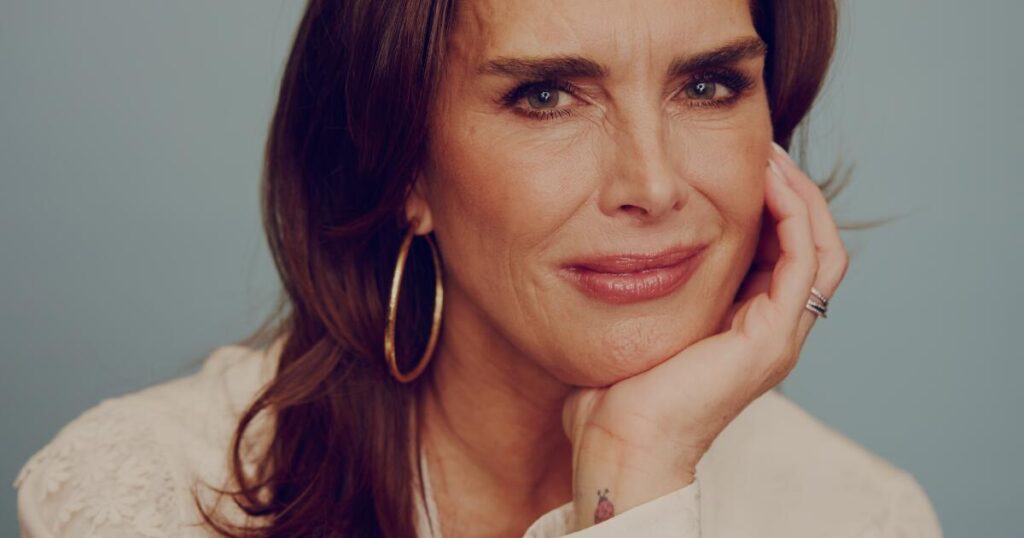
Brooke Shields would not consider herself an armchair detective by any means.
“I don’t want to really know,” she says on a recent weekday. “I’m not big on gore. I like getting just enough clues to make me feel smart, but not to really get it — at the end, I want to be like, ‘I didn’t know who did it.’”
But she’s having fun playing one onscreen. In Acorn TV’s “You’re Killing Me,” she plays Allison “Allie” Chandler, a bestselling mystery novelist behind the popular Selena St. Cloud series who, after feeling the push from her publisher to freshen up her work, partners with a young, aspiring writer and podcaster named Andi (Amalia Williamson) to solve real-life crimes in their small fishing town in Maine. And like the competent multitasking women they inhabit, as they’re piecing clues together, their dynamic fuels a path of internal discovery for both. The six-episode murder mystery dramedy — created by Robin Bernheim, a longtime collaborator of Shields — premieres Monday.
Over video call from the New York City office of AMC Networks, the parent company of Acorn TV, the 60-year-old actor spoke about how she relates to the character and finding self-worth beyond age and beauty. These are edited excerpts from the conversation.
What drew you to “You’re Killing Me,” and specifically the character of Allison Chandler, at this stage in your life and your career?
It felt bizarrely autobiographical in the sense that I’m in an era in my life where my kids are making fun of me because I say things like, “There will be no vaporizing in this house” — and I say it with complete conviction. There was this idea of this generational gap between these two women. When Robin and I were developing this, we thought, “Wouldn’t it be interesting to delve into that dynamic? And what world could we set it in that would make it fun, smart, a little dangerous at times, but really just purely entertaining?” What made me love Allie is that she’s not afraid to look stupid. But when her real wits and intelligence come into place, it’s unbeatable. There’s this level to her. She’s silly. She doesn’t mean to be, she doesn’t take herself too seriously, but she happens to be very intelligent, so that combination of those two things makes her just appealing. And then the relationship with Andi is so counterbalancing in a really delightful way.
She’s also confronting this existential question: What do I want my life to look like now? And trying to figure out if she has some agency in that, or does she just have to let it happen to her. What did that part of it spark in you?
It has to be twofold. You have to be at a place in your life where you claim your agency, but you can’t claim something so tightly that you think you can dictate it. You have to be open. And I think that’s what Andi helps Allie do. There’s this idea of knowing who she is, but also allowing herself to go with a flow, which is not in her DNA. But that also is very indicative of my generation and where I am in my life, which is: Kids are gone. We’ve done all this stuff to make sure they can go out in the world on their own, and now we’re at the precipice of, “Well, who am I? What does that mean? What do I do? Am I still a sexual being? What motivates me?” All that kind of stuff that happens to a woman in my age bracket.
What’s that been like for you to navigate?
Part of it’s terrifying, and part of it is like, “Let me out!” It’s basically uncharted territory. We’re not taught this as women. We’re not taught it culturally. We’re not taught it historically. … Women are much more formidable than people give them credit for in this age. You have to go through all the stages of it. I mean, I thought my world had just fell out from underneath me when my second daughter left. Then there’s a freedom in it. I started my own company, Commence, about that — about empowering women, to say: You’ve done the kids, you’ve had the career, what do you want now? There’s no rules. It’s scary.
Because you came up in Hollywood or were coming of age in Hollywood, does this stage of life actually feel like more of a moment of discovery for you about who you are? Or how do you think about it?
Absolutely, hands down. And I do attribute a lot of it to this show because while being a part of “You’re Killing Me,” I was an executive producer, and in my career, I’ve had titles before, but I had never been asked my opinion before. That doesn’t happen a lot. I never lived in Hollywood. I never knew that world, but I was a model and an actress. It wasn’t until I went to college that I started understanding that I had my own brain. This era of my life, I’m so enjoying having opinions and voicing them and watching what happens when I do that with respect. I’m a woman who’s lived a lot and have a lot more that I want to live. I’m grappling with it in real time. And so is Allie. Allie has had multiple marriages, and this young woman comes into her life, and it’s fraught, but they’re learning from each other. I feel like that’s where I am right now. But I feel so much stronger and better now than I ever have.
I want to talk more about the dynamic between Allie and Andi. In any industry, there’s always the fear of how long can I hold on to my relevance, and when am I going to be pushed out by the next generation? You’ve talked about your time at Princeton and, when it was over, worrying about whether people in Hollywood forgot about you. I’m curious what you’ve come to appreciate or understand about that.
There’s a currency that accompanies youth and beauty. At a very, very early age, I knew, “I’m not always going to be 15; I’m not always going to look like I did in ‘Blue Lagoon.’” OK, but then this body gave me babies, and this body survived accidents, and was on Broadway multiple times. You have to go through and decide where your real currency is for you. And to me, that was longevity, that was intelligence, that was friendships and being the kind of person I wanted to be. In Hollywood, as an actress — listen, once you’re not an ingenue, you’re done, right? There’s only a few Meryl Streeps and Glenn Closes and Helen Mirrens. The pool gets very, very small. As a young person, I knew that I couldn’t put all eggs in one basket. When I got an education, I thought, “Oh, OK, what motivates me? Is it writing? Theater?” I tried to look at where I was as a whole human and how I could still stay creative because if I had moved to Hollywood and just waited to be picked, I’d be a disaster at this point.
I was a fan of “Suddenly Susan,” where you leaned into the physical comedy, and I enjoyed seeing you do some of that here.
I had to fight for it … because everybody’s always so worried that I’m not going to be likable or I’m going to be silly or stupid. And I said, you balance it with the drama and the emotional part. It’s where I’m happiest. Maybe it’s no Academy Award but, to me, it’s joyous to be able to not be afraid to look silly or stupid or falter or have flaws or all of that, so that when I do show up differently emotionally and dramatically, it resonates a little bit more. I like that type of character to play.
Allison’s publisher thinks it’s time to retire the beloved fictional character, Selena St. Cloud. To make the point, he uses statements like, “Give the old gal a rest” and ”You need to broaden your appeal.” I suspect you’ve encountered your fair share of exchanges like that in your career. Can you tell me about one that stands out?
It’s not one, it’s this through line of once your ovaries don’t work, you kind of lose your value. And that is in every industry. Her sales with the Selena St. Cloud novels are waning a little bit and new blood comes in. And new blood is always much more exciting — it’s sexier, it’s prettier, it’s cuter, it’s buoyant and softer and everything. That’s a dynamic that women deal with all the time. I knew that from a young age. My mom was like, “There’s always going to be someone coming up behind you. Make room for them.” That was a really important lesson because it didn’t negate my value, but it allowed me to pave the road for other women. People don’t think that. They think we’re bitchy. They think we’re attacking each other. It isn’t that you’re replaceable, it’s that there’s more for you to do in different paths. That’s why I called my book “Brooke Shields Is Not Allowed to Get Old,” because people want want me to stay a certain way. So, I’ve experienced it, but I never had to really believe it. Because while I wasn’t being wanted in film, I was navigating to TV and theater and and comedy and writing and finding other ways to keep realizing my capacity creatively. That’s what these two women in this show are doing. One’s really good with forensics, the other is really good with motive and story. And it’s that intelligence that they share with each other, and they’re not jealous of each other. It’s not a competition. It’s a conglomeration of something that’s even better together.
Does acting feel more like natural at this point in your career?
I’m not judging myself in the same way that I used to. I used to think, “Oh, that wasn’t good” or “What if they don’t like me?” There was just this barrier. Now, I don’t have that barrier. And again, the comedy and drama — “Lipstick Jungle” did it. “Suddenly Susan” was much more comedic, but “Lipstick Jungle” was the first time I ever thought, “Oh, wait a minute, you’re actually accessing your talent and you don’t fit into one category or box.” Now, at this age, you also go, how much time do I have left? I’m going to go — excuse the expression — balls to the wall at this point.
I’m still angry “Lipstick Jungle” didn’t have a longer run.
We were poised to, but TiVo overnight took all the advertising money out of our budget. So NBC, and whatever the studio was, went from having multitudes of advertising money — not just in product placement, but in commercials — gone. People were fast forwarding through all the commercials because they were watching it on TiVo. And that petrified everybody. We were thrown out like baby with the bathwater.
Something that really struck me while watching your documentary a few years ago was, it can be hard now to comprehend what fame was like in the ’80s and the ’90s. Social media has changed fame in a lot of ways. But how do you think back on that time and what you were experiencing?
I buried my head in the sand for a really long time, and it wasn’t until the documentary that I looked back at the insanity of it. I was able to compartmentalize enough to not have it eat away at me — this feeling of, like, going to the Cannes Film Festival and having people try to cut your hair off and the frenzy of it. And because my mom kept me in the public eye for a very specific reason, but my private life was in school and with friends, and to this day, I have very few friends who are even in the entertainment industry. It was a level of infamy. It was a crazed type of infatuation with stardom, not generated from me, but at me. In my mind, it was ridiculous, because I didn’t understand the value of it. I still don’t really see the value of it, unless it’s used for good, or maybe even getting a table at a restaurant. But it always intellectually and psychologically felt it had nothing to do with the actual work. I think that’s the same today, but now, the word “influencer,” like, what? I probably was that when I was 6. How could I be on the cover of Time magazine as a face of an entire decade? To me, it’s funny to look back at, but I’ve never really placed too much actual value on it.
I can sometimes get lost in the what ifs. Do you have those moments? Like, what if your career had started later, do you think you would have been better equipped to handle the kind of fame you amassed in your youth?
Here’s a problem with “What if?” — it negates “What now?” If I start going down that road, your brain only knows how to give you a negative answer. Because it’s brilliant at it. It will answer every friggin’ negative question you ask it. What if I had gotten “Dangerous Liaisons”? This would have happened, this would have happened. I resist that. There was a period of time when I thought, “God, I wish I hadn’t become so famous so early” because it definitely narrowed my the ability for me to morph into characters and be the actress that I always thought I wanted to be.
You can’t change the past, but what you can change is your reaction now and the way you move forward into the future. And believe me, I’m not Zen at all, but I can’t do the what ifs, because I will always come out on the wrong side of that. Now I’m harnessing what I do have and what I am, and if that’s fame, and if that’s celebrity, it allows me to do this and get a green light for a show on Acorn — like there’s so many really talented actresses out there, and I’m given this opportunity. I don’t want to lose sight of that.
Apologies for taking a turn here, but I bring this up because when I saw the news alert, I thought of you because you were very open about your postpartum journey. Secretary Robert F. Kennedy Jr. recently announced initiatives intended to rein in antidepressants.
Those are my best friends.
You’ve talked about how helpful medication was for you. And you changed a lot of lives in talking about your postpartum journey. The initiative encourages clinicians to rely on non-drug treatments like therapy or nutrition and exercise.
Well, they should talk to Tom Cruise. Exercise and vitamins — there’s your headline.
Do you have any thoughts on it? Is there anything you’d want to say to him or the public?
I will certainly never be in a position where I feel like I can address someone like him. I don’t know him. What I can say is, I’m not sure I would be alive without the aid of medicine, including therapy, including a healthier lifestyle — not that I needed to be healthier — but those are things that, when I spoke to my delivery doctor, he said, “Medicine exists for a reason. And it’s how you adjust or adapt or accept — that’s your personal choice.” I’ve only known devastating stories in people in my life who have not either had access or have been unable to have access to the myriad of different ways that you can get help. I stand there and that’s all I can do.
The post In ‘You’re Killing Me,’ Brooke Shields navigates aging and relevance. She has some experience appeared first on Los Angeles Times.