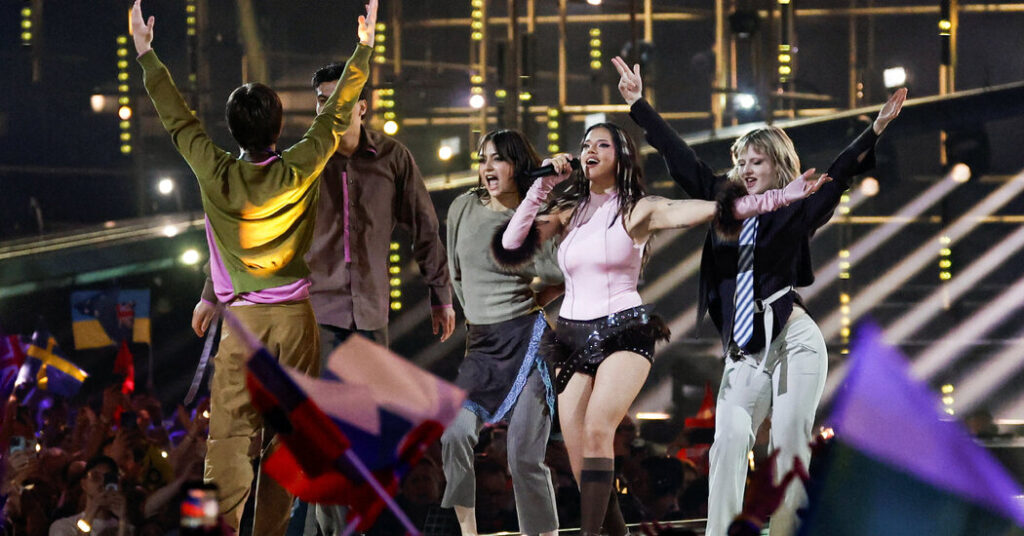
Bulgaria has just broken a glass ceiling in European popular culture: winning the Eurovision Song Contest.
And it is hoping that the victory — in a year in which the country also adopted the euro and elected a government that pledged to clean up corruption — can show that the country is a serious player on the European stage.
“Dara is yet another reminder that Bulgaria can win,” Prime Minister Rumen Radev wrote on Facebook about the 27-year-old singer who claimed the Eurovision title for the country on Saturday night.
Mr. Radev, who was sworn in this month, called it a “Bulgarian victory with global resonance.”
The Eurovision win, Bulgaria’s first, capped a period of domestic upheaval and change for the country, which has long been on the margins of the European Union since it joined the bloc as a member state in 2007.
When it joined the Schengen free travel area in 2025, European officials heralded the move as a major step. And in recent months, crowds of mostly young people took to the streets in the country to protest a political culture of corruption — demonstrations that led the previous prime minister to resign.
Now, as this year’s Eurovision winner, Bulgaria has a year to prepare to host the song contest’s 2027 edition, an event that will come 20 years after Bulgaria joined the E.U.
The victory came as a shock in Eurovision circles.
Bulgaria, which has long been one of the bloc’s poorest member states, had sat out the last three Eurovision contests, citing high costs. And its entry this year, the club-style track “Bangaranga,” had not been one of the pre-show favorites.
But Dara, whose real name is Darina Nikolaeva Yotova, prevailed with 516 points — way ahead of second-place Israel, which scored 343 points, and third-place Romania, with 296.
When she returned to Sofia, Bulgaria’s capital, on Sunday, crowds thronged the airport and Bulgaria’s main television stations broadcast her arrival live, making changes to regular programming to stream the celebration to the country of about 6.5 million people.
Dara hoisted the Eurovision trophy overhead as the cheering almost drowned out the playing of her song on loudspeakers. Glittering golden confetti filled the air. Some people waved Bulgarian flags. Others were holding children on their shoulders to help them see over the crowd.
A beaming Dara told the crowd that Bulgaria was “an exceptionally talented nation that will continue to receive more and more attention,” The Associated Press reported.
Dara was already a star in Bulgaria, regularly taking part in national talent competitions.
The singer told the British newspaper The Independent that she was trained in traditional Bulgarian vocal technique and folklore singing — she described “Bangaranga” as “pop music with folklore bones.”
Winning Eurovision was a chance for Bulgaria to be “really seen” on the international stage, she told the newspaper.
“If ‘Bangaranga’ can be the song that makes someone in Manchester or Edinburgh or Brighton pull out their phone and look up Bulgaria — look up its music, its coast, its literature, its people — then I’ve already achieved something real,” she said.
Boryana Dzhambazova contributed reporting from Sofia, Bulgaria.
Amelia Nierenberg is a Times reporter covering international news from London.
The post Bulgaria Hopes Eurovision Win Will Show Its Strength as a Continental Player appeared first on New York Times.