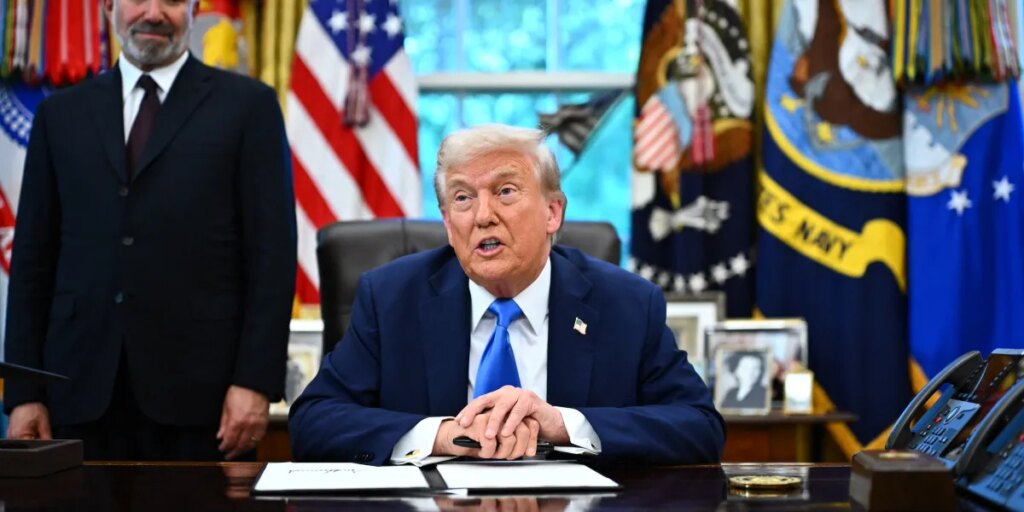
Good morning. Fortune editor-in-chief Alyson Shontell recently sat down with President Donald Trump for a wide-ranging conversation covering everything from tariffs to AI data centers to the war in Iran. The president also outlined the broader, top-down dealmaking mentality he’s bringing to the American economy.
Over the past two years, on multiple occasions, the Trump administration has taken an equity stake in an American corporation rather than offering a bailout, tax subsidy, or grant. The administration is now acquiring stakes in private-sector companies deemed critical to national security.
“The Trump/Lutnick camp frames this as a smart way to help American businesses that find themselves in dire straits, while also allowing for potential return on investment,” Shontell writes. “If the Treasury could get the kind of returns top venture capitalists and their limited partners make, it could eventually scale up to dent America’s deficit. If a company goes from bankrupt to billions, couldn’t it help Americans to share a piece of the pie?
“The bear case: Truly free markets—a foundation of democracy—require the government not to meddle in corporate governance. Government equity stakes could make it highly tempting for a future administration to cross that line. (What’s more, most venture investments flop.)”
When Trump decides to take the government into a struggling American company, two factors usually drive it, Shontell explains: the opportunity itself, and whether the CEO can win him over personally. Intel is the textbook case. Last August, in an unusual deal, Trump negotiated a 9.9% stake worth about $10 billion in the chipmaker, which was grappling with falling market share and heavy debt.
“[Intel CEO Lip-Bu Tan] came in to see me,” Trump told Shontell. “I liked him, I thought he was good.”
Shontell points out that Trump also had leverage: substantial federal grants for chipmaking that had been earmarked, but not yet delivered, to Intel. The chipmaker’s stock has taken off since.
The top sectors being prioritized for corporate equity stakes include semiconductors, critical minerals, and nuclear energy, according to research from CSIS.
In the interview, Shontell also addressed how U.S. stocks are reeling off record after record despite the Iran war and high oil prices. One source of that strength is capital expenditures by major tech companies like Amazon, Meta, and Alphabet on AI-infrastructure-related expenses. She asked the president what he feels is behind the resilience. You can read Shontell’s complete interview with Trump here.
Sheryl Estrada [email protected]
The post Trump’s new corporate playbook: Why the administration is taking equity stakes in companies like Intel appeared first on Fortune.