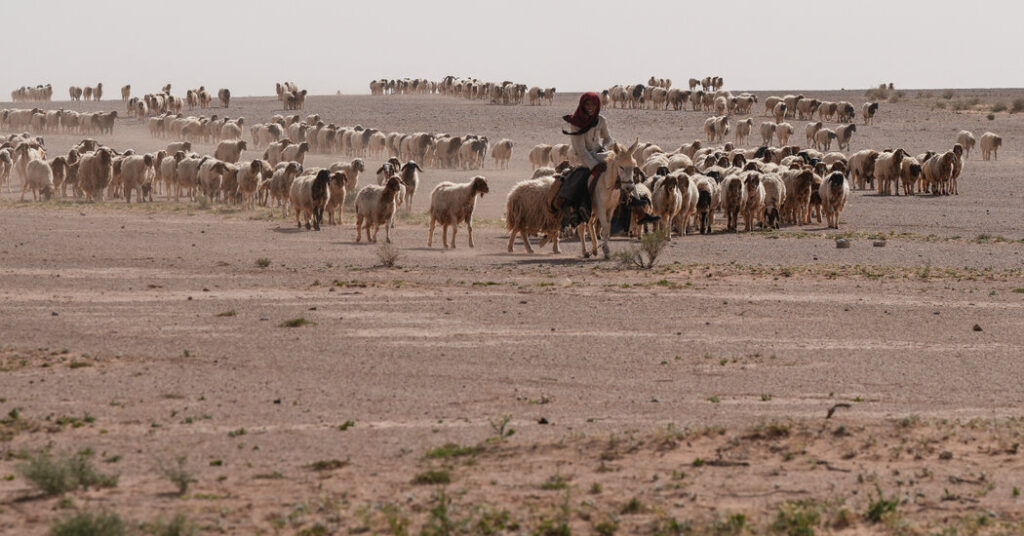
The truck rattling by at 2 p.m. on March 3 was a familiar sight to residents of the Bedouin encampment in Iraq’s rugged western desert — a local shepherd’s pickup, en route to the nearest town of al-Nukhaib.
Its return a few hours later, flaming and riddled with bullets, was anything but routine.
A helicopter was chasing the truck, three witnesses from the camp said, firing on it repeatedly until it jerked to a halt in the sand.
The deadly attack, which has not been previously reported, took place after Awad al-Shammari, 29, set off on a grocery trip, his cousin, Amir al-Shammari, told The New York Times. Instead of making it home, the shepherd stumbled upon a closely guarded Israeli military secret, hidden in the Iraqi desert. His family believes it cost him his life.
Mr. al-Shammari’s discovery would ultimately reveal how Iraq had played host to two covert bases operated intermittently by Israel, a hostile state, for well over a year.
Sometime between starting his ill-fated trip and its gruesome end, Mr. al-Shammari had contacted Iraq’s regional military command to report what he had seen: soldiers, helicopters and tents clustered around a landing strip. Israel was operating a base there to support its military operations against Baghdad’s regional partner, Iran, according to senior Iraqi and regional officials.
The presence of an Israeli outpost in Iraq was previously reported by The Wall Street Journal. Iraqi officials told The Times there was another undisclosed second base also in Iraq’s western desert.
The base Mr. al-Shammari came across predated the current war between the United States, Israel and Iran, the regional security officials said, and was used during the 12-day war against Tehran in June 2025.
Israeli forces began preparing to build the makeshift base as far back as late 2024, one of the regional officials said — identifying remote sites from which to operate in future conflicts.
Israel’s military declined repeated requests for comment on the camps or on Mr. al-Shammari’s killing.
The witnesses to Mr. al-Shammarri’s death spoke on condition of anonymity, citing concerns for their safety. Most of the officials who discussed the Israeli bases insisted on anonymity to discuss a highly sensitive security matter.
The information they shared indicates that at least one of the bases — the one Mr. al-Shammari stumbled upon — had been known to Washington since June 2025 or possibly earlier. That would most likely mean Baghdad’s other key ally, the United States, had withheld from Iraq the fact that hostile forces were on its soil.
“It shows a blatant disregard for Iraqi sovereignty, its government and its forces, as well as for the dignity of the Iraqi people,” said Waad al-Kadu, an Iraqi lawmaker who attended a confidential parliamentary briefing about that base.
The U.S. role in Iraqi security was part of Israel’s calculations in deciding it could safely operate clandestinely in Iraq, the regional officials said.
In both the brief war last year and the current conflict, two Iraqi security officials said, Washington compelled Iraq to shut down its radars to protect U.S. aircraft, making Baghdad more reliant on U.S. forces to detect hostile activity.
The disclosure of the bases raise uncomfortable questions for Iraq, too. Among them: Were its forces really unaware of a foreign presence until a shepherd exposed it? Or did they know, but chose to ignore it?
Either possibility reflects how Iraq, long trapped in a tug of war between Washington and Tehran, remains unable to exercise full control over its territory.
“The position of our security leaders is shameful,” Mr. al-Kadu said.
Maj. Gen. Ali al-Hamdani, commander of the Iraqi military’s Western Euphrates Forces, said the army had suspected an Israeli presence in the desert for over a month before the shepherd’s discovery.
“Until now,” he said, “the government has been silent about it.”
Iraq’s government, for whom acknowledging Israeli outposts is fraught, has still not acknowledged the Israeli bases. Iraq has no diplomatic relations with Israel, and its population sees Israel as an enemy. Lt. Gen. Saad Maan, a spokesman for Iraq’s security forces, told The Times that Iraq “has no information regarding the locations of any Israeli military bases.”
Growing outrage in Iraq over the revelations could threaten U.S. efforts to curb Iranian influence in the country, even as the war’s outcome remains uncertain.
Two regional security officials said the base Mr. al-Shammari exposed was used by Israel for air support, refueling and to provide medical treatment.
The outpost was made to shorten distances Israeli aircraft had to fly to reach Iran. It was intended as only a temporary presence to assist with military operations — like those in the June 2025 war, during which, the two regional officials said, the base proved extremely useful.
In a speech after last year’s war, Israel’s military chief of staff, Lt. Gen. Eyal Zamir, said the success of Israeli operations was made possible “among other things, by integration and deception carried out by air forces and ground commando forces.”
The Pentagon’s Central Command, which oversees operations in the Middle East, declined to comment on Israeli operations in Iraq, referring questions to the Israel Defense Forces.
But former top U.S. military commanders, Pentagon officials and American diplomats who served in the region said it was inconceivable, given the U.S. military’s close ties with the Israeli military, that Central Command did not know about the Israeli presence in western Iraq.
A dangerous secret
For weeks, Bedouin communities in Iraq’s western desert had been reporting unusual military activity to Iraq’s regional command, according to General al-Hamdani, the regional commander.
The army decided not to approach, he said, and instead conducted “surveillance monitoring” from afar of what commanders suspected were Israeli forces. They requested information from their U.S. counterparts, but got no response.
On the day Mr. al-Shammari stumbled upon the foreign forces, he too contacted the local authorities, according to his cousin and Maj. Gen. Fahim al-Gurayti, the spokesman for the regional Karbala Operations Command.
Shortly after that, General al-Gurayti and Mr. al-Shammari’s family said, the army and his relatives lost contact with him.
His family searched two days before finding the Bedouin residents who had witnessed his killing, learning what had become of him.
“We were told that a burned-up pickup truck the same as Awad’s was out there, but no one dared to go there,” the cousin, Amir, said. “When we got there, we found the car and body burned.”
His family shared photographs of his bloodied corpse, his head and fingers blackened, and his charred pickup truck. They buried his body next to the vehicle, beneath a simple gray tombstone.
A day after the shepherd’s report, Iraq’s regional command dispatched a reconnaissance mission, according to General al-Gurayti and General al-Hamdani.
As the units approached the area, they came under fire, according to a statement released a day later by Iraq’s Joint Operations Command. One soldier was killed, two were wounded and two vehicles were bombed before the units decided to retreat.
Top Iraqi security officials in Baghdad were struggling to understand what had happened.
Two senior officials said their efforts were repeatedly frustrated by top military commanders, who played down the incident.
In public, Iraq’s Joint Operations Command announced “foreign” forces had attacked their soldiers, and said it had raised complaints at the U.N. Security Council.
In private, the chief of staff of Iraq’s armed forces, Gen. Abdul-Amir Yarallah, called his counterparts in the U.S. military, according to General al-Hamdani and the two senior Iraqi officials. “They confirmed the force is not an American force,” General al-Hamdani said. “So we understood it was Israeli.”
Four days after the attack on the Iraqi soldiers, on March 8, the Iraqi Parliament compelled military leaders to provide a confidential debriefing. Lawmakers who were present said they could not divulge details. But one of them, Hassan Fadaam, told The Times that Israel had established at least one other outpost inside Iraq.
“The one in al-Nukhaib is just the only one that was found out,” he said.
A second Iraqi official confirmed the existence of a second base, without giving a location other than saying it was also in a western desert region.
Official protocol requires Washington to inform Baghdad of any activities on Iraqi soil, according to a former and a current senior Iraqi official.
That meant Washington either concealed the Israeli activity, these officials said, or informed Iraq’s top command of the operations, who kept them confidential. The officials thought it was extremely unlikely, however, that Iraqi leaders knew the presence was Israeli until the exposure by the shepherd, and most likely assumed the sites were American.
The balancing act
Ever since the U.S. invasion of Iraq in 2003, Baghdad has struggled with a political balancing act between its former occupier, Washington, and its powerful neighbor, Iran.
The Trump administration has put immense pressure on Iraq to curb Iranian influence. In particular, Washington wants Iraq to disarm militia figures aligned with Iran, and block them from roles in the government and security forces.
For years, Iraqi leaders were either unable or unwilling to do that, raising tensions with Washington.
The Israeli bases in Iraq put an already wobbly equilibrium at greater risk, said Ramzy Mardini, founder of the Middle East-based risks advisory firm Geopol Lab.
“Engagement with the U.S. now risks being framed as alignment with Israel,” he said. “If the war with Iran resumes, it could provide a pretext for more direct Iranian military involvement in Iraq.”
It could also give Iran-aligned militias grounds to refuse to disarm, he said.
Today, the Israeli base in al-Nukhaib is no longer operative. The status of the other Israeli outpost in Iraq is unknown.
The family of the shepherd says his killing has been ignored.
“They demand the government investigate this incident and why it happened,” his cousin, Amir, said. “They want his rights respected.”
Aaron Boxerman, Sanjana Varghese, Eric Schmitt, Christoph Koettl and Devon Lum contributed reporting.
Erika Solomon is The Times’s bureau chief for Iran and Iraq.
The post In Iraqi Desert, Two Israeli Outposts Were Kept Secret for Months appeared first on New York Times.