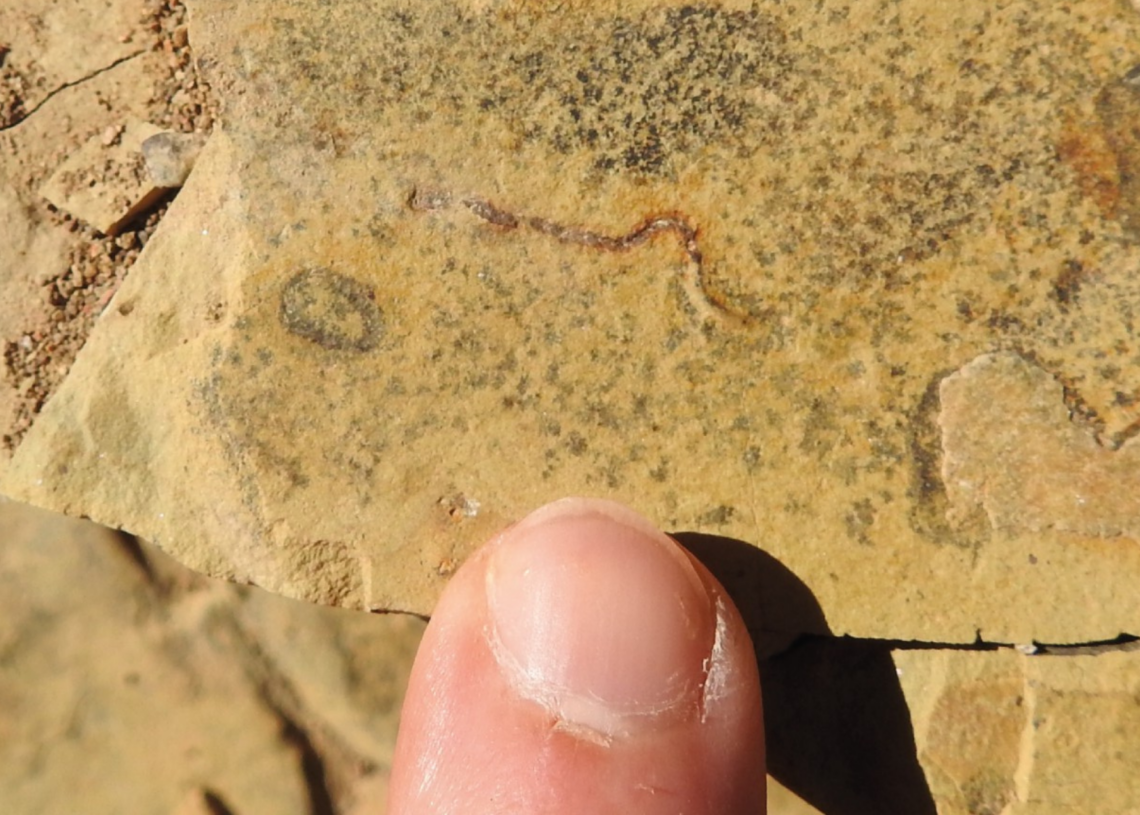
A 2017 archaeological discovery was small in stature but massive in significance. Researchers found fossilized worm-like creatures more than 500 million years old. At the time, they thought they had found some of the oldest animals ever discovered in the fossil record, a finding that may rewrite the timeline of early life on Earth. Fast forward to today, and a different team of scientists is arguing that the whole thing may have been a case of mistaken identity.
According to a new study published in Gondwana Research, the tiny fossils discovered in Corumbá, Brazil, are probably not traces left behind by ancient marine worms as previously thought. They think it might be colonies of algae and bacteria. If this proves true, it would be like if you thought you were digging up a chest of buried treasure and instead got a shoebox filled with coupons. There’s still some value to the finding, but it’s maybe not as much as previously thought.
The original 2017 discovery mattered so much because the fossils looked like they predated the Cambrian explosion, which was that famous evolutionary turning point about 539 million years ago that you probably barely remember hearing about in a high school science class. It’s the explosion of life that rapidly diversified life across the Earth’s oceans. If tiny wormlike critters really did exist before the Cambrian explosion, it would mean scientists would have to rethink when multicellular animal life first came about, which requires a rethinking of everything we know about the origins of life on Earth.
See? Little worm, big significance. Only, not so much anymore, thanks to modern technology.
The research team used a series of cutting-edge imaging tech, including nanoscale scans and even a particle accelerator, to notice preserved cell walls and organic structures that align more with microbes than with the burrowing of wormlike creatures.
The lead author of the original 2017 study, Luke A. Parry, thinks all the snazzy new high-resolution analysis stuff is cool, but, speaking to Gizmodo via email, thinks none of it fully disproves his earlier theory.
This is the inherent difficulty of trying to figure out what a 500 million+-year-old indentation in some sediment used to be. We’ll never be able to see these lifeforms with our own eyes, and we certainly won’t be able to see them in their own environments, so it’s all up to interpretation, even when you bring in some of the finest imaging tools ever created. The fossil record is ambiguous and may not always represent what you think it is. But, in this specific case, either way, we were still getting some incredible snapshots of our planet long before we, or even animals as we know them, ruled.
The post Scientists May Have Been Wrong About Earth’s Oldest Animal This Whole Time appeared first on VICE.