Times Insider explains who we are and what we do, and delivers behind-the-scenes insights into how our journalism comes together.
From her post behind a security desk in the New York Times Building, Lila Rivera monitors the hivelike flow of employees and guests who pass through its Midtown Manhattan lobby, which is open to the public.
When Ms. Rivera finds a moment to slow her thoughts, she often looks across the lobby toward a stand of birch trees.
“It makes you calm down,” she said.
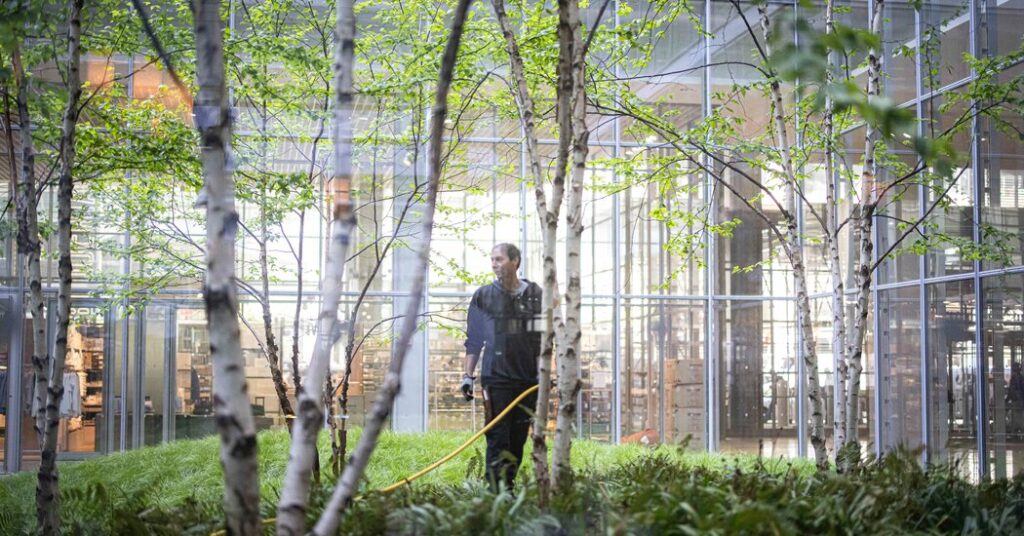
The birch trees are the tall, slender exclamation points on the Times Building’s atrium garden, a 4,900-square-foot green space that can be seen from the lobby — and from the newsroom above. Their presence was part of the original vision of The Times’s third headquarters when it opened in 2007.
And their existence is a struggle.
Birches would have a hard enough time growing anywhere in New York City. The trees prefer cooler climes upstate and in the mountains. But the birches at the Times Building live at the bottom of a shaft, nestled between 55-foot glass walls and a 52-story skyscraper.
“It’s a challenging environment,” said Paul Wagner, an arborist for SavATree, the company that is contracted to care for the birches.
Keeping The Times’s birches alive is the type of “plant health care” assignment Mr. Wagner specializes in.
Direct sunlight is limited to the northern half of the garden, where all 12 trees are clustered. The light that reaches the garden reflects off the glass, which turns up the temperature. The heat stresses the trees and, even within the small space, creates microclimates of varying conditions.
Mr. Wagner and his colleague Nguyen Malave perform seven to 10 on-site checkups a year. They use a photography technician’s loupe to inspect the leaves for signs of stress or infestation; treat the trees with organic insecticide and other horticultural oils; and trim back the canopy to better distribute the light.
Trees like hornbeam or honey locust might do better here. But birches, with their multiple bending trunks, seem to have more to say through the glass.
“They have a lot more interesting architecture than, let’s say, if you saw oaks in the forest,” Mr. Wagner said.
The first trees planted in the atrium in 2007 did not last long.
Those whitespire birches were nearly 40 feet tall, weighed thousands of pounds each and were lowered into the atrium by crane. But they were infested with bronze birch borer, an insect that tunnels under the bark of trees, often killing them. In the heat of the city, the infested whitespires could not survive.
Starting in 2015, The Times and Brookfield Properties, which manages the common areas of the building, began refreshing the garden. They installed new lighting and irrigation and, over time, planted seven renaissance birches, a white birch cultivar that is more resistant to the borer.
David Protell, the owner of Chelsea Garden Center, the atrium garden’s landscape contractor, found the renaissance birches at a nursery in Ohio.
“We needed to find trees that were substantial enough to give a presence,” Mr. Protell said, adding, “They have done beautifully.”
The renaissance birches produce two or three stems to a tree. Today, the trees bend over small undulations of earth covered in sedge and ostrich ferns.
Christopher Calabrese is among the trees’ most devoted admirers at The Times. A senior manager in the Newsroom Operations department, Mr. Calabrese helps organize the layout of the newsroom. He roams often, from the second floor, where he meets the canopy at eye level, up to the 10th floor, where he looks down on the foliage, which turns yellow in the autumn.
He said he liked to think of the atrium garden as a “reverse snow globe,” a small cradle of nature inside a bubble of glass and steel.
“Working in Midtown in an office where you’re able to see everything but not be able to feel anything, there’s something about the garden that is fun and is the sign of changing seasons,” Mr. Calabrese said.
The seasons deal an occasional blow. Last winter, several trunks snapped under the weight of heavy snow. In agreement with building management, Mr. Protell’s team removed three trees and planted three saplings. Nestled among the elders, and fresh in the eyes of Ms. Rivera at the security desk, they evoke the tree that was spared the ax in “A Young Birch,” a Robert Frost poem:
It was a thing of beauty and was sent To live its life out as an ornament.
The post A Newspaper’s Birches Bend and Occasionally Break appeared first on New York Times.