This is an edition of Time-Travel Thursdays, a journey through The Atlantic’s archives to contextualize the present. Sign up here.
In 1973, a celebrated writer reportedly knocked on a new colleague’s door and held out a glass. “Pardon me,” he said by way of introduction. “I’m John Cheever. Could I borrow some scotch?” Raymond Carver did not share Cheever’s authorial renown at that time—that would come later. And he did not have scotch.
He had only Smirnoff. In her 2013 book about writers and drinking, the British critic Olivia Laing describes how Cheever and Carver would drive to a nearby liquor store, stock up, and take alternating swigs of a bottle on their way to teach morning classes at the prestigious Iowa Writers’ Workshop.
Stories about the use of excessive alcohol in the creative process can be found in The Atlantic’s earliest years. In 1868, for example, one article proposed that “artists, writers, and actors” were particularly prone to the “malady” of alcoholism “before they had any recognized place in the world.” Another noted that third-century sages in China would retreat to the countryside to “drink wine and compose verse.” Even before developing writing, our Neolithic ancestors appear to have used alcohol in search of mind-expanding inspiration.
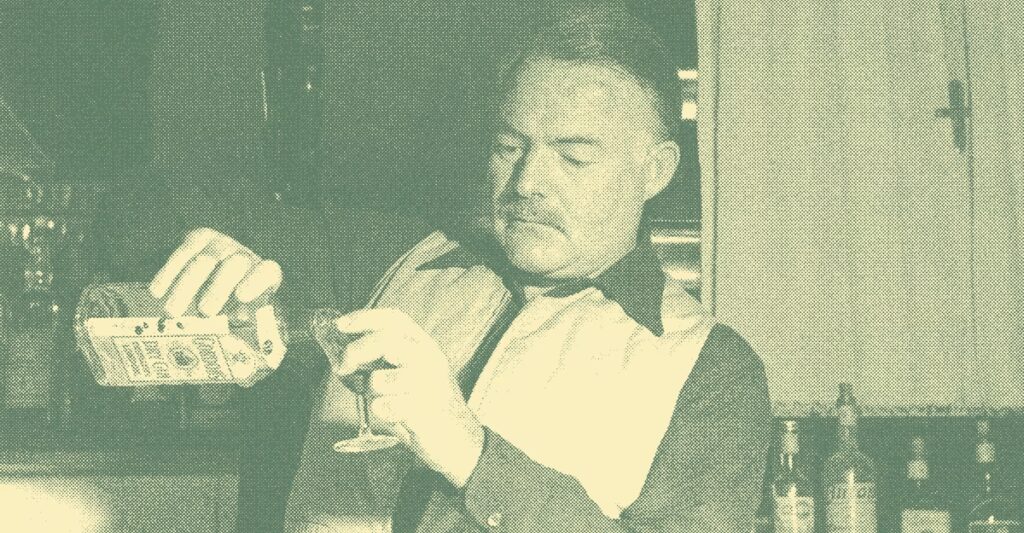
Tales of literary savants who were also habitual drinkers seemed especially prolific in the 20th century. Sometime around Prohibition and the Roaring ’20s, “America developed its distinctive 80-proof version of the romantic myth of the artist,” Phyllis Rose wrote for this magazine in 1989. She chronicled Ernest Hemingway, Eugene O’Neill, and William Faulkner, to name a few prominent examples, all of whom embodied the belief that great writing and drinking go hand in hand. Add Sinclair Lewis and John Steinbeck to the list, and you get five of the eight U.S.-born Nobel laureates for literature of the 1900s who had a history of drinking to excess. As the old saying goes, “Write drunk. Edit sober.”
For some, the link between drinking and writing has extended into more recent times too. In her 2018 memoir about her sobriety, Leslie Jamison describes arriving at the Iowa Writers’ Workshop decades after Cheever and Carver taught there. As my colleague Sophie Gilbert put it, Jamison still held the romanticized notion that cocktails could serve as creative catalysts, conflating “illumination with intoxication, clarity with alcoholic cloud.” In her 1996 memoir, the late essayist Caroline Knapp recounts that for her, frequent drinking came to feel like “a path to a kind of self-enlightenment, something that turns us into the person we wish to be, or the person we think we really are.”
Until, Knapp explains, alcohol “makes everything worse.” Artists can be complicated, selfish people, and substance abuse exacerbates these traits for many of them. Cheever was estranged from loved ones. A doctor told Carver that he risked developing significant brain damage if he continued drinking heavily. Hemingway had to be hospitalized for alcoholism in his later years. In an inebriated stupor, Faulkner told off his young daughter by saying, “You know, no one remembers Shakespeare’s child.” (He also once needed multiple skin grafts after burning himself on a steam pipe while drunk.) When you pull back the myth, the epiphanies that might be revealed by benders pale in comparison with the destructive effects.
In recent years, Americans have generally become less enamored with alcohol altogether. A Gallup poll from last year showed that 54 percent of respondents drank, down from 67 percent back in 2022. Younger adults seem less inclined to imbibe than their older counterparts; many are “sober curious,” and some are actively creating new social norms and markets for nonalcoholic drinks. The popularity of Dry January has swelled.
Along with these shifts has come a turn toward the “quit lit” subgenre, made up of sobriety memoirs. Knapp’s and Jamison’s are among them, but they are far from the only ones. These books focus on the costs of drinking, homing in on the process of recovery. They wager that sobriety can be just as captivating and just as—or even more—conducive to their craft. By showing how consistently writers have resorted to drinking, these stories evince their most important takeaway: that the experience of drinking in excess is not an original one. It is an all too “ordinary compulsion,” in Gilbert’s words.
American culture often “veers between excessive restraint and reckless abandon,” as Rose put it in 1989. Perhaps today’s aversion to unbridled drinking will one day give way to a renewed interest in it. If that happens, we’d do well to recall the stories of Cheever and Knapp, of Carver and Jamison, which remind us not only that alcohol’s mystique can hide its misery but also that the myth of the drunk, inspired artist is more mundane than it is magnetic.
The post The Origins of Alcohol as a Muse appeared first on The Atlantic.